
Yes, Phoenix homeschool families can find Christian-focused educational therapy and faith-aligned tutors to support a child's speech and communication goals. The most practical route starts with a directory listing AET-aware providers and confirming Empowerment Scholarship Account eligibility before you book a session. Gather your child's current goals, any past assessments, and a curriculum sample first, so your first call with a provider actually moves you forward.
TL;DR:
- Most qualified providers hold an AET certification, and verifying their credentials is essential for ESA reimbursement approval.
- Arizona families can integrate therapy into flexible schedules without disrupting core academics, especially with consistent weekly sessions.
- Faith-based materials, like Bible-based phonics and devotionals, enhance therapy by reinforcing skills and biblical values during daily routines.
- Parents should immediately clarify whether a provider has successfully processed ESA claims and request proper documentation upfront.
- Collaboration between parents and therapists on curriculum and progress review is the key factor in achieving meaningful homeschool outcomes.
Table of Contents
- What Is Educational Therapy, and How Is It Different From Tutoring?
- How Do You Find Christian-Friendly Educational Therapists in Phoenix?
- Does Arizona's ESA Cover Educational Therapy?
- How Do You Evaluate a Provider Before You Commit?
- What Do Real Outcomes Look Like for Homeschooled Kids?
- Where Do Christian Homeschool Families Find Community Support?
- How Do You Fit Therapy Into an Arizona Homeschool Schedule?
- What Faith-Based Materials Can Supplement Therapy Sessions?
- What I've Learned Helping Arizona Families Navigate This
- Start Your Search With Arizona Christian Homeschool Programs
- Sources
- FAQ
What Is Educational Therapy, and How Is It Different From Tutoring?
Educational therapy treats the root cause of a learning or communication struggle, not just the symptom on the page. An Educational Therapist builds individualized intervention plans that target metacognition, executive function, and the underlying skill gaps behind a child's difficulty, rather than reteaching a single subject.
Tutoring and educational therapy solve different problems, and mixing them up wastes time and money. A tutor helps a child practice and master specific academic content, algebra homework, a spelling list, a reading assignment. An educational therapist works when the struggle runs deeper than content mastery: a child who reverses letters, can't retain multi-step directions, or shuts down before starting written work.
Understood's guidance on educational therapy draws this line clearly: tutors reteach material, while educational therapists teach the strategies and executive-function skills a child needs to learn independently. The Child Mind Institute adds that ETs also weigh a child's emotional response to learning, since frustration and avoidance often travel together with a speech or communication delay.
Here's how to know which one your child actually needs:
- Choose tutoring when your child understands concepts but needs repetition, review, or grade-level catch-up in one subject.
- Choose educational therapy when a child avoids tasks, gets overwhelmed by multi-step instructions, or shows a gap between effort and results.
- Look for AET certification (ET/P® or BCET®) as your baseline credential check, since it signals completed training, supervised practice hours, and ongoing education through the Association of Educational Therapists.
- Ask about speech and communication overlap directly, since not every educational therapist works on expressive or receptive language goals.
How Do You Find Christian-Friendly Educational Therapists in Phoenix?
Start where your community already gathers. Church networks, co-op parent groups, and Christian homeschool circles usually know which local providers understand both faith-based instruction and a child's individual learning profile, often before that provider ever shows up in a general web search.
A statewide directory speeds this up considerably. Arizona Christian Homeschool Programs aggregates co-ops, tutors, and educational therapy listings across the state, which means you're not piecing together recommendations from five different Facebook groups. From there, cross-check candidates against the AET member directory to confirm certification, then ask directly about experience with homeschooled students and comfort integrating biblical principles into sessions.
Follow these steps in order:
- Search the directory first for educational therapy and tutor listings in your city, filtering for homeschool experience where the option exists.
- Cross-reference AET credentials for any candidate who isn't already vetted through a trusted referral.
- Ask your co-op or church network whether anyone has direct experience with the provider, especially around faith alignment and communication style.
- Consider telepractice if local matches are thin. Many certified educational therapists now work virtually, which widens your options beyond the Phoenix metro.
- Vet virtual providers the same way you'd vet an in-person one: confirm licensure or certification, ask for a sample session structure, and request a reference from another homeschooling family.
Before you make first contact, put together a short packet: your child's specific goals, any prior assessments or diagnoses, a sample of the curriculum you're using, and your family's weekly availability.
Pro Tip: Email two or three providers the same short question list at once. Comparing real answers side by side reveals mismatches in philosophy or availability faster than sequential phone calls ever will.
Does Arizona's ESA Cover Educational Therapy?
Arizona's Empowerment Scholarship Account program covers educational therapy and tutoring as eligible expenses when the provider meets the state's accreditation or licensure requirements. The Arizona Department of Education's ESA handbook for 2025 to 2026 spells out exactly what documentation families need to submit before reimbursement is approved.
Skipping this step is the single most common reason families get an ESA claim rejected. Before you book, request the paperwork you'll need for ClassWallet submission:
- Provider credentials showing the required accreditation or license, submitted as actual documents, not screenshots.
- A dated receipt or invoice itemizing the service, session length, and cost.
- A current MET, IEP, or 504 plan, when applicable to your child's specific eligibility category.
ClassWallet does not accept screenshots of credentials as valid documentation. If you only remember one thing from this section, remember that.
Before you commit to a provider, ask them directly whether they've submitted documentation for ESA reimbursement before. A provider who's done it knows the process and can hand you the right paperwork on day one instead of scrambling after your first invoice.
How Do You Evaluate a Provider Before You Commit?
A short interview before your first session saves you from months of mismatched expectations. Verify certification first (AET's ET/P® or BCET® designation, or relevant speech-language training if communication goals are central), then ask about their track record with homeschooled students specifically, since classroom-trained providers don't always translate well to a home learning environment.
Bring these questions to every intake call:
- How do you assess a new student, and what does the resulting plan look like?
- How do you collaborate with parents on curriculum alignment week to week?
- Are you comfortable integrating biblical principles or Christian values into sessions if the family requests it?
- What's a realistic homework or practice expectation between sessions?
- How will we measure progress, and how often will we review it together?
Watch for providers who dodge specifics about measurable goals or resist any parent involvement in planning. That resistance is a red flag, not a preference. Educational therapy is rarely covered by insurance, so most families pay privately or route payment through ESA once credentials are confirmed, according to Understood's overview of the field.
| Evaluation criteria | What to look for |
|---|---|
| Scope of support | Skills remediation for specific deficits, or broader strategy-building for executive function and independence |
| Qualifications | AET certification (ET/P® or BCET®); speech-language training if communication goals apply |
| Homeschool fit | Direct experience collaborating with parents on curriculum alignment |
| Cost and frequency | Typically weekly or biweekly sessions; private pay unless ESA-eligible credentials are confirmed |
What Do Real Outcomes Look Like for Homeschooled Kids?
Progress in educational therapy rarely follows a straight line, and Christian homeschool families often see the clearest gains when therapy gets woven into daily routines rather than treated as a once-a-week appointment disconnected from the rest of the school day. A child working through expressive language delays, for instance, tends to generalize new strategies faster when a parent reinforces them during read-aloud time or morning devotions, not just during the scheduled session.

The Association of Educational Therapists points out that parents frequently mistake avoidance or frustration for a behavior problem when it's actually a masked learning or communication deficit. A child who melts down before writing time isn't necessarily being difficult. He may be hitting a wall he doesn't have the language to describe. An educational therapist trained to spot that distinction can reposition the entire approach toward skill building instead of discipline, which changes the emotional tone of a homeschool day considerably.
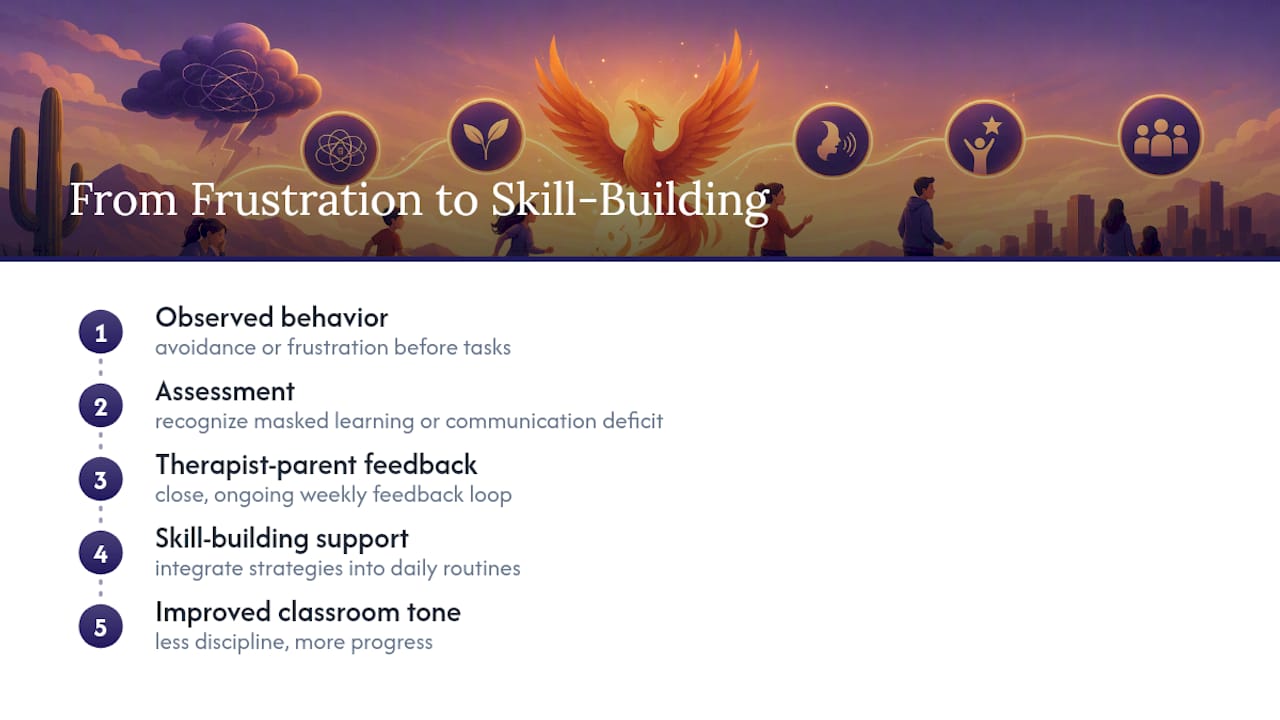
Families who see the strongest results tend to share one habit: close, ongoing communication between the therapist and the parent about what's working in the curriculum and what isn't. That feedback loop, adjusted week to week rather than reviewed once a semester, is what turns a therapy plan into actual classroom progress at home.
Where Do Christian Homeschool Families Find Community Support?
You don't have to navigate speech or learning challenges alone, and most Phoenix-area Christian homeschool families lean on more than one type of community as they go. Local co-ops often include parents who've already walked this exact path, and many are glad to share which providers worked well for their own kids.
Church-based homeschool groups serve a similar function, often with the added benefit of shared values already built into the relationship. If your congregation runs a homeschool ministry or parent fellowship, that's frequently the fastest way to get a warm referral instead of a cold search.
Beyond in-person networks, Arizona Christian Homeschool Programs functions as a hub connecting families across the state to co-ops, microschools, and enrichment programs that share a faith-centered approach to education. Browsing by city narrows results to your part of the Phoenix metro, whether that's the East Valley, the West Valley, or farther out.
Online parent communities fill in the gaps, particularly for families whose specific need, a rare combination of speech delay and dyslexia, for example, doesn't have an obvious local match. These groups tend to be generous with recommendations, especially once you're specific about what you're looking for and what your child's day-to-day challenges actually look like.
How Do You Fit Therapy Into an Arizona Homeschool Schedule?
Arizona gives homeschooling families wide latitude over scheduling, which is exactly what makes it possible to build therapy into your week without disrupting core academics. Most families find success blocking therapy sessions during a natural lull, right after lunch, or as the first activity of the day when a child's attention is freshest, rather than squeezing it in at the end when everyone's tired.
Arizona's homeschool statutes don't mandate specific instructional hours the way some states do, which gives you flexibility to treat a therapy session as a legitimate part of the school day rather than an interruption to it. If you're using ESA funds, keep your service documentation organized by month. It makes year-end reporting far less stressful.
Coordinate with your provider on a consistent day and time each week if possible. Consistency matters more for skill retention than session length does, particularly for younger children still building foundational communication skills. If your child also attends a co-op, check whether the co-op's own schedule creates a natural pairing, some families schedule therapy on non-co-op days to avoid overloading a single afternoon.
What Faith-Based Materials Can Supplement Therapy Sessions?
Therapy sessions go further when the practice between them reinforces both the skill and the family's values. Bible-based phonics and reading programs give children a chance to practice decoding and articulation using content that already matters to your family, rather than generic worksheets disconnected from anything you're teaching elsewhere in the week.
Devotional read-aloud time doubles as informal speech and language practice, particularly for expressive language goals, since it gives a child low-pressure repetition with vocabulary and sentence structure. Many educational therapists will happily suggest specific faith-based titles or workbooks if you ask, especially once they understand your curriculum and your child's specific goals.
If your child works with a structured-literacy specialist alongside broader educational therapy, Orton-Gillingham based resources built for homeschool use can complement both efforts without requiring a separate curriculum overhaul. And if speech delays connect to early language development more broadly, a parent's checklist for recognizing speech delays is a useful starting reference for knowing what's typical and what warrants a closer look before therapy even begins.
What I've Learned Helping Arizona Families Navigate This
The biggest misconception I see among homeschool parents is treating educational therapy like a specialized form of tutoring, something you add on top of curriculum rather than something that reshapes how curriculum gets delivered. That framing sets families up for frustration, because they expect a therapist to fix a worksheet problem when the actual issue is executive function or language processing underneath it.
What separates families who see real progress from those who don't isn't the provider's credentials alone. It's whether the parent and therapist actually talk to each other about the home curriculum, week to week, not once a semester. Faith alignment matters too, but it's the collaboration habit that determines whether therapy sessions translate into an easier Tuesday morning at the kitchen table.
— Grant
Start Your Search With Arizona Christian Homeschool Programs
You don't have to build this search from scratch or rely on guesswork about which providers actually understand homeschool families. Arizona Christian Homeschool Programs gives you one place to search educational therapy and tutor listings by city, filter for faith-aligned providers, and cross-reference ESA guidance before you ever pick up the phone.

Start with the homeschool co-ops near me search to see what's active in your part of the Phoenix metro, or browse the full directory if you're still narrowing down whether you need a co-op, a tutor, or a dedicated educational therapist. Once you've shortlisted a few names, verify certification directly with the provider and confirm their documentation is ESA-ready before booking your first session. Reaching out to two or three providers in the same week gives you a real comparison instead of a single data point.
Sources
- What Is An Educational Therapist (ET)? - Association Of Educational Therapists
- What you need to know about educational therapy - Understood
- What Is an Educational Therapist? - Child Mind Institute
- ESA 2025-2026 Handbook - Arizona Department of Education
FAQ
Does Arizona's ESA Pay for Educational Therapy?
Yes, when the provider holds required accreditation or licensure and the parent submits credentials and receipts through ClassWallet, following the rules in the ESA handbook.
What's the Difference Between an Educational Therapist and a Speech-Language Pathologist?
An educational therapist addresses broader learning, executive-function, and strategy gaps, while a speech-language pathologist specializes specifically in speech and language mechanics; some children benefit from both depending on the specific delay.
Is Virtual Educational Therapy a Good Option for Homeschoolers?
Telepractice works well for many homeschool families, especially when local Christian-friendly providers are limited, as long as you verify the same certification and homeschool experience you'd expect in person.
How Do I Know if My Child Needs Tutoring or Educational Therapy?
Tutoring fits a child who understands concepts but needs practice in one subject; educational therapy fits a child who avoids tasks, struggles with multi-step instructions, or shows a gap between effort and results.
Where Should I Start Looking for a Christian-Friendly Provider in Phoenix?
Start with Arizona Christian Homeschool Programs to browse local listings, then cross-check any candidate against the AET member directory for certification before scheduling a first session.