
The strongest approach to Christian high school homeschooling pairs a Bible-integrated curriculum with an accredited diploma or dual enrollment credits, not one or the other. Parents who plan this way keep both spiritual formation and college options open for their teen. Document every course on a transcript from ninth grade forward, because admissions offices and credential programs read paperwork, not good intentions.
TL;DR:
- An accredited diploma or dual enrollment credits are essential for college admission, military enlistment, and competitive programs that require outside review.
- Families should document every course from ninth grade onward on a transcript, including course descriptions, grades, credits, instructors, and supporting evidence like AP scores.
- At least 22 to 24 total credits are recommended over four years, with careful planning of core subjects, electives, and dual enrollment to meet college goals.
- Active participation in co-ops, sports, debate, volunteer work, and mentorship helps develop social skills and extracurricular resumes important for college applications.
- Strategies for advanced subjects include community college courses, live online classes, tutors, and accredited programs, particularly for STEM and calculus.
Table of Contents
- What Does Homeschool High School Christian Education Look Like?
- Why Accreditation Matters for Diplomas and Transcripts
- How Many Credits Does a Homeschool High Schooler Need?
- How Do You Choose a Biblically Grounded, Rigorous Curriculum?
- Where Do You Find Labs, Tutors, and Co-Ops?
- How Do You Build Character and Service Into the High School Years?
- How Do Homeschoolers Get a Graduation Ceremony?
- What Are the Legal Requirements for Homeschooling High School?
- How Do Homeschooled Teens Get Socialization and Extracurriculars?
- How Do You Teach Science and Math at an Advanced Level?
- How Arizona Christian Homeschool Programs Helps You Search Smarter
- Find Your Next Co-op or Accredited Program
- Sources
- FAQ
What Does Homeschool High School Christian Education Look Like?
Christian homeschool families choose among three main formats, and the right one depends on how much structure your teen needs and how confident you feel teaching upper-level subjects.
Parent-led curriculum gives you full control over pacing and content, with textbook-based programs that build in Scripture study alongside standard subjects. Accredited online schools put a certified teacher in charge of grading and issue an official transcript, which matters if you want a diploma with institutional backing. Live teacher-led classes sit in between: you keep the parent role but outsource specific subjects like chemistry or Spanish to a real instructor on video calls. Co-ops and microschools meet in person once or twice a week for labs, discussion-based classes, and the social rhythm many teens need during high school.
- Parent-led: best for confident teachers and highly self-motivated teens
- Accredited online school: best for families who want a transcript handled for them
- Live online classes: best for one or two tough subjects, not the whole load
- Co-op or microschool: best for labs, debate, and weekly in-person accountability
Most families blend two of these rather than picking just one.
Why Accreditation Matters for Diplomas and Transcripts
An accredited diploma removes a real obstacle: some selective colleges, nursing programs, and military enlistment paths want proof that coursework was reviewed by a recognized outside body, not just certified by a parent. Zion Academy's guidance for Christian homeschool families makes this point directly. A parent-issued diploma is legal everywhere and works fine for many teens, but it can create friction with programs that have strict credential rules.
Build your transcript with these entries for every course:
- Course title and a one-line description
- Letter grade and credit value (usually 0.5 or 1.0 per semester or year)
- Instructor of record, whether that's you, a co-op teacher, or a dual enrollment professor
- Supporting evidence: a college transcript, AP score report, or CLEP certificate
Pro Tip: Keep a simple spreadsheet from ninth grade on. Retyping four years of coursework the summer before college applications is a miserable way to spend August.
If your teen is aiming at a state university, an accredited program or one dual enrollment class on the transcript usually satisfies admissions. If they're eyeing a military academy, a competitive nursing program, or an Ivy League school, lean harder into accredited credit from the start rather than hoping a parent-issued diploma will be enough later.
How Many Credits Does a Homeschool High Schooler Need?
Plan around 22 to 24 total credits across four years, which is the range Outschool's high school planning guide recommends and roughly matches most state university minimums. Here's a workable sequence:
-
Ninth grade: Establish core subjects (English, math, science, history) plus one Bible or worldview elective; confirm your state's specific homeschool requirements before finalizing the year.
-
Tenth grade: Add a foreign language and consider your first PSAT for baseline scoring; this is also the year to research dual enrollment eligibility at a local community college.
-
Eleventh grade: Take the PSAT or a practice SAT/ACT in the fall, start one or two dual enrollment or AP/CLEP courses, and begin campus visits if college is the goal.
-
Twelfth grade: Finalize the transcript, retake the SAT/ACT if needed to hit target scores, and complete any remaining dual enrollment credits for a head start on college coursework.
Dual enrollment does double duty here. It fills a credit gap in a subject you can't teach well and produces a real college transcript, which Zion Academy notes can equal a semester or more of college credit before graduation. Start test prep the fall of eleventh grade. Waiting until senior year to think about the SAT is the single most common regret parents mention once applications are due.
How Do You Choose a Biblically Grounded, Rigorous Curriculum?
Evaluate every curriculum on two tracks at once: does it teach the subject well, and does it connect that subject to a Christian worldview? A science course needs real lab components, not just reading. A math course needs enough problem sets to build fluency, not just answer keys. History and literature should include primary sources and discussion, not summaries alone.
Worldview integration shows up in specific, checkable ways:
- A dedicated apologetics or worldview elective, not just devotions tacked onto another subject
- Literature or history guides that explicitly connect texts to Scripture and Christian thought
- Teacher materials written from a faith perspective rather than a secular text with a Bible verse pasted on top
BJU Press's homeschool curriculum is a solid example of literature-based, faith-centered material that keeps academic rigor while integrating Bible study throughout the high school years, and Zion Academy specifically recommends apologetics resources such as Summit Ministries or Apologia's Understanding the Faith series as electives. If you're weak in a subject like chemistry or calculus, a live online class, a tutor, or a community college course fills the gap without forcing you to teach something outside your depth. Arizona Christian Homeschools maintains a curriculum resource page if you want to compare options side by side, including profiles like Gather 'Round Homeschool as a model of what a full curriculum listing looks like.
Where Do You Find Labs, Tutors, and Co-Ops?
High schoolers need more than a textbook for chemistry labs, foreign language conversation practice, and debate or speech experience. Co-ops and microschools typically run once or twice weekly and cover exactly these gaps: lab sections with real equipment, art and music instruction, debate teams, and student leadership roles that look good on a college application.
- Co-ops handle labs, group discussion classes, and social structure in one package
- Tutors work best for a single stubborn subject like Algebra II or Latin
- Dual enrollment covers advanced STEM or a foreign language sequence while producing a college transcript
- Live online classes add teacher accountability without leaving the house
Outschool's research on high school planning notes that live online classes and teacher-led video lessons give families access to subject expertise they can't provide at home. Choose live classes over recorded video courses when your teen needs deadlines and a real grade from someone other than you. A quick search through Arizona's local Christian homeschool groups or a look at online curriculum marketplaces usually turns up more local options than families expect.
How Do You Build Character and Service Into the High School Years?
Academic planning matters, but the years between ninth and twelfth grade are also when character formation either takes root or gets crowded out by test prep. Build service and spiritual growth into the schedule the same way you build in credits, on purpose, not as an afterthought.
Weekly church involvement, a regular volunteer commitment, and a Bible or apologetics elective form a baseline most Christian homeschool families already lean on. Beyond that baseline, look for structured opportunities that stretch a teen's faith into action: a short-term mission trip, a consistent volunteer role at a food bank or crisis pregnancy center, or a mentorship where an older believer in your church or co-op walks alongside your student through a specific book or study.
Service hours can also do double duty on a transcript. Many colleges ask about extracurricular commitment in applications, and a documented, sustained service record (not a scattered list of one-off events) tells a more honest story about character than a single mission trip photo. Track hours and a short description the same way you track academic credits, with dates, a brief summary, and who can vouch for the commitment.
Discipleship works best when it isn't purely academic. A weekly small group, a co-op Bible study led by another parent, or a father-son or mother-daughter mentoring relationship often shapes a teen's faith more than another worksheet ever will. If your co-op or church doesn't already run something like this, most are glad to start one when a parent asks.
How Do Homeschoolers Get a Graduation Ceremony?
Homeschool graduates deserve real recognition, and most families have more options here than they realize. Many co-ops and support groups host an annual joint graduation ceremony each spring, complete with caps, gowns, and a keynote speaker, giving each graduate a moment on stage alongside peers rather than a quiet diploma handoff at the kitchen table.

State and regional homeschool associations often run larger ceremonies that pool graduates from dozens of families across a wider area, which can feel closer to a traditional high school commencement in scale. If no local group offers one, some families organize their own small ceremony through their church or a rented hall, invite extended family, and treat it with the same seriousness as any other graduation.
Accredited online programs frequently include their own graduation recognition as part of enrollment, sometimes with a formal ceremony and sometimes with a certificate and transcript packet mailed after final grades post. Ask about this before enrolling if a ceremony matters to your family, since policies vary widely between programs.
Whatever route you choose, keep the paperwork consistent with the rest of your transcript work: a diploma, a final transcript, and (if the ceremony is co-op or association run) a printed program listing the graduate's name look professional in a portfolio and matter more than the ceremony itself if your teen applies to college or a job that asks for proof of graduation.
What Are the Legal Requirements for Homeschooling High School?
Homeschooling through high school is legal in all 50 states, though the specific rules differ significantly from one state to the next, according to Outschool's homeschool planning guide. Some states require almost nothing beyond a notice of intent; others ask for standardized testing, portfolio review, or specific subject coverage documented annually.
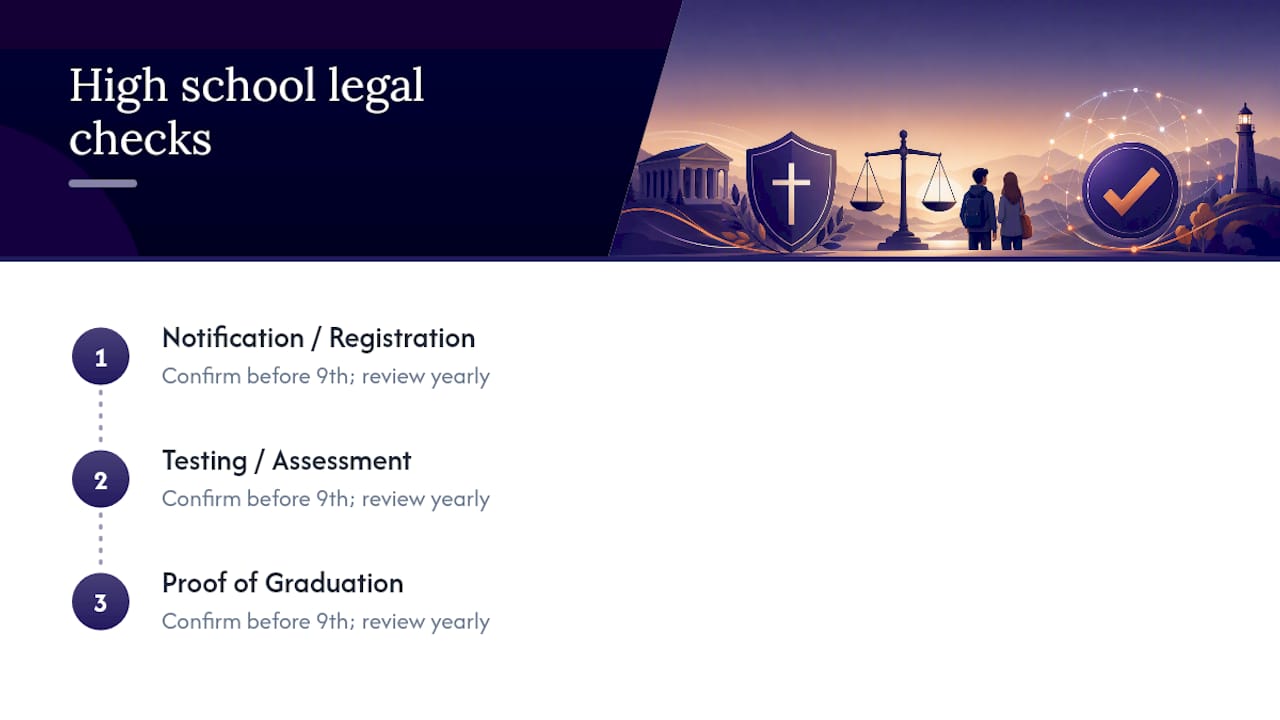
Before you build a four-year plan, confirm three things with your state's homeschool statute or your state's homeschool association: what notification or registration is required, whether any testing or assessment is mandated during high school years, and what your state considers acceptable proof of graduation. These requirements can change between a student's ninth and twelfth grade years, so it's worth a quick annual check rather than assuming the rules you learned in middle school still apply.
State requirements also affect how a dual enrollment or accredited online course interacts with your homeschool status. Some states have specific dual enrollment programs open to homeschoolers with their own eligibility rules and application windows, separate from how public school students enroll. Missing an application deadline because you assumed the process worked the same way for homeschoolers is a common and avoidable mistake.
None of this should discourage a family from homeschooling through high school. It just means the legal side deserves the same early attention you'd give to curriculum choice, ideally settled before ninth grade starts so credit planning and dual enrollment timing aren't disrupted mid-year by a requirement you didn't know existed.
How Do Homeschooled Teens Get Socialization and Extracurriculars?
The socialization question comes up in nearly every conversation about homeschooling a teenager, and the honest answer is that structure, not schooling format, determines whether a teen has a full social life. Co-ops, sports leagues, church youth groups, and community volunteer work all provide the peer relationships and shared experience that critics assume homeschoolers lack.
Athletics deserve specific mention because many states allow homeschooled students to try out for public school teams, and private Christian schools sometimes welcome homeschoolers onto their rosters for a fee. Where that's not available, homeschool-specific sports leagues have grown enough in most regions to field competitive teams in basketball, volleyball, and track.
Debate and speech, drama productions, and student leadership roles inside a co-op fill the extracurricular gap that worries some parents most, since these activities look substantial on a college application and build the kind of public speaking confidence that classroom learning alone doesn't develop. Many co-ops also run their own version of student government or yearbook committees, giving teens a taste of the extracurricular resume that colleges expect to see.
Part-time jobs and volunteer commitments round out the picture, and both count as legitimate extracurricular experience on a transcript or college application. A teen who works ten hours a week at a local business or volunteers consistently at church is building exactly the kind of real-world reference and responsibility that colleges and employers value, arguably more than another club membership would.
How Do You Teach Science and Math at an Advanced Level?
Advanced science and math intimidate more homeschool parents than any other subject, and for good reason: teaching yourself calculus the same semester you're teaching it to your teen isn't realistic for most families. The fix isn't to avoid these subjects, it's to be strategic about who teaches them.
For lab sciences like chemistry, biology, and physics, a co-op with a dedicated lab class solves the equipment problem most homes can't solve on their own. If no co-op is available, some curriculum providers now ship lab kits directly with video-guided instructions, and community college lab sections are open to dual enrolled students in most regions.

For math beyond Algebra II, three options work well depending on your teen's learning style: a live online class with a real instructor and real deadlines, a tutor who meets weekly to check problem sets and clear up confusion, or dual enrollment at a community college once your teen is ready for college-level coursework. Outschool's guide points out that live online classes give families access to subject expertise they can't always provide at home, which is exactly the situation most parents face with precalculus and beyond.
Whichever route you choose, don't let a hard subject slide because it's uncomfortable to teach. A tutor for one hour a week or a single dual enrollment course is a small cost compared to a transcript gap that raises questions during college admissions.
How Arizona Christian Homeschool Programs Helps You Search Smarter
Arizona Christian Homeschools brings co-ops, microschools, tutors, and accredited program listings into one searchable directory, so you're not piecing together options from scattered Facebook groups and word of mouth. Filter by grade level and program type, check each listing for accreditation and diploma policy, and reach out directly to ask about transcript documentation before you commit a semester.
Start this search by eighth grade if college is the goal. That timing gives you a full year to line up dual enrollment eligibility, confirm accreditation status, and settle on a curriculum before ninth grade credits start counting toward a transcript.
Find Your Next Co-op or Accredited Program
Sorting through accreditation policies, transcript requirements, and program formats on your own eats up hours that most parents don't have to spare during an already full school year. Arizona Christian Homeschools solves that by putting local co-ops, microschools, tutors, and accredited program listings in one searchable directory, so you can filter by grade level and program type instead of chasing down every option one Facebook group at a time.

Each listing includes contact information and program details, which means you can ask about diploma policy, transcript documentation, and ESA eligibility before your teen sets foot in a classroom. If your family qualifies for Arizona's Empowerment Scholarship Account, several listed programs already accept ESA funds for co-op fees, tutoring, or curriculum costs. Visit the homeschool co-op directory to filter for accredited high school programs near you and start reaching out to a few this week, while there's still time to align credits before the school year locks in.
Sources
- Christian Homeschool High School: Complete Guide For Grades 9-12 - Zion Academy Of America
- How to Homeschool High School: A Complete Guide for Parents - Outschool
- Christian Homeschool Curriculum | BJU Press Homeschool
FAQ
What is the best Christian high school homeschool curriculum?
There's no single best option, but strong programs share three traits: real lab and problem-set rigor, explicit apologetics or worldview integration, and either accreditation or a clear path to dual enrollment credit. Compare a few using Arizona Christian Homeschools' curriculum resources before committing to one for all four years.
What does the Bible say about homeschooling?
Scripture doesn't mention homeschooling directly, but passages like Deuteronomy charges parents with teaching their children continually, which many Christian families cite as the theological foundation for taking direct responsibility for education.
What is the hardest age to homeschool?
Many parents report the transition into high school (ninth and tenth grade) as the toughest stretch, since subjects grow more specialized right as teens push for independence, which is why dual enrollment, tutors, and co-ops become more valuable during these years than earlier ones.
What states give you money for homeschooling?
Several states now offer Education Savings Accounts or similar programs that homeschool families can use toward curriculum, tutoring, and co-op fees; Arizona's Empowerment Scholarship Account is one of the most established, and Arizona Christian Homeschools lists which local programs accept ESA funds.
Do I need an accredited diploma to homeschool through high school?
No, a parent-issued diploma is legal in every state, but an accredited diploma or dual enrollment transcript removes friction with selective colleges, nursing programs, and military enlistment, according to Zion Academy's high school planning guide.