
To start homeschooling in Arizona, file a notarized Affidavit of Intent with your county superintendent within 30 days of beginning instruction and provide teaching in five subjects: reading, grammar, mathematics, social studies, and science. That single filing, governed by A.R.S. §15-802, is the only state-required paperwork for an independent homeschool. Arizona defines a homeschool as a school "conducted primarily by the parent, guardian or other person who has custody of the child," and compulsory attendance applies to children ages 6–16.
Your immediate action list:
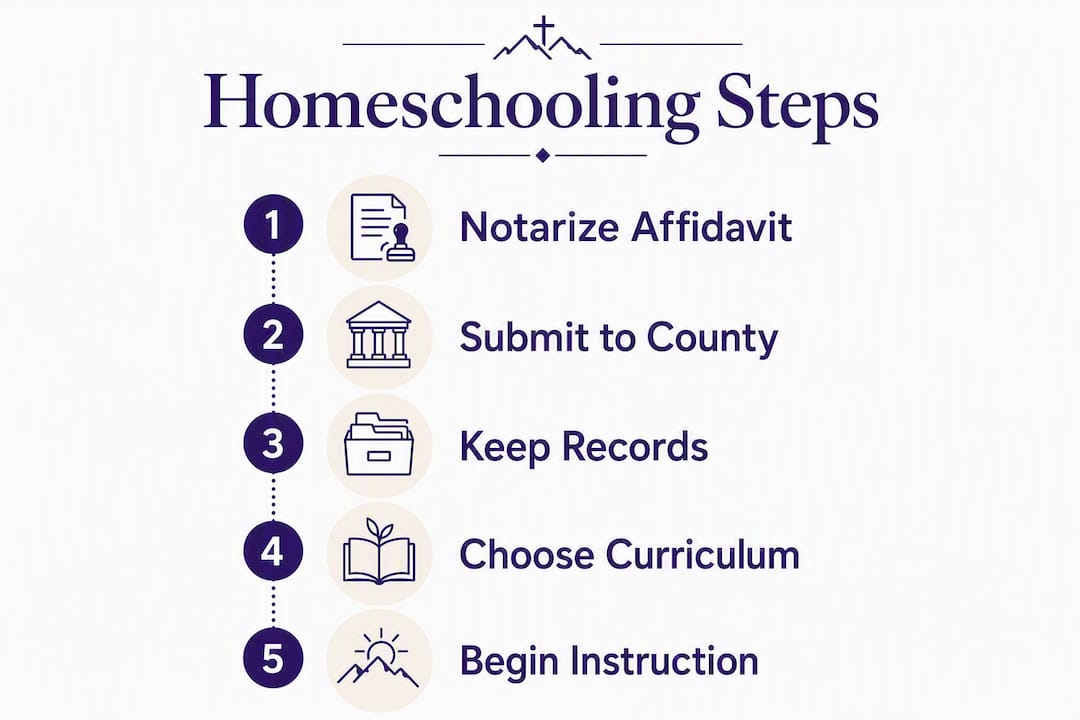
- Notarize the Affidavit of Intent (any notary public can do this).
- Mail or deliver it to your county superintendent's office within 30 days of your start date.
- Keep a date-stamped copy for your permanent records.
- Notify your child's current school in writing if withdrawing from public or charter enrollment.
One critical distinction: if you plan to use Arizona's Empowerment Scholarship Account (ESA), do NOT file the homeschool affidavit. ESA participants enter a separate state contract with its own reporting obligations. Choosing one pathway means you do not use the other.
Table of Contents
- How to file the affidavit and legally start homeschooling in Arizona
- Which Arizona homeschooling route is right for your family?
- What does Arizona law actually require for homeschoolers?
- How to withdraw from public school and what records to keep
- How homeschoolers can access special education services in Arizona
- What does it cost to start homeschooling in Arizona?
- Where to find co-ops, tutors, and local resources in Arizona
- Your 30–60 day checklist for starting homeschooling in Arizona
- Key Takeaways
- What the first year of homeschooling in Arizona actually looks like
- Arizona Christian Homeschools makes finding your community easier
- Official sources and further reading
How to file the affidavit and legally start homeschooling in Arizona
The process is straightforward, but the details matter. Follow these steps in order.
-
Prepare the Affidavit of Intent. The affidavit must include the child's full name, date of birth, your name and contact information, and proof of the child's age or identity (a birth certificate copy works). The document must be notarized before filing. Many county superintendent offices provide their own affidavit form; download it from your county's page before visiting a notary.
-
File within 30 days of starting. Mail or hand-deliver the notarized affidavit to your county superintendent. This is a one-time filing unless you stop homeschooling and later resume. Pima County returns a date-stamped copy as proof of receipt, and Cochise County provides downloadable affidavit PDFs and a homeschool liaison contact. Check your own county's page for its specific procedure.
-
Withdraw your child from public or charter school in writing. Send a brief letter to the school principal or registrar stating the child's name, grade, last day of attendance, and your intent to homeschool. Keep a copy. There is no required waiting period once you submit the letter.
-
Build your permanent homeschool file. Store the notarized affidavit copy, the child's birth certificate copy, and the school withdrawal letter together. Add to this file throughout the year.
Pro Tip: Scan every document before mailing and request a date-stamped return copy or use certified mail with a return receipt. That timestamp is your legal proof of timely filing.
County procedures vary. Yavapai County uses the Homeschool Connect platform for registration guidance. Apache, Coconino, Gila, Graham, and Greenlee counties each maintain their own superintendent pages with local filing instructions.

Which Arizona homeschooling route is right for your family?
Three legal pathways exist for Arizona families. Each carries different paperwork, oversight, and funding implications.
| Pathway | Filing Requirement | State Oversight | Funding | Extracurricular Access |
|---|---|---|---|---|
| Independent homeschool | One-time notarized affidavit | Minimal after filing | Self-funded | Limited public-school access |
| ESA-funded homeschool | ESA contract with ADE | Contract reporting required | $200–$1,500+ | ESA-eligible vendors only |
| Virtual charter / hybrid | Charter enrollment | Charter school rules apply | State-funded | Charter school activities |
Independent homeschool gives families the most flexibility. You choose curriculum, set the schedule, and answer to no state authority beyond the initial affidavit. No annual renewal, no testing, no curriculum approval.
ESA (Empowerment Scholarship Account) provides state funding for educational expenses, but accepting ESA funds means entering a contract with distinct reporting obligations. You do not file a homeschool affidavit if you enroll in ESA. Families can use ESA funds for tutors, curricula, therapies, and enrichment programs listed as ESA-eligible. The Arizona Department of Education ESA page outlines contract terms and eligible expenses.
Virtual charter or hybrid programs operate under charter school rules. Do not file an independent homeschool affidavit if your child is enrolled in a virtual charter. These programs offer structured curricula and sometimes access to extracurricular activities, but they come with enrollment requirements and less scheduling freedom. Families exploring hybrid programs in Arizona can browse options through the Arizonachristianhomeschools directory.
Key considerations when choosing:
- Families wanting maximum curriculum freedom and no ongoing reporting: independent homeschool.
- Families needing financial help for curriculum, tutors, or therapy: ESA pathway.
- Families wanting structured instruction with some school-based activities: virtual charter or hybrid.
What does Arizona law actually require for homeschoolers?
Arizona is a low-regulation state for homeschooling. The Homeschool Legal Defense Association (HSLDA) summarizes Arizona's requirements clearly: notify the county, cover five subjects, and you have met the law's core demands.
What the law requires:
- Instruction in reading, grammar, mathematics, social studies, and science per A.R.S. §15-802.
- A notarized Affidavit of Intent filed with the county superintendent within 30 days of beginning.
- Compulsory attendance compliance for children ages 6–16.
What the law does NOT require for independent homeschools:
- Standardized testing or state assessments.
- Curriculum approval or a state-approved course list.
- Teacher credentials or certifications for parents.
- Annual renewal filings.
- Immunization records (not required for independent homeschoolers).
- Attendance logs submitted to the state.
Many parents assume the district will monitor their instruction or that they need an approved curriculum. Neither is true for independent homeschools in Arizona. Parents retain full legal responsibility for curriculum design and academic assessment.
Pro Tip: Even though transcripts and work samples are not legally required, maintain them anyway. Colleges, community colleges, and public schools requesting re-enrollment will ask for documentation that the state never collected.
How to withdraw from public school and what records to keep
Withdrawing your child and building a solid records file protects you from compliance questions and keeps future academic doors open.
Withdrawal notice
Notify the school in writing on or before your first day of homeschooling. A simple letter works:
"Dear [Principal's name], I am writing to notify [School Name] that [Child's Name], currently enrolled in [Grade], will be withdrawing effective [Date] to begin homeschooling. Please confirm receipt of this notice."
Keep a copy. Email delivery creates a timestamp; certified mail creates a paper trail.
Recommended records to maintain
| Record Type | What to Keep | Why It Matters |
|---|---|---|
| Notarized affidavit | Date-stamped copy | Legal proof of timely filing |
| Proof of age | Birth certificate copy | Required for affidavit |
| Withdrawal letter | Signed or timestamped copy | Confirms school disenrollment |
| Work samples | Representative assignments per subject | Supports college applications and transfers |
| Annual summary | Course list, grades, brief descriptions | Functions as a transcript |
| Progress notes | Informal notes or evaluations | Useful for re-enrollment or special services |
Arizona does not require you to submit any of these records to the state. Keeping them is entirely for your family's benefit. A simple annual summary that lists courses, a brief description, and a grade or narrative evaluation mirrors a transcript format and protects your child's options for college or public-school reentry.
Pro Tip: Store both paper and scanned digital copies. A cloud folder organized by school year takes minutes to set up and can save hours of reconstruction later.
How homeschoolers can access special education services in Arizona
Homeschooling does not eliminate your child's rights under the Individuals with Disabilities Education Act (IDEA). Families retain the right to request evaluations and services through the local public school district, even while homeschooling.
How to access services:
- Contact the special education office at your local public school district and request a Child Find evaluation in writing.
- Document every request, response, and meeting date.
- If the district agrees to provide services, get the service agreement in writing and keep progress notes.
Available supports vary by district. Some districts provide speech therapy, occupational therapy, or resource support to homeschooled students under a service agreement; others do not. ESA funds can also cover educational therapy and specialists for families on the ESA pathway.
Practical options for families with special needs:
- District-provided services under a written agreement (availability varies).
- Private educational therapists, many of whom accept ESA funds.
- ESA-eligible tutors with experience in learning differences.
- Faith-based co-ops that offer differentiated instruction in small groups.
Pro Tip: Start by calling the district's special education liaison, not the front office. Ask specifically about "Child Find" services for homeschooled students. Put your initial request in writing and keep a copy.
What does it cost to start homeschooling in Arizona?
Startup costs are modest. Ongoing costs depend entirely on the curriculum and enrichment choices you make.
One-time startup costs:
- Notarization fee: typically $5–$15 per signature at a bank or UPS Store.
- Affidavit printing and mailing: under $5.
- Curriculum starter pack: ranges from free (library resources, open-source curricula) to $150–$300 for a basic packaged program, or $400–$800+ for a full-year boxed curriculum like Sonlight.
Ongoing annual costs:
- Curriculum subscriptions or replacement materials: $200–$1,500+ depending on grade and approach.
- Co-op fees: typically $50–$300 per semester for group classes and activities.
- Extracurriculars, sports, or enrichment programs: varies widely.
- Tutoring or specialized instruction: $30–$80+ per hour if needed.
Arizona's ESA program can offset many of these expenses for eligible families. ESA funding provides state funds for qualifying students to use on curricula, tutors, therapies, and enrichment programs. Families considering this route should review ESA-approved curriculum options and ESA-approved tutors before committing to purchases.
30–90 day timeline:
- Days 0–30: Notarize and file affidavit; withdraw from school; purchase core curriculum.
- Days 30–60: Establish a weekly schedule; attend a trial co-op session; set up your records file.
- Days 60–90: Evaluate your child's progress; add tutoring or enrichment if needed; revisit curriculum fit.
Where to find co-ops, tutors, and local resources in Arizona
County superintendent offices are your first stop for the official affidavit form and local filing procedures. Each county maintains its own page:
- Pima County: schools.pima.gov — accepts affidavits and returns date-stamped copies.
- Cochise County: cochise.az.gov — downloadable affidavit PDF and homeschool liaison contact.
- Yavapai County: yavapaicoesa.gov — Homeschool Connect platform for registration guidance.
- Apache, Coconino, Gila, Graham, Greenlee: Each county superintendent's office maintains its own filing instructions and contact information.
Beyond the legal filing, local faith-based co-ops and community groups supply the social and curricular support that makes homeschooling sustainable long-term. The Arizonachristianhomeschools directory connects Arizona families to Christian co-ops, ESA-friendly tutors, hybrid programs, enrichment classes, and curriculum providers across the state.
Finding the right co-op early makes a measurable difference in the first year. Families who connect with a local group within the first 60 days report stronger routines, better socialization for their children, and more confidence navigating curriculum choices. The Arizonachristianhomeschools directory lists groups by city and program type, so you can filter by location, ESA eligibility, and faith alignment before reaching out.
Vetting checklist for co-ops and tutors:
- Does the program accept ESA funds, and is it listed as an eligible vendor?
- What are the instructor's credentials or experience in the subject area?
- Does the co-op carry liability insurance?
- Can you attend a trial class before committing to a semester fee?
- How does the program communicate with parents about progress and scheduling?
Pro Tip: Attend one or two trial sessions before paying a semester fee. Ask to see a sample lesson plan and find out how the co-op handles absences. A good fit on paper can feel very different in practice.
For faith-based enrichment programs that integrate spiritual development with academic content, the Arizonachristianhomeschools directory includes options across Arizona's major metro areas and rural counties.
Your 30–60 day checklist for starting homeschooling in Arizona
Use this checklist to stay on track during the first two months.
Legal and administrative (complete within 30 days):
- Download the Affidavit of Intent from your county superintendent's website.
- Complete all required fields: child's name, date of birth, your contact information, proof of age.
- Have the affidavit notarized.
- File with the county superintendent by mail or in person; request a date-stamped copy.
- Send a written withdrawal notice to your child's current school.
- Create a permanent homeschool file: store the affidavit copy, birth certificate copy, and withdrawal letter.
Curriculum and scheduling (days 15–45):
- Choose a core curriculum covering reading, grammar, math, social studies, and science.
- Set a basic weekly schedule with consistent start times.
- Identify any subjects where tutoring or co-op classes would help.
Community and support (days 30–60):
- Search for a local co-op through the Arizonachristianhomeschools co-op directory.
- Attend a trial session before committing.
- If considering ESA, begin the application process separately — do not file the affidavit if you pursue ESA.
- Connect with an online homeschool community or local support group for encouragement and practical advice.
Key Takeaways
Filing a notarized Affidavit of Intent with your county superintendent within 30 days is the single legal requirement that makes you a compliant independent homeschooler in Arizona under A.R.S. §15-802.
| Point | Details |
|---|---|
| File the affidavit first | Notarize and submit to your county superintendent within 30 days of starting; this is a one-time filing. |
| ESA and affidavit are mutually exclusive | Families using ESA funds enter a state contract and do not file the homeschool affidavit. |
| No testing or credentials required | Arizona mandates no standardized tests, curriculum approval, or teacher qualifications for independent homeschools. |
| Keep records voluntarily | Transcripts and work samples are not required by law but protect college and transfer options. |
| Arizonachristianhomeschools directory | Connects Arizona families to Christian co-ops, ESA-friendly tutors, and hybrid programs by city and program type. |
What the first year of homeschooling in Arizona actually looks like
The paperwork is the easy part. Most families find that the first 90 days are less about legal compliance and more about discovering what actually works for their child's learning style. Scheduling takes longer to settle than most parents expect. Socialization, which is often the first concern people raise, tends to resolve quickly once a family connects with a local co-op or support group. The harder adjustment is giving yourself permission to adapt the plan when the original curriculum or schedule is not working.
Arizona's low-regulation environment is genuinely freeing, but that freedom requires you to be intentional. No one is checking whether your child mastered long division in October. That responsibility sits entirely with you, and most families find it both challenging and deeply rewarding.
The Arizonachristianhomeschools community exists precisely for this transition period. Connecting with other Christ-centered families who have navigated the same questions, from affidavit filing to co-op selection to ESA decisions, shortens the learning curve considerably.
Arizona Christian Homeschools makes finding your community easier
Sorting through co-ops, tutors, and ESA vendors on your own takes time that new homeschool families rarely have. Arizonachristianhomeschools offers a searchable directory built specifically for Arizona's Christian homeschooling community, with listings organized by city, program type, and ESA eligibility.

The directory includes Christian co-ops near you, ESA-approved tutors, hybrid program listings, enrichment classes, and curriculum options including Christian Light Education. Every listing is focused on faith-aligned, academically grounded programs that serve Arizona families. Browse the directory by your city or county, filter by ESA eligibility, and contact programs directly. Start by searching for co-ops and tutors in your area at arizonachristianhomeschools.com.
Note: Arizonachristianhomeschools operates as a community directory. Listings are provided as a resource; no program listed is required by Arizona law.
Official sources and further reading
Use these primary sources to download forms, verify statutes, and access official ESA guidance.
- A.R.S. §15-802 — Arizona Legislature: The governing statute for compulsory school attendance, homeschool definition, and affidavit requirements. Read this first.
- U.S. Department of Education — Arizona Home School Regulation: — Federal summary of Arizona's homeschool rules, including affidavit and notification requirements.
- HSLDA — Arizona Homeschool Laws: Plain-language summary of Arizona's requirements; confirms low-regulation status and lists what is and is not required.
- Pima County Superintendent — Homeschool Information: Affidavit acceptance procedures, date-stamped copy return, and practical filing guidance for Pima County families.
- Cochise County — Home Schooling: Downloadable affidavit PDF and homeschool liaison contact for Cochise County.
- Yavapai County — Homeschool Connect: Registration guidance and Homeschool Connect platform for Yavapai County families.
This article provides general information about Arizona homeschool law. It is not legal advice. Confirm current requirements with your county superintendent's office, the Arizona Department of Education, or a qualified attorney before making enrollment decisions.