
The fastest reliable route to a faith-aligned online tutor is a vetted Arizona Christian homeschool directory, cross-checked against your child's specific needs and your Empowerment Scholarship Account eligibility before you sign anything. That single step balances three things at once: whether the tutor's faith commitment matches your family's, whether they fit your curriculum and grade level, and whether the state will help pay for it. Start there, then vet carefully.
TL;DR:
- Using a vetted Arizona Christian homeschool directory ensures the tutor's faith alignment, curriculum fit, and eligibility for ESA funding are verified upfront.
- Local directories filter for faith-based experience and homeschool familiarity, while national services might be necessary for niche subjects or less common expertise.
- Conducting a structured trial lesson with clear criteria and requesting proof of credentials and background checks reduces mismatches and builds confidence in the selection.
- Tuition costs vary widely based on specialization, credentials, and session format, but bundle discounts and ESA-eligible vendors can significantly lower expenses.
- Successful integration depends on aligning the tutor's approach with your curriculum and recording progress regularly, especially for remedial, enrichment, or Bible study goals.
Table of Contents
- Where To Find Online Christian Tutors Serving Arizona Families
- Vetting a Christian Tutor: Qualifications, Faith Fit, and the Trial Lesson
- What Online Christian Tutoring Costs in Arizona, and How ESA Funding Helps
- Integrating Online Tutoring Into Your Arizona Homeschool Plan
- How To Hire an Online Christian Tutor: A Step-by-Step Checklist
- How Arizona Christian Homeschool Programs Supports Your Search
- What Arizona Parents Say About Online Christian Tutoring
- Warning Signs to Watch for When Choosing a Tutor
- Arizona Homeschool Resources Worth Bookmarking
- An Honest Take on the Search for Faith-Aligned Tutoring
- FAQ
Where To Find Online Christian Tutors Serving Arizona Families
Most Arizona parents start their search in one of two places: a general tutoring marketplace or a faith-specific directory. The difference matters more than it seems, because a general marketplace filters for subject and price, while a Christian-specific directory filters for what actually distinguishes this search: doctrinal alignment, homeschool fluency, and comfort teaching families who structure their school year differently than a public school district does.
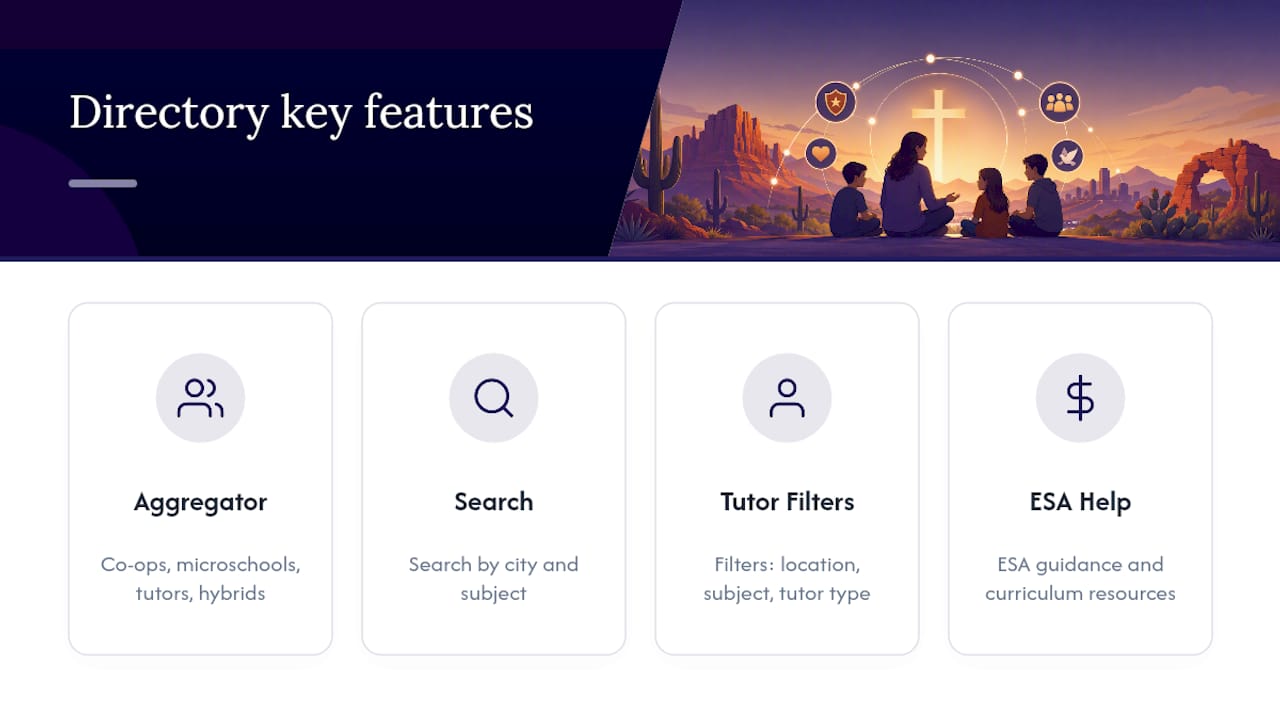
The Arizona Christian Homeschool Programs directory works well as a first stop precisely because it was built around that second filter. It aggregates co-ops, microschools, hybrid schools, and individual tutors across the state, and its dedicated tutor-finder page lets you search by city, subject, and tutor type without wading through profiles that have no connection to Christian education at all. If you homeschool in Mesa, Prescott, or Sierra Vista, that localization matters. A tutor who has worked with Arizona ESA families before already understands the paperwork rhythm your family lives by.
National Christian tutoring services deserve a place in your search too, especially for niche subjects like AP Calculus, upper-level Latin, or specialized reading intervention where the local pool is thin. Before you commit to a national platform, confirm three things:
- State service confirmation. Some tutoring companies are licensed or staffed only in certain states; ask directly whether they serve Arizona families and whether their tutors hold any state-specific certifications you might need.
- Curriculum fit. A tutor fluent in Saxon Math or Christian Light Education will get your child up to speed faster than one who has to learn your curriculum's sequencing on the fly.
- ESA vendor acceptance. Not every tutoring company is registered as an eligible ESA vendor. Ask for their vendor status in writing before you count on scholarship funds to cover sessions.
When you're reading a tutor's online profile, look past the subject list. The fields that actually tell you about faith integration and homeschool experience are usually buried lower on the page: a short bio mentioning ministry background, references to "Christ-centered instruction" or "biblical worldview," and any note about prior homeschool families served. A tutor who lists "5 years classroom experience" but nothing about homeschooling specifically may still be excellent, but they will likely need more onboarding to understand your family's rhythm, your recordkeeping needs, and the flexibility homeschool schedules require.
For specialized needs, narrow your search further. A tutor experienced with dyslexia support should be able to name the specific reading program they use, not just say they "work with struggling readers." For AP prep, ask how many students they've coached through the actual exam and what their pass-rate experience looks like, if they track it. For dedicated Bible study tutoring, distinguish between a general Christian worldview overlay and someone qualified to teach hermeneutics or guide deeper scriptural study, since those are different skill sets entirely.
Pro Tip: Search the directory by subject first, then cross-reference by city. A strong reading specialist three towns over who teaches fully online is often a better match than a mediocre local tutor, especially for K–8 core subjects where daily consistency matters more than proximity.
Vetting a Christian Tutor: Qualifications, Faith Fit, and the Trial Lesson
Hiring an online tutor without a structured evaluation process is how families end up with a mismatch three weeks in, after money has changed hands and a child has grown attached to someone who isn't the right fit academically or spiritually. A repeatable vetting process protects against that, and it doesn't need to be complicated.
Start by requesting concrete credentials, not vague reassurances:
- Degree and subject expertise. Ask what the tutor studied and where. A math tutor with an engineering degree brings something different to the table than one with an education degree, and both can be excellent, but you should know which you're getting.
- Teaching certification or homeschool-specific training. Certification isn't mandatory for private tutoring, but it signals structured pedagogical training. Absence of certification isn't disqualifying if the tutor has strong homeschool experience instead.
- Ministry or faith-based training. Ask directly whether they've taught in a church, Christian school, or homeschool co-op setting, and for how long. This is different from simply identifying as Christian.
- Homeschool-specific experience. A tutor who has only taught in traditional classrooms may need guidance adjusting to the self-paced, parent-directed style most Arizona homeschool families use.
- References from other homeschool families. Ask for two, and actually call them. A five-minute conversation with a past client tells you more than a paragraph of testimonials on a website.
During your initial consultation, the questions you ask should probe both pedagogy and faith integration, since one without the other is an incomplete hire. Ask how they'd structure a first month of lessons for your child's specific level. Ask how faith shows up in an actual lesson, not as an abstract value, but practically: do they open with prayer, weave scripture into reading comprehension passages, or keep the faith element more implicit in how they encourage and correct? There's no universally right answer, but you need to know their approach matches what your family wants.
Background checks are worth requesting outright, especially for any tutor who hasn't come through a vetted co-op or established Christian tutoring company. A tutor working independently should be willing to provide a recent background check or explain clearly why they haven't. Hesitation or defensiveness on this point is itself useful information.
The trial lesson is where most of the real evaluation happens, and it deserves more structure than parents typically give it. Treat it as a scored evaluation, not a casual first meeting:
- Did the tutor arrive prepared with a lesson plan, or improvise on the spot?
- Did your child stay engaged for the full session, or lose focus after ten minutes?
- Did the tutor check for understanding throughout, or just talk at your child?
- Was there any faith integration, and did it feel natural rather than forced?
- Did the tutor follow up afterward with notes, a recap, or a suggested next step?
A tutor who sends a short written recap after the trial lesson, even two or three sentences summarizing what was covered and what to work on next, is signaling the kind of communication habit that makes an ongoing tutoring relationship far easier to manage. That single follow-up email often tells you more than the lesson itself.
What Online Christian Tutoring Costs in Arizona, and How ESA Funding Helps
Private online tutoring rates in Arizona vary widely depending on the tutor's experience, subject specialty, and how much prep time a session requires. A tutor handling elementary reading review typically charges less per hour than one prepping a high schooler for the SAT or teaching AP Chemistry, and that gap reflects the additional expertise and preparation those specialized sessions demand. Rather than anchor to a single number, ask each tutor directly for their rate and what it includes, since "per hour" sometimes covers prep and grading time and sometimes doesn't.
Several factors reliably push rates up or down:
- Specialization. Test prep, learning differences support, and advanced subjects like calculus or upper-level foreign language command higher rates than general elementary tutoring.
- Credentials. A certified teacher or someone with an advanced degree in the subject area typically charges more than an undergraduate tutor, though not always more effectively.
- Session length and frequency. Shorter, more frequent sessions sometimes cost more per hour than longer weekly blocks, since setup and wrap-up time gets repeated more often.
- Group versus individual instruction. A tutor teaching two or three homeschool children in a shared online session typically charges less per student than one-on-one instruction, since the cost of their time is spread across more families.
Package pricing is one of the more reliable ways families bring per-session costs down. Buying a bundle of ten or twenty sessions upfront often earns a discounted rate compared to paying week to week, and it also locks in a consistent time slot on the tutor's calendar. Group co-op sessions work similarly: several families splitting the cost of one tutor teaching a small group session can cut the per-child cost substantially while still delivering more personal attention than a large classroom setting would.
Arizona's Empowerment Scholarship Account program is the funding piece that makes faith-based tutoring genuinely affordable for many families who'd otherwise have to absorb the full cost themselves. ESA funds are distributed to eligible families and can be applied toward a range of educational expenses, tutoring services among them, but only when the tutor or company is registered as an approved ESA vendor. This is the step families skip most often, and it's the one that causes the most frustration later.
Before you commit to any tutor, confirm their ESA vendor status directly, in writing if possible. A resource like Arizona's ESA guidance on writing and reading tutors walks through what qualifies and what documentation the state typically expects. Don't assume a tutor is ESA-eligible just because they work with homeschool families; vendor registration is a specific administrative status, not a general reputation.
If your ESA allocation doesn't stretch far enough to cover everything you want, a few practical moves stretch it further. Group co-op sessions split across multiple ESA-funded families reduce each family's individual draw. Some tutors offer sliding-scale rates for families who ask directly, particularly for longer-term commitments. Prepaid bundles purchased at the start of a semester, when ESA funds are freshly disbursed, often lock in a better rate than paying session by session throughout the year.
Integrating Online Tutoring Into Your Arizona Homeschool Plan
A tutor works best when they slot into your existing homeschool structure rather than becoming a separate, disconnected activity your child does on the side. The families who get the most out of tutoring treat it as one coordinated piece of the school year, not an add-on.
Matching a tutor to your curriculum starts before the first lesson. If your family uses Christian Light Education, tell the tutor upfront and ask whether they've worked with that scope and sequence before. A tutor unfamiliar with your specific curriculum can still be effective, but expect a short adjustment period while they learn how your materials are organized. The same goes for Saxon, Abeka, or any other widely used Christian homeschool curriculum: naming it explicitly during your first conversation saves weeks of misalignment later.
Recordkeeping is where a good tutor genuinely lightens your load rather than adding to it. Arizona homeschool reporting requirements are relatively light compared to some states, but families still benefit from documented objectives, sample work, and progress notes, particularly if a child later transitions back into a traditional school setting. A tutor who sends brief weekly plans and short progress notes after each session gives you a paper trail without any extra effort on your part. Mapping those tutor notes into your own scope-and-sequence record is far easier than trying to reconstruct what was covered months after the fact.
Different situations call for different uses of a tutor, and it's worth being clear with yourself about which one applies:
- Remedial support for a child who has fallen behind in a specific skill, like phonics or fraction concepts, where consistent one-on-one attention closes the gap faster than a parent juggling multiple children's lessons can.
- Enrichment for a child who has outpaced the family's curriculum in a particular subject and needs material a parent may not feel equipped to teach, such as upper-level science or a foreign language.
- Dedicated Bible study for families who want deeper scriptural instruction than a general curriculum's devotional content provides.
- Test prep for SAT, ACT, or AP exams, where a tutor's familiarity with test structure and timing adds real value beyond content review.
Tutoring also pairs naturally with co-ops and microschools rather than replacing them. Many Arizona families use a hybrid model: a weekly in-person or hybrid co-op for group learning and social connection, paired with an online tutor for one or two subjects that need more individualized attention than a co-op classroom can provide. The Arizona homeschool co-op directory is a useful place to find that group piece if you haven't already, and combining it with targeted tutoring often costs less overall than a full private tutoring schedule across every subject.
How To Hire an Online Christian Tutor: A Step-by-Step Checklist
Turning everything above into an actual hire works better with a clear sequence. Here's the order that keeps families from skipping steps that matter.
- Define your goals before you search. Write down the specific academic gap or enrichment need, your preferred faith integration level, your weekly schedule availability, and your budget range, including whether ESA funds will cover part of it. Vague goals lead to a vague search.
- Build a shortlist of three to five tutors. Pull candidates from the Arizona homeschool tutor directory and, if needed, a national Christian tutoring service for specialized subjects. Don't stop at the first profile that looks decent.
- Run initial consultations with each candidate. Ask about credentials, faith integration approach, homeschool experience, and ESA vendor status in the same conversation, so you're comparing candidates on equal footing.
- Schedule a trial lesson with your top one or two choices. Score it against the criteria covered earlier: preparation, engagement, faith integration, and follow-up communication.
- Set lesson cadence and measurable milestones before the first paid session. Agree on frequency, session length, and what progress looks like after four or eight weeks, so both you and the tutor have a shared benchmark.
- Confirm payment terms and vendor status in writing. If you're using ESA funds, get the vendor confirmation documented before sessions begin, not after.
- Document progress weekly. Keep the tutor's lesson notes and sample work in your homeschool records, and revisit the milestone benchmarks at the agreed checkpoint.
- Adjust the plan based on what you're seeing. If engagement drops or progress stalls, address it directly with the tutor before assuming the relationship isn't working. Most issues are fixable with a schedule or approach change.
How Arizona Christian Homeschool Programs Supports Your Search
Arizona Christian Homeschool Programs exists specifically to solve the problem this article is built around: making it easier for Arizona families to find educational options rooted in Christian values without piecing together a search from scattered, generic listings. The directory aggregates co-ops, microschools, tutors, and hybrid schools in one localized place, searchable by city and subject, alongside an events calendar that helps families stay connected to the broader Arizona homeschool community.
The tutor-finder page is built around the exact filtering families need most: location, subject, and tutor type, with an eye toward highlighting faith integration and homeschool-specific experience rather than treating those as afterthoughts. The site also maintains ESA-focused guidance, including curriculum-specific resources that help families understand how scholarship funds intersect with specific educational choices.
Worth stating plainly: the directory is a starting point, not a substitute for your own vetting. It surfaces options and provides context, but the credential checks, faith-fit conversations, and trial lessons described earlier are still the parent's responsibility. Arizona Christian Homeschool Programs narrows the search radius considerably; the final judgment call about fit still belongs to you.
What Arizona Parents Say About Online Christian Tutoring
Parents who've gone through this search consistently mention the same handful of turning points. The first is almost always the relief of finding a tutor who doesn't need faith explained to them, someone who already understands why weaving scripture into a reading lesson matters, rather than treating it as an unusual request. That single point of alignment often does more for a family's confidence than any credential on paper.
The second common thread is scheduling flexibility. Families juggling multiple children's homeschool schedules, co-op days, and part-time work consistently point to online tutoring's flexibility as the feature that made consistent lessons possible in the first place. A tutor who can meet at 7:30 in the morning or after dinner solves a logistics problem that in-person tutoring rarely can.
The third theme, and the one that surprises new homeschool parents most, is how much a good trial lesson reveals. Families who ran a structured trial before committing routinely report catching mismatches early, whether in teaching style, pacing, or faith approach, that would have been far more disruptive to discover three months into a paid commitment. The lesson isn't just a sales pitch; it's diagnostic, and treating it that way pays off.
Warning Signs to Watch for When Choosing a Tutor
Not every tutor advertising as "Christian" or "faith-based" has thought carefully about what that means in practice, and a few warning signs tend to show up consistently among mismatches.
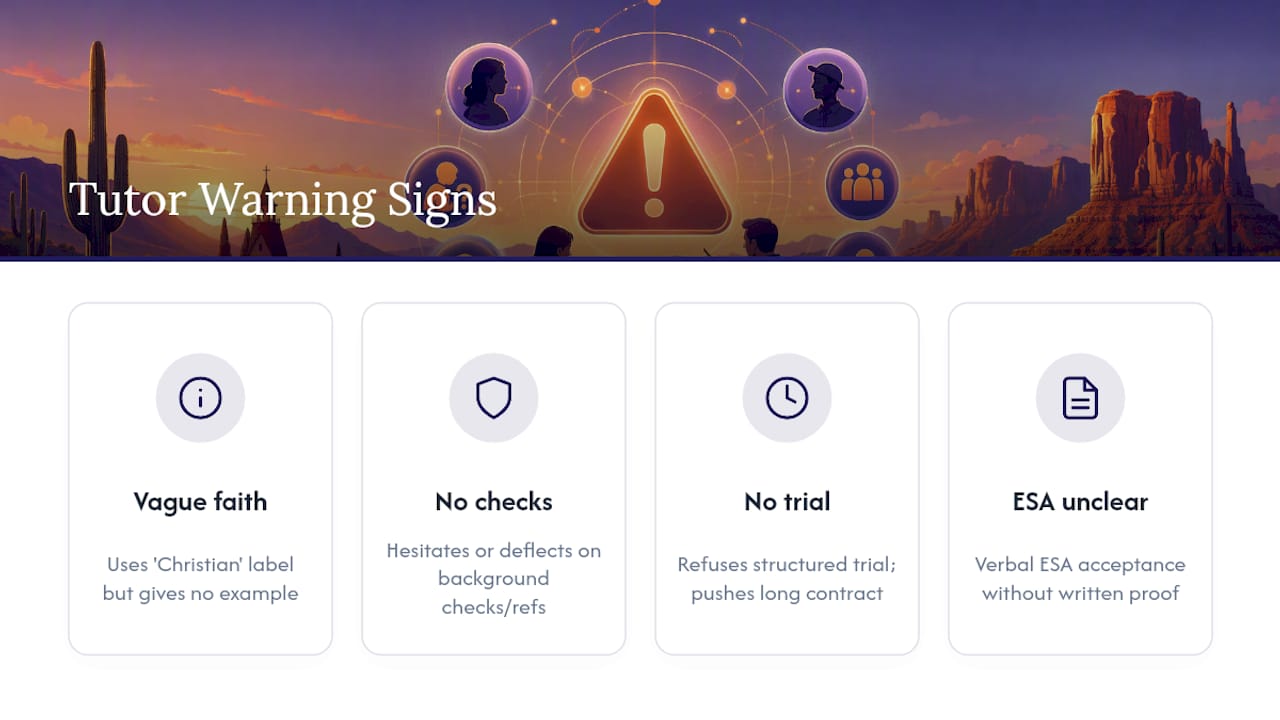
Vague faith language without specifics is the first flag. A tutor who says "I incorporate Christian values" but can't describe a single concrete way that shows up in a lesson may be using the label more as a marketing term than a genuine practice. Ask for an example and listen closely to how specific the answer is.
Reluctance around background checks or references deserves attention too. A tutor who hesitates, deflects, or gets defensive when you ask for either is giving you real information, even if they never say no outright.
Watch for tutors who resist structured trial lessons or push straight to a long-term contract. Confidence in your own teaching is fine; refusing to prove it in a low-stakes trial first is a pattern worth questioning.
Finally, be cautious of any tutor or company that's vague about ESA vendor status or gives you a verbal "yes, we accept that" without documentation. Get vendor confirmation in writing before you count on those funds, every time.
Arizona Homeschool Resources Worth Bookmarking
A handful of pages make the search and setup process considerably faster once you know they exist.
- The Arizona co-op and microschool directory for group-based tutoring and shared-cost enrichment options.
- The ESA guidance page on writing and reading tutors for confirming what scholarship funds typically cover.
- Sol Book Box for families layering early Spanish-language reading material into a bilingual or dual-language homeschool plan.
An Honest Take on the Search for Faith-Aligned Tutoring
Most guides on this topic treat faith fit and academic quality as separate boxes to check. That's backward. The research behind this guide points to something simpler: a tutor's teaching skill and their faith integration aren't two different evaluations, they're one evaluation viewed from two angles, because how someone teaches reveals what they actually believe about a child's mind and character.
The conventional advice, hunt for credentials first, worry about fit later, gets the order wrong for this audience. Arizona families searching for Christian tutors already have plenty of credentialed options available nationally. What's scarce is a tutor who has genuinely taught homeschool families before and understands why your Tuesday looks nothing like a public school Tuesday. Prioritize that experience over a diploma from a prestigious program.
If there's one thing to do differently than most families do: run the trial lesson like an evaluation, not a courtesy. Score it. Compare it. That twenty-minute session tells you more than three phone calls ever will.
— Grant
FAQ
How much do online Christian tutors charge in Arizona?
Rates vary by subject, tutor experience, and specialization, with elementary support typically costing less per hour than advanced subjects like AP courses or specialized reading intervention. Ask each tutor directly for their rate and what it includes, and consider package pricing or group co-op sessions to lower the per-hour cost.
Which online Christian homeschool option is considered the best?
There's no single "best" option for every family; the right fit depends on your child's grade level, curriculum, and how much faith integration you want in daily lessons. A local directory search filtered by subject and tutor type, followed by a scored trial lesson, is the most reliable way to find your family's best fit.
Does Arizona pay parents to homeschool?
Arizona doesn't pay parents directly, but the Empowerment Scholarship Account program provides eligible families with funds that can cover a range of educational expenses, including tutoring from ESA-registered vendors. Confirm a tutor's vendor status in writing before assuming ESA funds will cover their sessions; the ESA guidance page for writing and reading tutors covers what typically qualifies.
What is the best online tutoring company?
The best choice depends on whether you need a national platform for a specialized subject or a locally connected tutor who already understands Arizona homeschool rhythms and ESA paperwork. For most Arizona Christian homeschool families, starting with a local directory built specifically around faith-based, homeschool-friendly options narrows the search faster than a general marketplace.