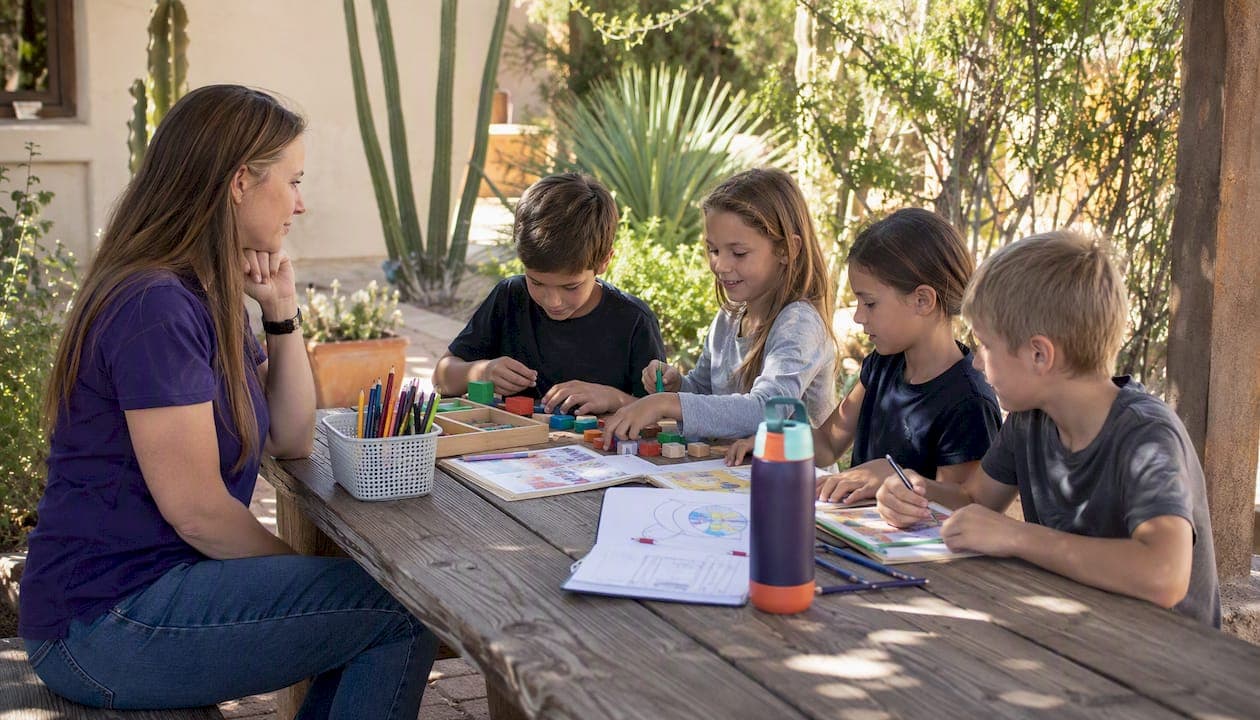
A microschool is a small, professionally facilitated learning environment where a dedicated educator leads a consistent daily program for a handful to a few dozen students. Homeschooling places the parent as the primary teacher, with the family setting the schedule, pace, and curriculum at home. Families who work full-time or want structured peer interaction tend to fit microschools well. Families who want complete curriculum control and maximum schedule flexibility often thrive with homeschooling. Arizona families will find a practical funding example later in this article, because the state's Empowerment Scholarship Account (ESA) program changes the effective cost and legal setup of both models.
Best for a microschool:
- Two working parents who need a reliable daily drop-off structure
- Children who are highly social and need consistent peer interaction
- Families who want professional instruction without the full cost of private school
Best for homeschooling:
- Parents who want to integrate faith deeply into every subject and daily rhythm
- Families with children whose learning needs require a fully customized pace
- Parents with the time and confidence to serve as the primary educator
Table of Contents
- How microschool vs homeschool compare across ten key dimensions
- Ten detailed differences that matter most to families
- Benefits and trade-offs: what each model does best
- How U.S. law treats microschools and homeschooling
- What microschooling and homeschooling actually cost
- Curriculum approaches, assessment, and college prep
- Arizona ESA funding: a practical case study
- How to choose: a practical decision checklist
- Key Takeaways
- What the "microschool" label does not tell you
- Find Christian microschools and co-ops near you in Arizona
- Useful sources for parents
How microschool vs homeschool compare across ten key dimensions
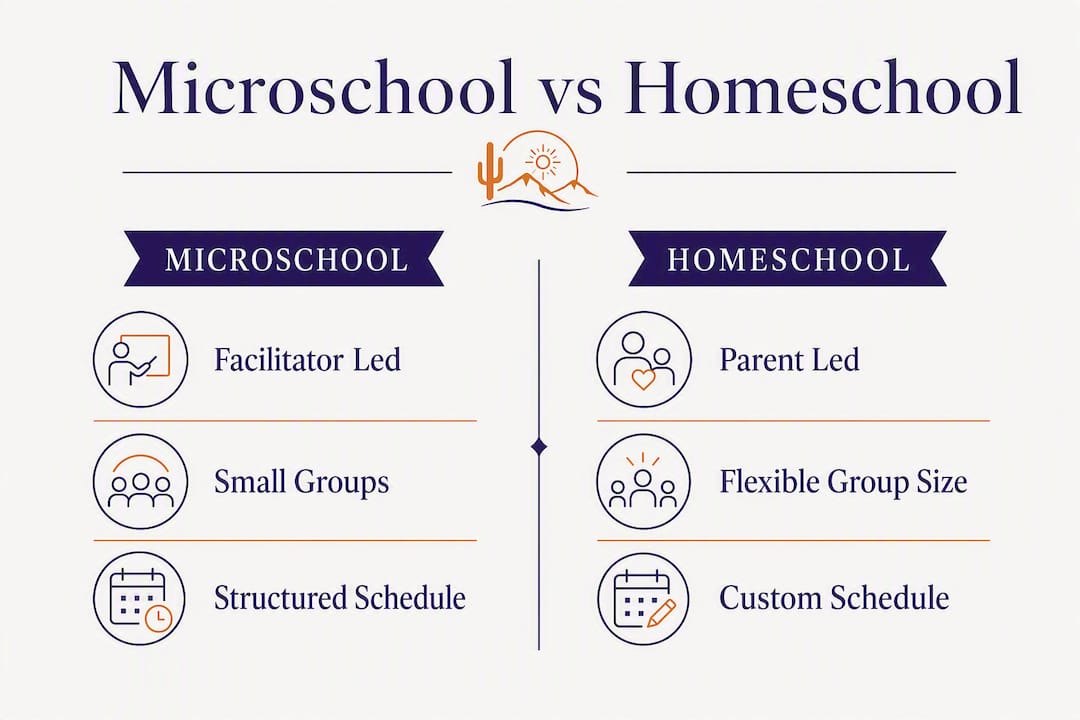
The table below maps the ten dimensions parents most often use when deciding between these two models. Individual programs vary, and state rules affect several of these dimensions, so treat this as a starting framework rather than a universal rule.
| Dimension | Microschool | Homeschool |
|---|---|---|
| Who leads instruction | Hired facilitator or educator | Parent (primary educator) |
| Class size / peer group | Typically a handful to a few dozen students | Siblings or small co-op groups |
| Social opportunities | Built-in daily peer interaction | Requires deliberate planning (co-ops, sports, church groups) |
| Daily structure | Consistent schedule set by the program | Family-defined, flexible |
| Curriculum control | Program sets the curriculum; parent input varies | Parent chooses and adapts all curriculum |
| Cost model | Tuition or program fees (ESA funds may apply) | Family-funded curriculum; lower direct cost |
| Family involvement required | Drop-off model; lower daily teaching burden | High; parent teaches, plans, and administers |
| Location / logistics | Community space, church, or rented venue | Home-based |
| Assessment / records | Program handles; accreditation uncommon | Parent maintains; must meet state requirements |
| Built-in community / supports | Peer group and staff built in | Requires building through co-ops and networks |
State rules and individual program structures vary significantly. Always verify requirements with your state's Department of Education and the specific program you are considering.
Ten detailed differences that matter most to families
The ten dimensions above tell you what differs. This section tells you why it matters and how to test each one before you commit.
1. Who leads instruction
Experts emphasize that the single biggest decision factor is "who leads the learning." In a microschool, a facilitator or guide runs the daily program. In homeschooling, that responsibility falls entirely on the parent. This is not a small distinction. A parent who loves their child deeply but does not enjoy teaching grammar or algebra will feel that gap every single day.
Pro Tip: During a trial day at a microschool, watch how the facilitator handles a student who is stuck. Do they scaffold the problem or simply give the answer? That one interaction tells you more about instructional quality than any brochure.
2. Class size and peer group
Microschools typically enroll anywhere from a handful to several dozen students and often operate out of homes, churches, or rented community spaces. That small size is the point: it allows a facilitator to know each child well. Homeschooling, by contrast, usually means one to three children learning together unless the family joins a co-op.

3. Social opportunities and extracurricular access
A highly social child placed in a solo homeschool environment without a strong co-op network can struggle. Microschools build peer interaction into the daily schedule. Homeschooling families must construct that social layer intentionally, through church groups, community sports, and enrichment programs.
Consider this scenario: A family in the Phoenix metro pulled their daughter from public school because she was bored academically. They started homeschooling, and within three months she was excelling in math but asking every morning when she would see her friends. They eventually added two co-op days per week, which solved the social gap without giving up curriculum control. That hybrid path is worth knowing exists.
4. Daily structure and schedule
Microschools provide a consistent daily routine, which is a genuine advantage for children who need predictability. Homeschooling gives families the freedom to school at 6 AM or 2 PM, to take a week off for a family trip, or to spend three hours on a single science project when curiosity strikes. Associate Professor Kellie Rolstad of the University of Maryland notes that the standard assumption of seven hours a day, five days a week is not a requirement for learning, and microschools often blend structured and unstructured time in ways that reflect that reality.
5. Curriculum control and customization
Homeschooling gives parents complete authority over what is taught, when, and how. A Christ-centered family can weave Scripture into history, science, and literature without asking anyone's permission. Microschools set their own curriculum, and parent input varies widely by program. Some microschools are deeply values-aligned and welcome faith integration; others are secular. Ask directly before enrolling.
Pro Tip: Request a sample scope-and-sequence document and a sample week of lesson plans before committing to any microschool. A program that cannot produce those documents on request is a program that may not have them.
6. Cost model
Homeschooling costs vary based on curriculum choices, co-op fees, and enrichment activities, but the direct instructional cost is generally lower than microschool tuition. Microschools charge program fees that reflect the cost of a professional facilitator and a physical space. In Arizona, ESA funds can offset those costs for eligible families, which changes the comparison significantly. More on that in the Arizona section below.
7. Family time and involvement required
Homeschooling requires families to act as the primary educator and administrator, which means lesson planning, grading, record-keeping, and teaching all fall on the parent. Microschools lower that daily burden considerably. For a single parent or a two-income household, that difference is often the deciding factor.
A working father of two described his family's situation plainly: homeschooling was the right educational philosophy, but the logistics were impossible with two full-time jobs. A three-day microschool combined with two days of home learning gave them the values alignment they wanted without requiring one parent to leave the workforce.
8. Location and logistics
Microschools meet in a physical location, which means commute time, drop-off schedules, and weather days are real considerations. Homeschooling happens at home, which eliminates commute but requires dedicated learning space and the discipline to keep school and home life from blurring together.
9. Assessment, records, and credentialing
Microschools frequently do not seek formal accreditation because they prioritize agility and personalization. That means a microschool diploma may not carry the same automatic recognition as an accredited private school diploma. Homeschooling families maintain their own records and transcripts, which must meet state requirements and, for high school students, be thorough enough to support college applications. Neither model comes with automatic credentialing, so both require deliberate planning for high school and beyond.
10. Built-in community and supports
Microschools are intentionally diverse in model and structure, and one consistent advantage is that community comes built in. Homeschooling families build community through co-ops, church groups, sports leagues, and enrichment programs. That community is often just as rich, but it requires more effort to construct and maintain.
Benefits and trade-offs: what each model does best
Understanding the strengths of each model helps families match their priorities to the right structure.
| Microschool | Homeschool | |
|---|---|---|
| Biggest strength | Professional instruction with built-in peer community | Complete curriculum and schedule control |
| Second strength | Lower daily teaching burden for parents | Deep faith integration across all subjects |
| Third strength | Consistent structure for children who need routine | Flexible pacing for advanced or struggling learners |
| Primary trade-off | Less curriculum control; tuition costs apply | High parental time and energy required daily |
| Second trade-off | Accreditation uncommon; verify transcript policies | Social life requires deliberate construction |
| Third trade-off | Quality varies widely by program and founder | Parent burnout is a real risk without support |
Red flags to watch for in a microschool:
- No written curriculum or assessment policy available on request
- High staff turnover or a founder who cannot explain how learning is documented
- Vague answers about special-education accommodations (most microschools are not required to provide IEP-level services, so families needing those supports must verify capacity directly)
- No clear answer on how the program is registered with the state
Red flags to watch for in a homeschool setup:
- No plan for socialization beyond the immediate family
- Curriculum chosen without considering the child's learning style
- No awareness of state record-keeping requirements
- No support network (co-op, church group, or online community) for the teaching parent
Family logistics, desired social environment, and the parent's willingness to be the primary educator are the strongest predictors of which model will succeed. Prioritize those three factors before comparing curriculum catalogs.
How U.S. law treats microschools and homeschooling
Legal status is where many families get surprised. Many microschools register as homeschool operations or private schools to navigate state regulations, and that registration choice has real consequences for funding eligibility and reporting requirements.
In most U.S. states, a microschool operates under one of two legal structures:
- Private school registration: The program files as a private school, which typically requires meeting state attendance-day minimums, maintaining enrollment records, and in some states passing a fire or health inspection. This structure often makes the program eligible for school-choice funds.
- Homeschool affidavit or declaration: The program operates under each family's individual homeschool filing. This is simpler administratively but may limit access to state school-choice programs.
State-level checklist: what to verify before enrolling
- Does your state require a homeschool affidavit, notice of intent, or registration with the local school district?
- What are the minimum instructional days or hours per year?
- What records must you keep (attendance logs, portfolios, standardized test scores)?
- Are immunization records required, and does the program conduct background checks on staff?
- Is the program registered as a private school or under individual homeschool filings, and does that affect ESA or scholarship fund eligibility?
- Does the program have written policies on special-education accommodations?
Pro Tip: When interviewing a microschool founder, ask these four questions directly: "How is your program registered with the state?" "What records do you provide to families at the end of the year?" "Have all staff passed background checks?" and "What is your process if a child needs learning accommodations?" A founder who answers all four clearly and in writing is a founder running a serious program.
The HSLDA (Home School Legal Defense Association) maintains state-by-state legal summaries for homeschooling families and is a reliable starting point for understanding your state's specific requirements.
What microschooling and homeschooling actually cost
Costs vary by geography, program model, and curriculum choices. The ranges below reflect general patterns across the U.S., not guaranteed figures for any specific program.
Microschool costs (annual, per child):
- Low end: $3,000–$6,000 (small home-based programs, minimal overhead)
- Typical: $8,000–$15,000 (dedicated space, professional facilitator)
- Higher end: $18,000+ (enriched programs with specialists, field trips, or technology integration)
Homeschooling costs (annual, per child):
- Curriculum only: $300–$1,500 depending on approach (boxed curriculum vs. individual resources)
- With co-op fees and enrichment: $2,000–$5,000
- With tutors or online courses added: $4,000–$8,000
Time commitment comparison:
- Microschool parent: drop-off and pickup logistics; occasional volunteer or participation requirements; home review or reading in the evenings
- Homeschool parent: 3–6 hours of active teaching per day for elementary-age children; planning and grading on top of that; administrative record-keeping throughout the year
Microschools can also function as hybrid programs where students attend on-site part-time and learn at home on other days. A common split is three days at the microschool and two days at home, which reduces tuition costs and gives families more curriculum control while preserving the peer community and professional instruction.
Sample hybrid week (3 days microschool / 2 days home):
| Day | Location | Who leads |
|---|---|---|
| Monday | Microschool | Facilitator |
| Tuesday | Home | Parent |
| Wednesday | Microschool | Facilitator |
| Thursday | Home | Parent |
| Friday | Microschool | Facilitator |
Families using hybrid homeschool programs in Arizona often find this split works well with ESA funding, since costs are lower than full-time enrollment and the home days allow deep faith integration.
Curriculum approaches, assessment, and college prep
Both models support a wide range of curricular philosophies. The approach a family or program chooses shapes everything from daily lesson structure to how a high school transcript reads.
Common curricular approaches:
- Classical: Logic, rhetoric, and grammar stages; heavy on primary sources, Latin, and Socratic discussion. Used widely in Christian homeschool communities.
- Mastery-based: Students advance only when they demonstrate proficiency at each level. Common in math-focused programs and some microschools.
- Project-based learning: Students work on extended, real-world projects that integrate multiple subjects. Many microschools favor this approach.
- Online curriculum bundles: Platforms like Acellus, Connections Academy (for public virtual school), or faith-based providers like Abeka and BJU Press offer structured, self-paced courses. Widely used in homeschooling.
- Eclectic: Parents or programs mix approaches by subject, choosing what works best for each child.
For Christian homeschool curriculum options that integrate faith across subjects, Arizonachristianhomeschools maintains a directory of providers used by Arizona families.
Transcript and college prep checklist:
- Maintain a course list with credit hours and grades for every high school year
- Document standardized test scores (SAT, ACT, PSAT, or AP exams) and keep score reports
- Request a written transcript policy from any microschool before high school enrollment
- Ask whether the program issues a diploma and whether that diploma is recognized by in-state colleges
- For dual enrollment or early college courses, confirm the community college's homeschool admission requirements
- Keep a portfolio of student work, especially writing samples and research projects
Microschools that do not seek formal accreditation should provide families with written documentation of learning outcomes, course descriptions, and staff qualifications. Without that documentation, a college admissions office has little to evaluate beyond standardized test scores. Families should request these policies in writing before high school begins, not after.
Arizona ESA funding: a practical case study
Arizona's Empowerment Scholarship Account program is one of the most expansive school-choice funding mechanisms in the United States. Understanding how it interacts with microschool and homeschool registration is practical knowledge for any Arizona family.
Here is how ESA funding typically affects the microschool vs. homeschool decision in Arizona:
- Confirm your child's eligibility. Arizona's ESA program has broad eligibility. Check the Arizona Department of Education's ESA page for current eligibility categories and application steps, since rules are updated periodically.
- Identify how the program is registered. Microschools that accept school-choice funds in Arizona often register as private schools rather than under homeschool affidavits, because state rules limit holding a homeschool affidavit while using ESA funds. Ask the program directly: "Are you registered as a private school or under individual homeschool filings?"
- Review what ESA funds can cover. ESA funds can typically be used for tuition at an approved private school (including many microschools), curriculum purchases, tutoring, and enrichment programs. The Arizona enrichment programs directory on Arizonachristianhomeschools lists providers that note ESA eligibility where applicable.
- Understand the reporting requirements. Families using ESA funds must submit quarterly expense reports and keep receipts. Microschools registered as private schools handle some of this documentation, but the family remains responsible for compliance.
- Confirm the program's eligibility with the state, not just the program. Misclassifying a program or misunderstanding state rules can jeopardize funding eligibility. Contact the Arizona Department of Education directly to confirm that a specific program is approved before spending ESA funds there.
Important: ESA rules change. This overview reflects general patterns as of 2026, but families should verify current requirements with the Arizona Department of Education and consult the program directly before making enrollment decisions. For families outside Arizona, state-level education funding rules vary significantly, and your state's DOE is the authoritative source.
How to choose: a practical decision checklist
Use these questions to move from comparison to decision.
Is a microschool right for your family?
- Do both parents work, or does the family need a reliable daily structure?
- Does your child thrive with consistent peer interaction and a professional instructor?
- Can your family afford tuition, or do you have ESA or scholarship funds available?
- Are you comfortable with the program setting the curriculum and assessment approach?
- Have you visited the program, observed a class, and reviewed written policies?
Is homeschooling right for your family?
- Does at least one parent have the time and confidence to serve as the primary educator?
- Do you want complete control over curriculum, including deep faith integration?
- Do you have or can you build a support network (co-op, church group, online community)?
- Is your child self-motivated enough to work independently for portions of the day?
- Are you prepared to handle record-keeping, transcripts, and state compliance requirements?
Interview questions to ask any microschool founder:
- How is your program registered with the state, and does that affect ESA eligibility?
- What curriculum do you use, and how is it documented for transcripts?
- What are your staff qualifications, and have all staff passed background checks?
- How do you handle a student who is significantly ahead or behind grade level?
- What is your policy for students who need learning accommodations?
- What records will you provide to our family at the end of each year?
- What is your staff turnover history, and who leads the program if the founder is unavailable?
Walk away if you encounter:
- No written curriculum or assessment policy
- Vague or evasive answers about state registration
- Staff who have not passed background checks
- No clear plan for high school transcripts or college preparation
- A founder who discourages parent observation or questions
Key Takeaways
Microschools suit families who need professional daily instruction and built-in peer community; homeschooling suits families who want full curriculum control and are prepared to serve as the primary educator.
| Point | Details |
|---|---|
| Who leads instruction | Microschools use a professional facilitator; homeschooling places the parent as the primary educator every day. |
| Cost and funding | Microschool tuition typically runs higher than homeschool curriculum costs, but Arizona ESA funds can offset microschool fees for eligible families. |
| Legal registration matters | Many microschools register as private schools to accept ESA funds; holding a homeschool affidavit while using ESA funds is restricted in Arizona. |
| Accreditation is not standard | Most microschools do not seek formal accreditation; families must request written transcript and assessment policies before high school enrollment. |
| Arizonachristianhomeschools directory | Arizonachristianhomeschools lists vetted Christian microschools, co-ops, and hybrid programs in Arizona with ESA eligibility notes to help families search locally. |
What the "microschool" label does not tell you
The conventional wisdom in alternative education circles treats "microschool" as a quality signal. It is not. The label describes a size and structure, not a standard. There is no single standard for microschools; quality and focus depend entirely on the founders and the community they serve. A microschool run by a former licensed teacher with a written curriculum, clear assessment policies, and a documented transcript process is a genuinely strong option. A microschool that is essentially an informal playgroup with a tuition invoice is a different thing entirely.
The same caution applies to homeschooling. Families who enter homeschooling with a clear curriculum plan, a support co-op, and realistic expectations about the time commitment tend to thrive. Families who pull their children from school without a plan and assume the freedom will sort itself out often find themselves overwhelmed within a semester.
The honest framing is this: both models can produce exceptional educational outcomes, and both can fail a child if the family does not do the work of evaluating fit before committing. The ten dimensions in this article are not abstract categories. They are the actual questions that determine whether a child will look back on their education as a gift or a gap.
For Arizona families specifically, the ESA program changes the financial math enough that it is worth a phone call to the Arizona Department of Education before ruling out a microschool on cost grounds alone. And for families who want faith woven into every part of the school day, a Christ-centered microschool or a well-supported homeschool co-op can deliver something a conventional private school rarely does: a community that shares your values and your commitment to raising children with both academic excellence and spiritual depth.
Find Christian microschools and co-ops near you in Arizona
Arizonachristianhomeschools is the directory Arizona families use to find vetted, faith-based educational programs across the state, from Phoenix and Tucson to Sedona and the Verde Valley. Rather than searching program by program, families can browse by city, filter by program type, and see which listings note ESA eligibility.
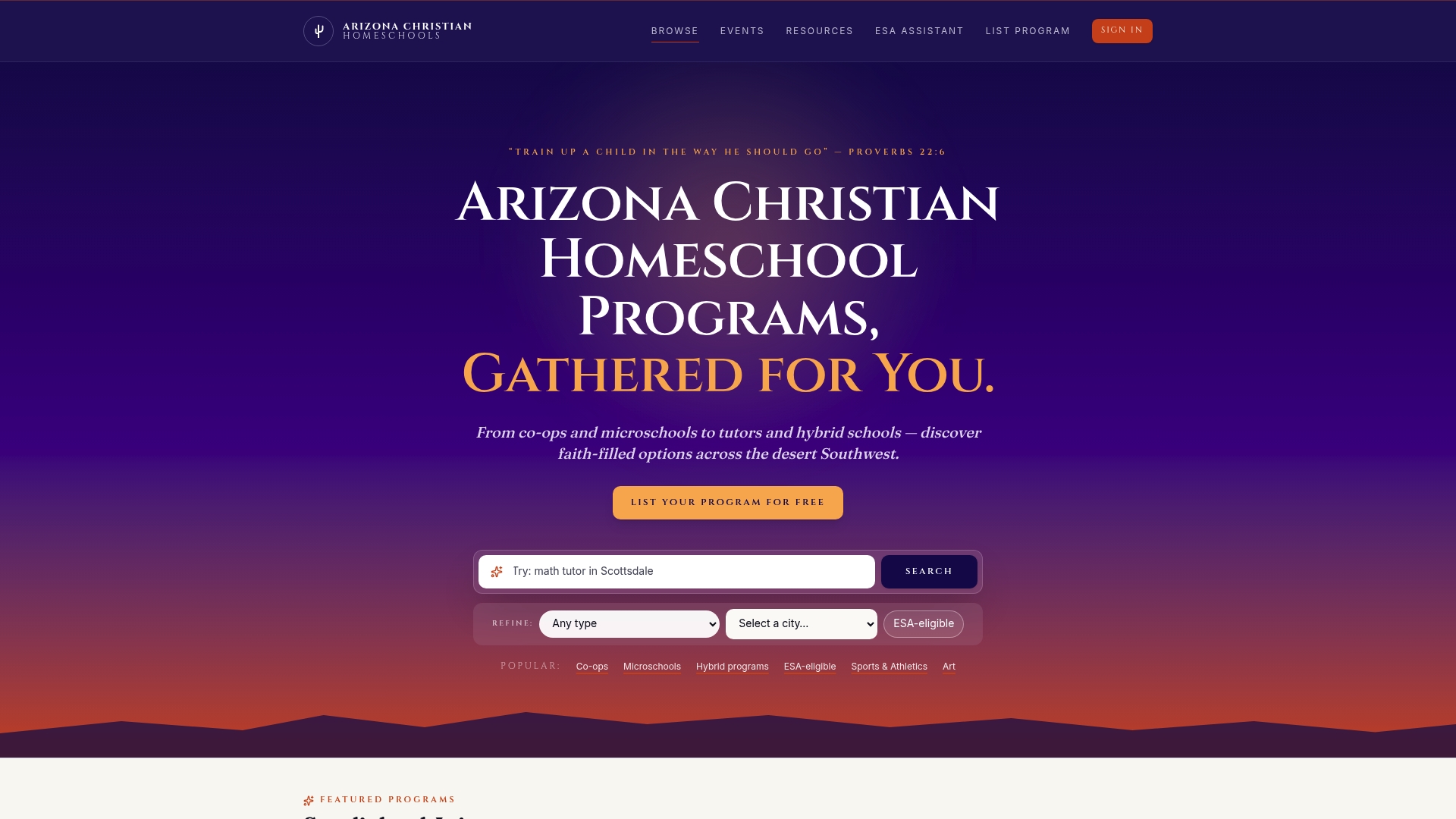
The directory includes Christian microschools, hybrid programs, homeschool co-ops, tutors, enrichment providers, and curriculum resources, all organized to make the search straightforward. ESA eligibility notes appear on listings where programs have confirmed their status, so families using school-choice funds can identify compatible programs quickly.
Directory features at a glance:
- Search by city or region across Arizona
- Filter by program type (microschool, co-op, hybrid, tutor, enrichment)
- ESA eligibility indicators on applicable listings
- Events calendar for community programs and co-op open houses
- Resource guides on homeschooling and ESA funding
Whether your family is ready to enroll or still comparing options, browse Christian co-ops and microschools near you to see what is available in your area. Families in northern Arizona can also explore the Sedona and Verde Valley program listings for localized options with ESA notes.
Useful sources for parents
These resources provide authoritative, up-to-date information on microschooling, homeschooling law, and school-choice funding. State rules change, so always verify current requirements directly with your state's Department of Education.
- National Microschooling Center: Defining Microschools — The clearest published definition of what a microschool is and how programs vary in structure and governance.
- University of Maryland College of Education: What's a Microschool? — Academic perspective on microschool structure, daily schedules, and how they differ from traditional schools.
- RAND Corporation: Microschools as an Emerging Education Model — Systematic research review of the microschooling landscape and what is and is not yet known about academic outcomes.
- GreatSchools: What Is a Microschool? — Parent-facing overview of microschool characteristics and what to look for when evaluating programs.
- HSLDA: State Homeschool Laws — State-by-state legal summaries for homeschooling families; the most reliable starting point for understanding your state's specific requirements.
- Arizona Department of Education: ESA Program — Official source for Arizona Empowerment Scholarship Account eligibility, approved uses, and application process.
- Homeschool Start Guide: Microschool vs Homeschool — Practical breakdown of legal registration differences and how program structure affects funding eligibility.
- Arizonachristianhomeschools: Arizona Christian Microschools Directory — Local directory of Christ-centered microschools and co-ops in Arizona, with ESA eligibility notes and program search by city.
This article provides general educational information, not legal or financial advice. Confirm current state rules, ESA eligibility, and program registration status with the Arizona Department of Education or a qualified education advisor before making enrollment decisions.