
For most children, a mastery-first approach is the better starting point. Two reasons drive that recommendation: learning science consistently shows that deep understanding of a concept before moving on builds a stronger foundation, and mastery programs are generally easier for parents and small-group teachers to implement without specialized training. That said, the spacing effect documented by cognitive scientists and programs like Everyday Mathematics shows that distributed practice across time improves long-term retention in ways that a pure mastery block can miss.
When should you lean toward spiral instead? If your child loses skills noticeably over summer or long breaks, or if you are working with a multi-age group where revisiting topics at increasing depth fits the classroom rhythm, a spiral or hybrid approach often serves better. Arizonachristianhomeschools connects Arizona families with co-ops, tutors, and curriculum options that span both methods, so you can trial either without committing to a full-year purchase.
- Mastery first: best for most learners, especially those who need depth before breadth
- Spiral or hybrid: best for students who forget over breaks, multi-age homeschool groups, or classrooms where distributed review is already built in
- Watch for the "illusion of competence": short-term accuracy after massed practice can look like mastery but fade within weeks
Table of Contents
- How do mastery and spiral math compare side by side?
- What does a spiral math approach actually look like?
- What are the real trade-offs parents need to weigh?
- Which learners and settings does each approach fit best?
- How do you implement mastery, spiral, or a hybrid plan?
- What does learning science say about these two approaches?
- How do you decide which approach fits your child?
- Key Takeaways
- The method matters less than the feedback loop
- Arizona families can find the right math support here
- Useful sources and curriculum pages
How do mastery and spiral math compare side by side?
| Dimension | Mastery approach | Spiral approach |
|---|---|---|
| Pacing / scope | One concept at a time; moves only after demonstrated understanding | Multiple concepts introduced across a year; revisited repeatedly |
| Review frequency | Minimal built-in review; relies on mastery before moving on | Frequent distributed review; prior topics resurface regularly |
| Assessment style | Diagnostic pre-assessment + formative checks + mastery exit criteria | Mixed daily review; progress tracked across revisits |
| Teacher / parent prep time | Lower per unit; higher when corrective instruction is needed | Higher upfront (sequencing); lower daily prep once routine is set |
| Student stress level | Can rise if "mastery" is interpreted as perfection; lower once concept clicks | Lower daily pressure; can frustrate students who want closure |
| Suitability for different learners | Strong for ADHD (shorter focused units), dyslexia (repetition within a concept) | Strong for students who forget over breaks; suits multi-age groups |
| Long-term retention | Requires added spaced review to match spiral retention outcomes | Built-in spacing supports durable retention when sequencing is tight |
Where named programs typically land:
- Singapore Math sits firmly in the mastery column, using a concrete-pictorial-abstract sequence and mastery-based progression before introducing new topics.
- Everyday Mathematics, the most widely studied spiral program, uses a tight spiral design with daily mixed review and multi-year topic revisits
What does a spiral math approach actually look like?
Spiral math, grounded in Jerome Bruner's spiral curriculum theory, introduces a concept at a basic level and then revisits it multiple times across months and years, each time with greater complexity. The goal is reinforcement through spacing: a student encounters addition in first grade, revisits it in the context of larger numbers in second grade, and meets it again embedded in multiplication in third grade.
A spiral week typically includes a daily mixed-review warm-up covering several previously learned skills, a brief lesson introducing or extending a current topic, practice blending new and prior topics, and a weekly cumulative check covering recent content.
The distinction between a "tight" and "loose" spiral matters practically. A tight spiral, like Everyday Mathematics, revisits prior topics every few days and integrates them into new lessons. A loose spiral may not return to a topic for several months, which can leave gaps for students who did not fully grasp it the first time. Homeschool guides consistently note that families who struggle with spiral programs are often using a loose spiral without realizing it.
Saxon Math is one of the most widely used spiral-style programs in Christian homeschool communities. Its daily lesson structure includes a warm-up of previously learned facts, a new concept introduction, and a mixed practice set, which is a textbook tight-spiral format.
Pro Tip: If your child is using a spiral program and seems confused, check whether the program is a tight or loose spiral before switching curricula entirely. Adding a daily five-problem mixed review to a loose spiral often resolves the retention problem without a full curriculum change.
What are the real trade-offs parents need to weigh?
Both approaches have genuine strengths, and both have failure modes that are easy to stumble into.
Mastery strengths and spiral weaknesses:
- Mastery builds deep conceptual understanding before moving on, which reduces the chance of students carrying forward a fragile grasp of foundational skills
- Students often feel more confident because they are not asked to move on until they are ready
- Spiral programs, when loosely designed, can produce the "mile-wide, inch-deep" problem that curriculum researchers at Cambridge Assessment have documented: broad exposure without durable understanding
Spiral strengths and mastery weaknesses:
- Distributed practice in spiral programs leverages the spacing effect, which cognitive science consistently links to better long-term retention
- Spiral programs naturally prevent the forgetting that can occur when a mastery curriculum moves on and never returns to a topic
- Pure mastery programs, without added cumulative review, can create students who perform well on unit tests but struggle on cumulative assessments months later
Common misconceptions worth clearing up:
- "Mastery means perfection." It does not. A reasonable mastery threshold is 80–85% accuracy on a formative check, not 100%. Holding students to perfection before moving on creates anxiety and slows pacing unnecessarily.
- "Spiral is superficial." A well-designed tight spiral is not superficial. The research on Everyday Mathematics shows that students in well-implemented spiral programs can achieve strong conceptual understanding precisely because they encounter concepts repeatedly in new contexts.
Practitioners who have used both approaches in classroom and homeschool settings often note that the curriculum label matters less than implementation quality. A mastery program taught without consistent formative checks is just slow pacing. A spiral program taught without attention to whether students are actually retaining prior topics is just busy work. The method is only as good as the feedback loop built into it.
Operational trade-offs for homeschoolers vs. classroom teachers:
- Homeschool parents using mastery programs spend more time on corrective instruction when a child is stuck, since there is no small-group pull-out option
- Classroom teachers using spiral programs invest more time upfront designing a coherent sequence across the year, but daily lesson prep tends to be lower once the routine is established
Which learners and settings does each approach fit best?
The honest answer is that no single approach fits every child. But certain learner profiles do align more naturally with one method.
Mastery tends to work well for:
- Students with ADHD who benefit from shorter, focused units with a clear endpoint before transitioning to a new concept
- Students with dyslexia or dyscalculia who need more repetition within a single concept before it consolidates
- Fast learners who can move through a concept quickly and benefit from enrichment tasks rather than waiting for the class
- Homeschool families with one or two children where a parent can provide immediate corrective instruction
Spiral tends to work well for:
- Students who lose skills noticeably over summer or long breaks, since regular revisiting prevents that slide
- Multi-age homeschool groups where different children can engage with the same topic at different levels of complexity
- Students who find the pressure of "you must master this before moving on" stressful; spiral's lower-stakes daily review reduces that pressure
- Small co-op classrooms where a teacher needs a structured, self-contained daily routine
Grade-level considerations:
- Early elementary (K–2): Mastery is often preferable because foundational number sense requires deep understanding before abstraction. Rushing through addition and subtraction to cover more topics creates gaps that compound later.
- Late elementary (3–5): A hybrid approach tends to work well. Students have enough foundational knowledge that spaced review of prior skills becomes genuinely useful.
- Middle school (6–8): Spiral review of prior concepts becomes increasingly important as students prepare for algebra. Programs like Art of Problem Solving take a mastery-depth approach suited to students who are mathematically strong and ready for challenge.
For students with ADHD or processing weaknesses, the best practice is not strictly one method or the other. Shorter mastery units with embedded daily micro-reviews, or a mastery foundation with injected spaced retrieval, manages cognitive load more effectively than either pure approach alone.
How do you implement mastery, spiral, or a hybrid plan?
Mastery implementation checklist
- Administer a short diagnostic (5–8 questions) to identify prior knowledge gaps before starting a new unit
- Teach the concept using high-quality initial instruction: concrete materials first, then pictorial, then abstract
- Check for understanding daily with a 3–5 question formative exit ticket
- Identify students who have not met the mastery threshold and provide corrective instruction the next day
- Re-assess with a parallel version of the exit ticket (same skill, different numbers)
- Move students who have mastered the concept to enrichment; continue corrective cycles for others
- Add two to three cumulative mixed-practice problems daily to prevent forgetting of prior units
Spiral implementation checklist
- Map your year's topics and identify which concepts need to be revisited and at what increasing level of complexity
- Build a daily warm-up routine of four to five mixed-review problems covering the past two to four weeks
- Keep new-concept instruction brief (20–30 minutes) so daily review has time in the schedule
- Track which prior topics each student is retaining and which are slipping; adjust review frequency accordingly
- Use a monthly cumulative check to confirm that spaced practice is producing durable retention
Sample weekly schedules
| Day | Homeschool (mastery core + spaced review) | Small co-op / classroom (tight spiral) |
|---|---|---|
| Monday | Diagnostic warm-up + new concept lesson | Mixed review warm-up + new concept intro |
| Tuesday | Guided practice + formative exit ticket (30 min) | Guided practice + 3 mixed-review problems (30 min) |
| Wednesday | Corrective instruction or enrichment (20 min) + 3 cumulative review problems | New concept extension + partner practice (30 min) |
| Thursday | Parallel formative check + concept application | Mixed practice set blending current + 2 prior topics (30 min) |
| Friday | Cumulative mixed quiz + concept wrap-up | Weekly cumulative check + concept consolidation |
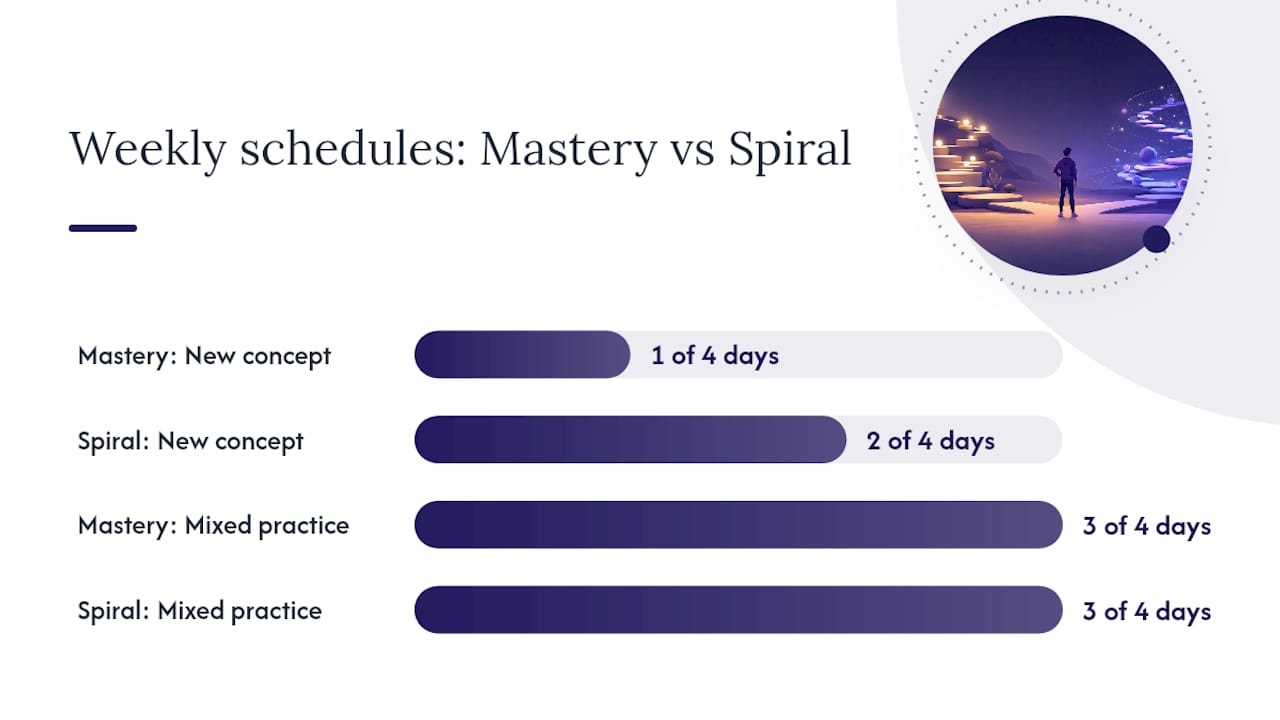
Hybrid model: Teach each concept to mastery (steps 1–6 above), then add the daily cumulative warm-up from the spiral checklist. This preserves the depth advantage of mastery while building in the spacing that prevents forgetting. Most homeschool guides describe this as the most practical model for families managing multiple children.
Pro Tip: Schedule a low-stakes cumulative mixed-practice quiz every two weeks covering the last four to six units. Keep it to ten questions and do not grade it formally. This single habit exposes the illusion of competence, where a student believes they know a concept because they passed the unit test, but cannot recall it three weeks later without prompting.
What does learning science say about these two approaches?
The research base here is clearer than most curriculum debates suggest.
The spacing effect is one of the most replicated findings in cognitive psychology. Distributing practice across time, rather than concentrating it in a single block, consistently produces better long-term retention. Everyday Mathematics was designed explicitly around this principle, and its research page documents that students in well-implemented spiral programs outperform comparable peers on longer-term assessments. This is the core scientific argument for spiral curricula.
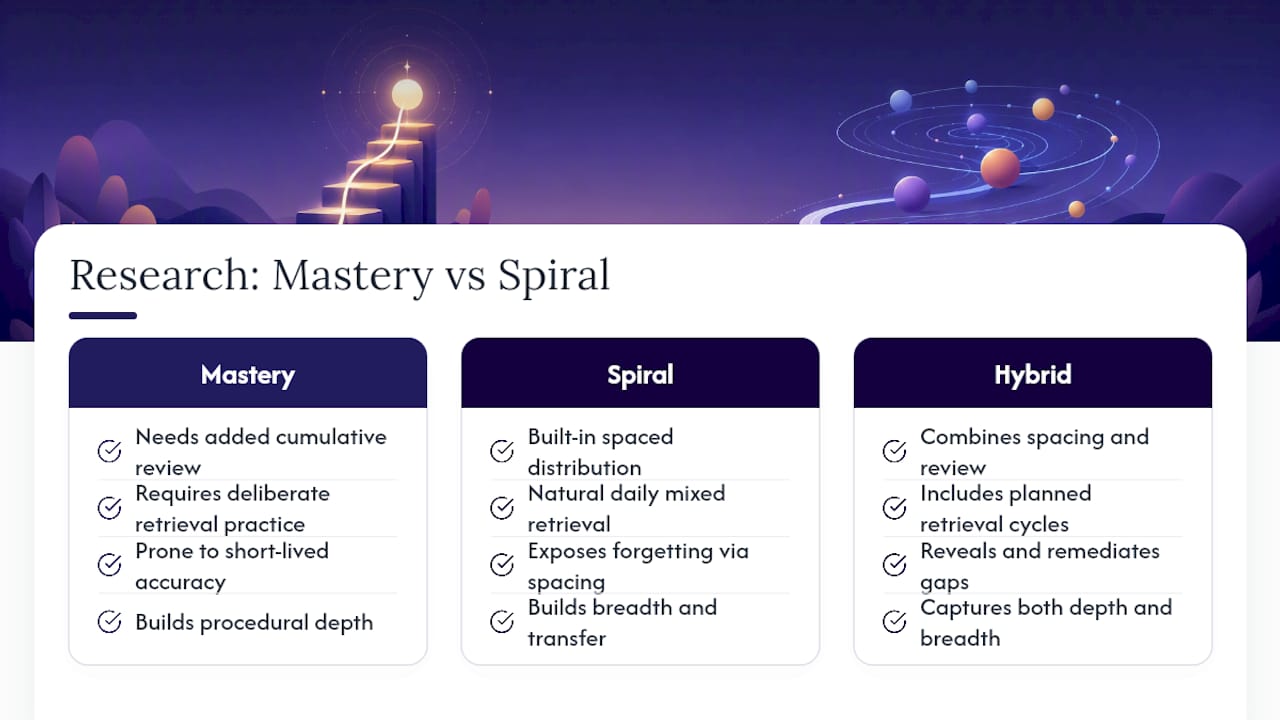
Retrieval practice strengthens memory more than re-reading or re-teaching the same material. Both mastery and spiral programs can incorporate retrieval practice, but spiral programs tend to do it more naturally through daily mixed review. Mastery programs need it added deliberately, which is why the cumulative quiz habit described above is so useful.
The illusion of competence is the most practically important concept for parents to understand. When a student drills a single skill repeatedly over a short period, their accuracy rises quickly. That accuracy can look like mastery. But cognitive scientists and programs like Everyday Mathematics note that this short-term gain often fades within weeks when the student moves on and stops practicing that skill. Spaced, mixed practice exposes this forgetting by asking students to recall skills they have not practiced recently, which reveals what they actually know versus what they temporarily performed well on.
Key finding: Distributed practice across time consistently outperforms massed practice for long-term retention, which is why any mastery program benefits from adding cumulative review, and why a well-sequenced spiral is not just pedagogical variety but a research-backed retention strategy.
The spiral curriculum framework also supports transfer of learning: when students encounter a concept in multiple contexts across time, they are more likely to recognize and apply it in new situations. Mastery programs build depth; spiral programs build breadth and transfer. A hybrid captures both.
Cambridge Assessment's curriculum design research adds a useful caution: spiral models are only as strong as their sequencing. A poorly sequenced spiral revisits topics too infrequently or without genuine increases in complexity, producing the "mile-wide, inch-deep" outcome that critics rightly point to.
How do you decide which approach fits your child?
Work through these questions in order. Your answers will point to a clear starting choice.
- Does your child lose noticeable skills over summer or after a two-week break? If yes, a spiral or hybrid approach is likely better. Built-in distributed review is the most direct solution to skill loss over time.
- Does your child have ADHD, dyslexia, or a processing difference? If yes, start with mastery using shorter units (one to two weeks per concept) and add daily micro-reviews. Pure spiral can overwhelm students who need closure before moving on.
- Does your child get frustrated when asked to move on before feeling confident? Mastery is the better fit. The explicit "you are ready to move on" signal reduces anxiety for students who need that closure.
- Do you have limited daily teaching time (under 45 minutes for math)? A tight spiral with a structured daily routine is often more manageable than running full mastery cycles with corrective instruction.
- Is your child a fast learner who gets bored with extended work on a single concept? Mastery with enrichment tasks, or a hybrid, prevents boredom while maintaining depth.
Decision thresholds:
- Choose mastery if your child is in early elementary, has a processing difference, or needs depth and confidence before moving forward
- Choose spiral if your child forgets over breaks, thrives with variety, or is in a multi-age group where revisiting topics at different levels is practical
- Choose hybrid if neither pure approach fits, or if you want the research benefits of both spacing and depth
Four-to-six week trial:
- Pick one approach and run it for four to six weeks without switching
- Track two things: how the child performs on a short cumulative check at the end of week four (covering all topics since week one), and how they feel about math sessions day to day
- If cumulative retention is strong and daily engagement is positive, continue. If retention is weak, add spaced review regardless of which approach you started with
Key Takeaways
For most students, a mastery-first approach with added cumulative spaced review delivers the strongest combination of deep understanding and long-term retention.
| Point | Details |
|---|---|
| Start with mastery for most learners | Depth-first instruction builds stronger foundations, especially in early elementary grades. |
| Add spaced review to any mastery plan | Two to three cumulative mixed-practice problems daily prevents the forgetting that pure mastery programs miss. |
| Spiral suits students who forget over breaks | Built-in distributed practice in tight spiral programs directly addresses skill loss between terms. |
| Match the approach to the learner profile | ADHD and dyslexia favor shorter mastery units; multi-age groups and retention-challenged students favor spiral or hybrid. |
| Arizonachristianhomeschools | The directory connects Arizona families with co-ops, tutors, and curriculum programs spanning mastery, spiral, and hybrid approaches. |
The method matters less than the feedback loop
The mastery-versus-spiral debate often distracts parents from the variable that actually determines outcomes: whether the child is getting consistent, timely feedback on what they know and what they have forgotten.
A mastery program without formative checks is just slow pacing. A spiral program without attention to whether prior topics are actually sticking is just a busy schedule. The research on spacing and retrieval practice does not declare a winner between the two approaches. It declares a winner for a practice: regularly asking students to recall skills they have not practiced recently, in mixed contexts, under low stakes.
The practical implication is that a parent or teacher who adds a ten-question cumulative quiz every two weeks to any curriculum, mastery or spiral, will likely see better retention outcomes than one who follows either curriculum's default structure without modification. That is not a criticism of either method. It is a recognition that curriculum design and classroom implementation are two different things, and the second one is where most of the outcome variance lives.
For Arizona families, the good news is that both mastery-oriented programs like Singapore Math and spiral-style programs like Saxon Math are well-supported locally, and co-ops and tutors who specialize in each approach are accessible through community directories. The choice between mastery and spiral is real, but it is also recoverable. A four-to-six week trial with honest tracking will tell you more than any comparison article can.
Arizona families can find the right math support here
Choosing between mastery and spiral math is one decision. Finding a co-op, tutor, or curriculum provider who can actually support that choice in your community is another, and that second step is where many families get stuck.
Arizonachristianhomeschools is a free directory built specifically for Christian homeschool families across Arizona, listing co-ops, microschools, tutors, and curriculum programs organized by location and approach. Whether you have decided on a mastery-focused program like Singapore Math or a spiral-style curriculum like Saxon Math, the directory helps you find local support, from a co-op that runs structured math groups to a tutor who specializes in corrective instruction for students who are behind.

Arizona families can also leverage the state's Empowerment Scholarship Account (ESA) for eligible tutoring and curriculum expenses, which makes trialing a new approach significantly more affordable. Browse the homeschool co-ops near you to find a group that matches your chosen method, or explore the full curriculum directory to compare programs side by side.
Useful sources and curriculum pages
Research sources used in this article:
- The Spiral: Why Everyday Mathematics Distributes Learning - Everyday Mathematics
- Math Instruction: Spiral vs. Mastery
- Spiral curriculum - Pressbooks (University of Iowa)
- What is math mastery? Teaching for mastery in math | Third Space Learning
- All About Mastery Vs Spiral Math - Smarter Learning Guide
- Mastery Vs. Spiral Math: Choosing The Right Fit - Clever Homeschool
- Perspectives on curriculum design: comparing the spiral and the network models - Cambridge Assessment
Curriculum pages on Arizonachristianhomeschools:
- Singapore Math — Mastery-oriented; concrete-pictorial-abstract sequence
- Saxon Math — Tight spiral; daily mixed review built in
- Math-U-See — Mastery-oriented; strong for hands-on learners
Read the research sources in the order listed above: spacing effect first, then implementation trade-offs, then the curriculum pages for whichever approach your checklist pointed to.