
Arizona parents can use Empowerment Scholarship Account funds to pay tuition and eligible fees at qualifying private Christian schools. Every Arizona K-12 resident student qualifies, including incoming kindergartners who turn five by January 1 of the contract year. Before signing anything, confirm the specific school's ESA status directly with its office and review how it processes payments through ClassWallet.
TL;DR:
- Most ESA awards in Arizona cover only part of private school tuition, so families must budget for additional out-of-pocket expenses.
- Parents must verify a school's ESA acceptance directly with ADE and confirm its payment process before signing enrollment contracts.
- The application process involves timely submission of documentation, careful management of quarterly disbursements, and awareness of potential delays or denials.
- ESA funds can be used for tuition, textbooks, tutoring, and online courses, but families should review allowable expenses thoroughly beforehand.
- Building a list of ESA-eligible schools and programs via local directories helps families compare options like co-ops, microschools, and hybrid programs aligned with their needs.
Table of Contents
- Quick Checklist: What To Confirm Before You Sign an ESA Contract
- What ESA Funds Can Cover and How ClassWallet Payments Work
- How To Verify a Christian School's ESA Status
- Step-by-Step Application and Timeline for Arizona ESA
- Common Pitfalls and Critical Rules Parents Must Know
- How Arizona Christian Homeschools Helps You Find ESA-Eligible Options
- Christian Private Schools Across Arizona That Accept ESA Funds
- Curricula and Teaching Approaches Common in Arizona's ESA-Eligible Christian Schools
- Religious Instruction Boundaries Under Arizona's ESA Rules
- What Parents Are Responsible for While Using ESA at a Christian School
- Where Standard ESA Advice Falls Short
- Find ESA-Friendly Christian Co-ops and Microschools Near You
- Sources
- FAQ
Quick Checklist: What To Confirm Before You Sign an ESA Contract
Before you commit to a Christian school for your family, work through this short list. It will save you from awkward conversations about money after enrollment is already underway.
- Confirm residency and age. Your child must be an Arizona resident, and kindergarten entrants need to be five years old by January 1 of the contract year, per the Arizona Department of Education's ESA program rules.
- Ask the school directly about ESA acceptance. Not every Christian school handles ClassWallet invoicing the same way, and some require a deposit while payments process.
- Estimate your award versus tuition. ESA amounts vary by grade and need, so calculate the likely gap between your award and the school's published tuition.
- Gather your paperwork early. Proof of residency, enrollment records, and any IEP, MET, or 504 documentation should be ready before you apply, since these support both eligibility and award calculation.
Skipping any one of these steps is how families end up scrambling in August, wondering why a deposit check bounced or why an invoice sat unpaid for six weeks.
What ESA Funds Can Cover and How ClassWallet Payments Work
ESA dollars stretch across a wider range of expenses than most parents expect. Funds can go toward private school tuition, required textbooks and curricula, approved tutoring services, qualifying online course providers, and even community college courses when a student is eligible. The ESA Parent Handbook lays out the full list of allowable vendors and expense categories, and it's worth reading before you assume something is covered.
Money moves on a quarterly schedule. ADE disburses funds into your ClassWallet account four times a year, and from there you either pay approved vendors directly through the platform or submit invoices for reimbursement. Schools that already work with ESA families typically walk you through their own ClassWallet invoicing process during enrollment.
Here's the number that catches most families off guard: ESA awards run close to the state's per-pupil funding amount, typically covering most but not all of the cost, according to the ESA handbook. That means most private Christian school tuition bills leave a balance the family has to cover out of pocket. ADE also confirms that ESA funds are not counted as taxable income to the parent, which at least simplifies one part of the financial picture.
- Private school tuition and required fees
- Textbooks and curriculum materials
- Tutoring services and approved learning programs
- Online accredited courses and eligible college coursework
How To Verify a Christian School's ESA Status
Don't take a school's word for it that it accepts ESA funding. Verify it yourself, in this order:
- Check the ADE participating schools list. The Arizona Department of Education maintains the official record of qualified schools inside the ESA portal, and this is your first stop for confirmation.
- Request the school's written ESA policy. Ask specifically whether it accepts ClassWallet invoices directly, whether a deposit is required while payment processes, and what happens if there's a timing gap between quarters.
- Search a localized directory. A resource like the Arizona Christian Homeschools directory lists co-ops, microschools, tutors, and full-time schools that self-identify as ESA-friendly, often with more day-to-day detail than a state list provides.
- Ask about alternatives if the school isn't listed. Some Christian schools that aren't full ESA vendors still allow ESA dollars for specific services, like approved tutoring or supplemental curriculum, even if full tuition isn't covered.
A school's admissions office should be able to answer these questions without hesitation. If they can't, that's a signal to dig further before you sign a contract or pay a deposit.
Step-by-Step Application and Timeline for Arizona ESA
Getting from "interested" to "funded" involves more waiting than most families expect, so plan around it rather than being surprised by it.
- Apply through the ADE ESA portal. You'll need proof of Arizona residency, identity verification for the applicant, and details about the student's current enrollment status.
- Wait for processing and contract execution. Once approved, you sign a contract with ADE, which is the point your account becomes active and eligible for disbursement.
- Track disbursement timing. Funds land in your ClassWallet account on a quarterly schedule, so coordinate your school's deposit and first tuition payment around that calendar rather than assuming money will be there on day one.
- Monitor your application status in the portal. For operational questions, ADE handles the day-to-day account management, and its ESA support page is the right first contact.
- Prepare for a possible appeal. If ADE denies or adjusts your award and you disagree, the State Board of Education processes appeals of administrative decisions.
Pro Tip: Screenshot every portal confirmation and save every ADE email with a subject line or reference number. If you ever need to appeal a decision, that paper trail is what makes your case credible.
Common Pitfalls and Critical Rules Parents Must Know
A few mistakes show up again and again in ESA applications, and most are avoidable with a little foresight.
- Don't stack ESA with STO tax-credit scholarships. The two programs are incompatible for the same student in the same fiscal year, and accepting an ESA contract after already receiving STO funds can mean returning that scholarship money.
- Late ClassWallet invoices delay everything. If invoices aren't submitted on time, payments stall, and the school still expects tuition. Parents remain financially responsible for any unpaid balance.
- Documentation errors are the most common denial trigger. Incomplete residency proof, mismatched enrollment records, or missing IEP/MET paperwork routinely slow applications down.
- Appeals go to the State Board, not ADE. Save every portal communication, since the Board relies on that history when reviewing a disputed decision.
How Arizona Christian Homeschools Helps You Find ESA-Eligible Options
There are online directories built specifically for families navigating this exact search: co-ops, microschools, hybrid programs, tutors, and full-time private Christian schools across the state. Listings may flag ESA eligibility where it's known, along with whether a program is set up to work with ClassWallet.
You can filter by program type and city, whether you're looking for a small Sedona co-op or a full-time K-12 school in the East Valley. The directory is refreshed with current 2026 guides as programs update their ESA participation, and this article's analysis comes from Grant, who covers Arizona homeschool funding and program trends for the site.

Christian Private Schools Across Arizona That Accept ESA Funds
Christian private schools that participate in the ESA program range widely in size and character, and there's no single template. Some are small, single-campus schools serving a few hundred students with deep denominational roots in a specific tradition, whether Baptist, nondenominational evangelical, Lutheran, or Catholic. Others are larger K-12 institutions with several hundred to over a thousand students spread across multiple grade divisions.
Geographic distribution follows population, which means the Phoenix metro area, including the East Valley and West Valley, along with Tucson, hosts the highest concentration of ESA-participating Christian schools. Smaller communities in places like Prescott, Flagstaff, and Sedona tend to have fewer full-time options but often make up for it with active co-ops and hybrid programs that also accept ESA funds for tutoring or partial enrollment.
Denominational diversity matters here because it shapes more than Sunday chapel. It influences the statement of faith families sign, the curriculum publishers a school partners with, and sometimes even which extracurriculars are offered. A school's size also affects logistics: a large K-12 campus usually has a dedicated financial aid or ESA coordinator on staff, while a smaller school might route every ESA question through the same administrator who also teaches a class. Neither situation disqualifies a school, but it does change what kind of response time you should expect when you call with a billing question.
Curricula and Teaching Approaches Common in Arizona's ESA-Eligible Christian Schools
Most ESA-eligible Christian schools in Arizona build their academic program around a traditional classroom model layered with a biblical worldview integrated into core subjects, not siloed into a single religion class. History, literature, and science courses often reference scripture directly rather than treating faith as a separate elective.
Curriculum choices vary by school but tend to cluster around a handful of familiar names in Christian education, including Abeka, BJU Press, and Christian Light Education for schools with a more independent-study bent. Classical Christian education, built on the trivium model of grammar, logic, and rhetoric stages, has also grown in popularity among Arizona schools over the past decade, particularly in newer microschools and hybrid programs.
Hybrid schedules are common too. A student might attend a physical campus three or four days a week and complete the rest through an accredited online provider, a structure that fits neatly with ESA's flexibility since funds can cover both the in-person tuition and the online course fees. Families choosing between these approaches should think less about which curriculum is "best" and more about which teaching style matches how their child actually learns, since a rigorous classical program and a project-based hybrid model can produce equally strong outcomes for different kids.
Religious Instruction Boundaries Under Arizona's ESA Rules
ESA funding does not require a Christian school to alter its religious instruction, chapel requirements, or statement of faith to participate. Arizona's program is built around parental choice, which means the state doesn't dictate curriculum content or restrict how much faith-based instruction a private school includes.
That said, there are practical limitations worth understanding. ESA funds cover tuition and instructional costs, but families should confirm with each school whether certain fees, like building funds, capital campaigns, or optional retreats, fall outside what ADE classifies as an eligible educational expense. Schools themselves set admissions policies, including whether a family must agree to a statement of faith, and ESA eligibility does not override those private admissions standards.
It's also worth noting that accepting ESA funds doesn't turn a private Christian school into a public one. The school retains its religious character and independence; the state's role is limited to verifying that the family and expenses meet program rules. Admissions offices at schools like Northwest Christian School consistently remind families that ESA funding is a financial tool, not a substitute for evaluating whether a school's mission, accreditation, and academic culture actually fit their child.
What Parents Are Responsible for While Using ESA at a Christian School
Accepting ESA funds comes with ongoing obligations, not a one-time application and then silence. Parents must actively manage their ClassWallet account, which means submitting invoices promptly, uploading receipts when required, and tracking whether each quarterly disbursement has actually posted.
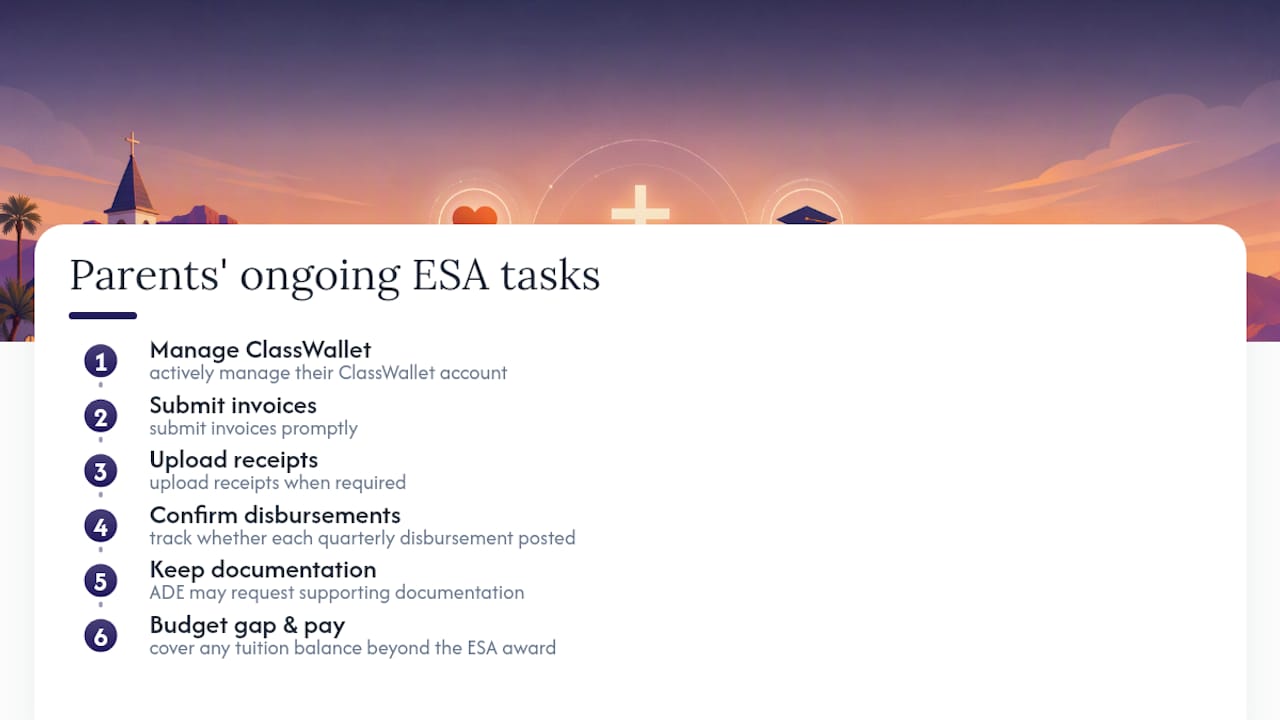
Recordkeeping matters more than most families expect going in. ADE can request documentation supporting how funds were spent, and a disorganized paper trail turns a routine check into a stressful scramble. Parents also carry the responsibility of covering any tuition balance beyond the ESA award. Since most awards fall short of full private school tuition, budgeting for that gap is part of the ongoing commitment, not a one-time calculation at signup.
Coordination with the school itself is another ongoing task. Some Christian schools require proof of an active, signed ESA contract before a student can start attending, while others allow enrollment to begin with the expectation that parents cover initial costs until the first ClassWallet disbursement arrives. Knowing which policy your school follows before the first day of class prevents a lot of unnecessary stress for everyone involved.
Where Standard ESA Advice Falls Short
Most guidance on Arizona's ESA program treats eligibility and enrollment like a single event: apply, get approved, enroll. That framing undersells how much ongoing management the program actually requires, particularly for families choosing private Christian schools where tuition regularly exceeds the award.
The bigger blind spot is treating ESA acceptance as a school's most important quality. It isn't. A school that accepts ClassWallet payments but has a mediocre academic program, weak accreditation, or a mismatched statement of faith isn't a good choice just because the paperwork is easy. Families should vet a Christian school the way they'd vet any major decision, on mission fit, teaching approach, and academic rigor, and treat ESA compatibility as one filter among several, not the deciding one.
If there's one priority to fix first, it's sequencing. Confirm a school's written ESA policy and payment logistics before you fall in love with the campus tour. Too many families reverse that order, get emotionally invested, and then discover a billing mismatch that could have been resolved with one phone call in week one.
— Grant
Find ESA-Friendly Christian Co-ops and Microschools Near You
Arizona Christian Homeschools gives you something the state's official ESA portal doesn't: a searchable directory built around real, local options, not just a compliance list. Search by city, program type, and grade level to find Christian co-ops, microschools, and hybrid programs that families have flagged as ESA-friendly and ClassWallet-ready.
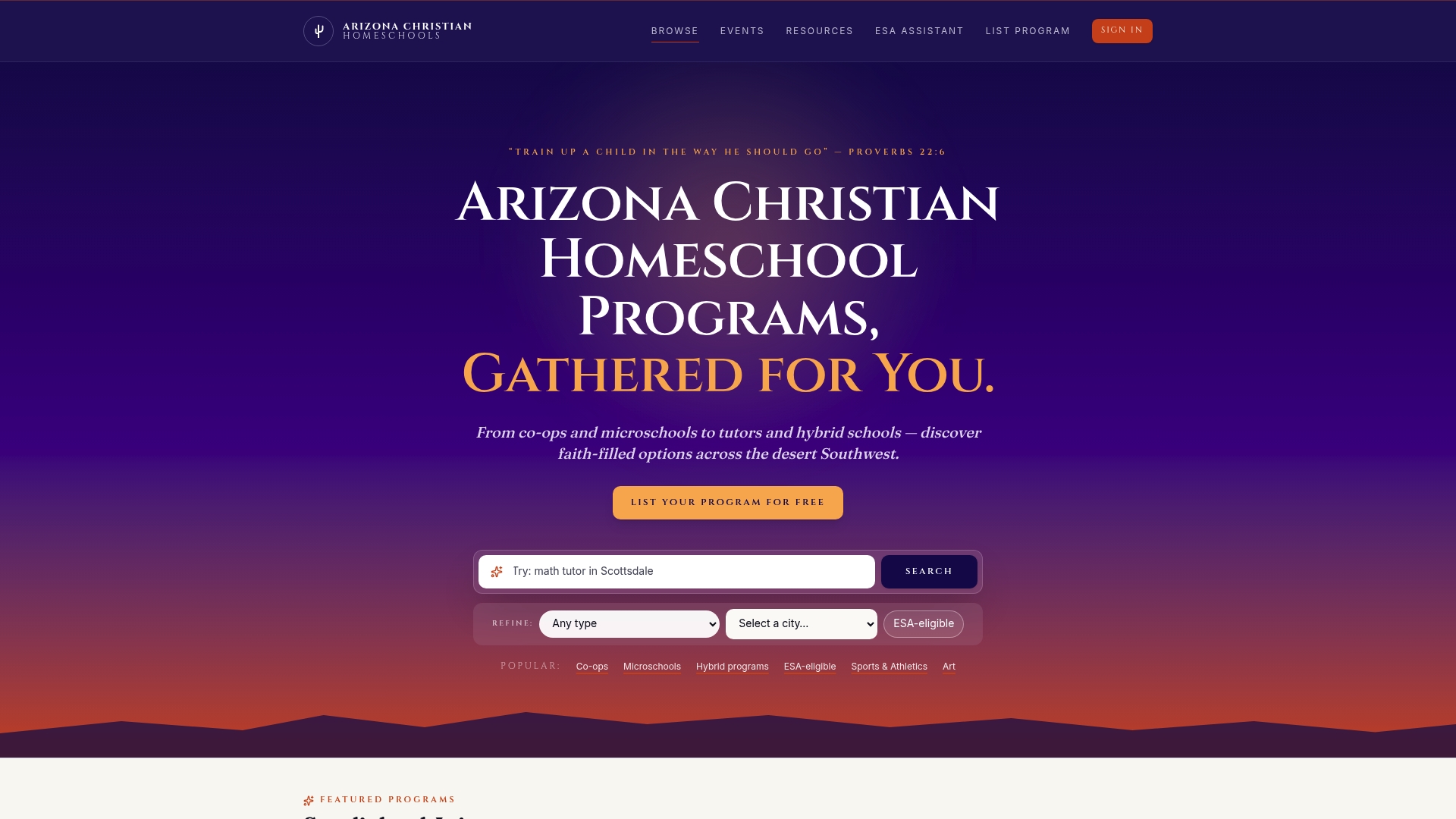
Listings note where a program accepts ESA payments directly and where you'll need to submit reimbursement through ClassWallet, so you're not guessing before you make a call. If you're weighing a full-time private school against a co-op or hybrid model, browse the homeschool co-op directory to compare options by location and see which programs fit your family's schedule and budget. Start your search today and narrow down a shortlist before your next ESA quarterly disbursement lands.
Sources
- Empowerment Scholarship Account | Arizona Department of Education
- Azoca
- Empowerment Scholarship Account (ESA) program | Arizona State Board of Education
FAQ
Which Online Schools in Arizona Are ESA Approved?
Several accredited online providers participate in Arizona's ESA program, and the current qualified list is maintained through the ADE ESA portal rather than any third-party site, so always confirm directly there before enrolling.
Who Is Eligible for ESA in Arizona?
Every Arizona K-12 resident student qualifies for the ESA program, including kindergarten entrants who turn five by January 1 of the contract year, per ADE's program rules.
Who Are the ESA-Approved Vendors in Arizona?
Approved vendors include private schools, tutors, curriculum publishers, and online course providers that meet ADE's criteria, and the full current list is published through the ESA Parent Handbook and portal.
Can ESA Pay for Private School?
Yes. ESA funds can pay tuition and required fees at qualifying private Christian schools, though awards typically cover only part of total tuition, leaving families responsible for the remaining balance.