
Yes, you can still apply for the Arizona Empowerment Scholarship Account program right now. There is no single statewide deadline you need to race against. What actually controls your family's funding is the quarter in which your ESA contract gets signed, not a fixed date on a calendar.
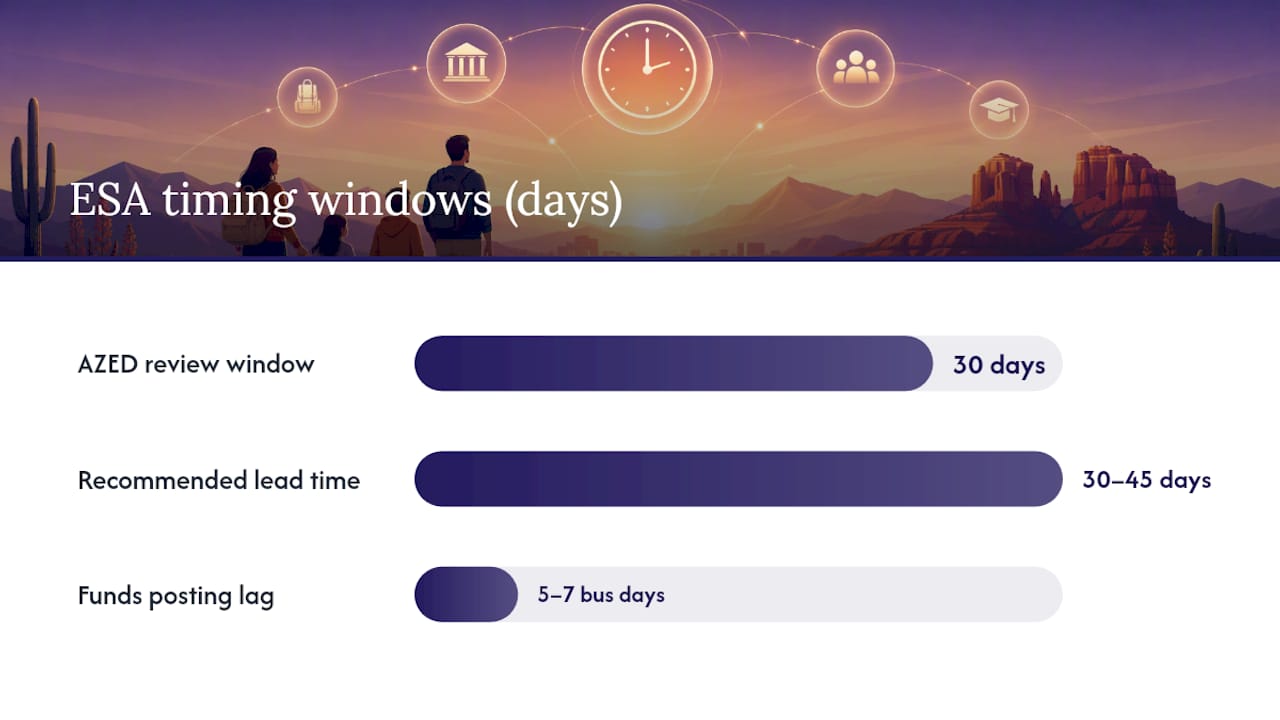
That distinction trips up a lot of parents searching for "ESA deadlines 2026 Arizona," because most state programs do run on hard cutoff dates. Arizona's ESA works differently. The Arizona Department of Education (AZED) accepts applications year-round for the 2026-2027 school year, and once your application is complete, AZED reviews it within 30 days and emails you a final determination. Funding then begins in whatever quarter your contract is actually signed, whether that's July, October, January, or April.
Here's what to do this week if you're starting the process:
- Confirm your child meets the residency and age requirements before you touch the application.
- Gather a full-color image of the birth certificate and a current Arizona residency document.
- Submit a genuinely complete application, since an incomplete one won't start the 30-day review clock.
The ESA Parent Handbook and AZED's own ESA support page are the two documents worth bookmarking before you begin. Everything else in this guide builds on what those two sources say.
Key Takeaways
Arizona ESA applications are accepted year-round, but funding always starts the quarter your contract is signed, not the quarter you applied.
| Point | Details |
|---|---|
| No fixed deadline | Applications are accepted year-round, so there is no single statewide cutoff date to hit. |
| Quarter signing rule | Funding begins the quarter your contract is signed, so timing near a quarter boundary matters. |
| Submit complete applications | A complete application starts AZED's 30-day review clock; missing documents delay everything. |
| Watch the posting lag | Existing accounts see funds requested between the 15th and 30th, with a 5 to 7 business day deposit lag. |
| Use a local directory | Arizona Christian Homeschools helps families find ESA-friendly co-ops and hybrid programs once funding is approved. |
Table of Contents
- Arizona ESA 2026 Application Dates and Funding Quarters
- Who Qualifies for Arizona ESA in the 2026-2027 School Year?
- What Documents Do You Need for Your 2026 ESA Application?
- How to Apply for Arizona ESA: Step by Step
- How Long Does Arizona ESA Approval Take?
- What Happens After ESA Approval: Funds and Disbursement
- How Arizona Homeschool Families Actually Use ESA Funds
- A Local Perspective on Arizona's ESA Timeline
- Ready to Put Your ESA Funds to Work?
- Where to Find Official Arizona ESA Information
- Sources
- FAQ
Arizona ESA 2026 Application Dates and Funding Quarters
Arizona's fiscal year splits ESA funding into four quarters, and the date you land in one of them determines when money starts moving into your account. The ESA Support page lays out the exact ranges:
| Quarter | Date Range | Example |
|---|---|---|
| Q1 | July 1 to September 30 | Contract signed August 12 → funding begins Q1 |
| Q2 | October 1 to December | Contract signed November 3 → funding begins Q2 |
| Q3 | January 1 to March | Contract signed February 20 → funding begins Q3 |
| Q4 | April 1 to June 30 | Contract signed May 5 → funding begins Q4 |
The rule is simple even though the consequences aren't always obvious: funding begins the quarter your contract is signed, not the quarter you submitted your application. If your application clears review on September 25 and you sign the contract October 2, you've just slipped from Q1 into Q2. That's not a penalty AZED is imposing on you. It's just how the calendar works, and it's why families who apply near a quarter boundary sometimes get surprised by a delayed start.
For families with an existing ESA account, the timing works a bit differently. The department requests funds for existing accounts between the 15th and 30th of the month each quarter, and there's typically a 5 to 7 business day lag between that request and when money actually posts to your account.
Pro Tip: If you want funding to start in a specific quarter, submit your complete application at least 30 to 45 days before that quarter ends. That gives AZED's 30-day review window enough runway to finish and gets your contract signed before the deadline slides you into the next quarter.
Who Qualifies for Arizona ESA in the 2026-2027 School Year?
Eligibility for the Arizona ESA program comes down to a handful of concrete requirements, and most families can check their own status against this list in a few minutes.
- Both the student and the applicant must be Arizona residents.
- A kindergarten entrant must be at least five years old as of January 1 of the contract year.
- The applicant is typically the student's legal parent or guardian.
- Students entering any grade K through 12 generally qualify, along with a preschool category for students with qualifying disabilities.
- The applicant must be listed on the student's birth certificate, or must provide legal documentation when names don't match.
Picture two common cases. A rising kindergartner who turns five on December 20 clears the age bar with room to spare, since the cutoff is January 1 of the contract year. A student with a documented disability entering preschool falls under the preschool disabilities category, which opens ESA eligibility earlier than the standard kindergarten track.
Name mismatches are worth flagging early, since they're one of the more common reasons applications stall. If a parent's last name changed after a divorce or remarriage and doesn't match the name on the child's birth certificate, that gap needs to be closed with legal documentation at the time of submission. Full details on age cutoffs, residency proof, and disability categories live on our Arizona ESA eligibility page.
What Documents Do You Need for Your 2026 ESA Application?
Getting your paperwork right the first time is the single biggest lever you have over how fast your application moves. AZED's eligibility and application page treats certain documents as non-negotiable and others as flexible, and knowing which is which saves you a round of back-and-forth.
Primary documents (required for every applicant):
- A full-color image of the student's birth certificate. A black-and-white photocopy or a phone photo with glare typically won't pass review.
- Proof that the applicant is named on the birth certificate, or legal documentation (adoption decree, custody order, name-change certificate) when the names differ.
- Proof of Arizona residency for both the student and the applicant.
Secondary or situational documents:
- Legal guardianship paperwork, if the applicant isn't a biological or adoptive parent.
- Disability documentation, for students applying under the preschool disabilities category.
- An affidavit option in place of standard residency proof, for families in transitional housing situations, per AZED's checklist.
Three things routinely knock an otherwise good application back to incomplete status: a name on the application that doesn't match the birth certificate exactly, a scanned document that's too blurry or dark to read, and a missing signature on one of the required forms. Before you hit submit, run through this quick check: names match across every document, every file opens cleanly and is legible, every required signature line is filled in, and every upload is a full-color image rather than a grayscale scan.
Pro Tip: Name your files clearly before uploading, like "BirthCertificate_LastName.pdf" instead of "IMG_4021.jpg." It sounds minor, but reviewers moving through hundreds of applications process clearly labeled files faster, and it reduces the chance yours gets flagged for a manual double-check.
How to Apply for Arizona ESA: Step by Step
The application itself moves through a predictable sequence, and knowing the order ahead of time keeps you from backtracking.
- Create an account on the ESA portal using a working email address you check regularly.
- Complete the application fields, including student information, residency details, and applicant identity.
- Upload every required document in full color, matching names exactly across each file.
- Submit and monitor your email for AZED communications, including requests for additional information.
- Sign the contract once you receive an approval determination, which locks in your funding quarter.
A "complete application" means every required field and document is present and legible on first submission. That distinction matters because AZED's 30-day review clock only starts running once the application is genuinely complete. Submit something with a missing signature or a mismatched name, and you're not looking at a 30-day wait. You're looking at a request for corrections first, and the clock resets from there.
Families who treat the application as two separate clocks, the quarter you want funding to start and the 30-day review window AZED needs to process a complete file, tend to plan backward from their target quarter and submit early enough to hit it. Families who treat it as one deadline tend to get surprised.
If you get stuck at any point, AZED's ESA service center and the ESA portal are your two direct lines of help. For a walkthrough with more visual detail, our step-by-step Arizona ESA application guide covers the portal screens themselves.
Pro Tip: Before you upload anything, open every PDF once to confirm it's not corrupted, and double check that the name on your application matches your ID exactly, down to middle initials. Both are quick five-minute checks that prevent a two-week delay.
How Long Does Arizona ESA Approval Take?
Once your application is genuinely complete, AZED commits to reviewing it within 30 days and sending your final determination by email. During that window, AZED generally can't tell you whether you're leaning toward approval or denial, since the review is still in progress.
If AZED needs more documentation partway through review, here's how to handle it without losing time:
- Log back into the portal and upload the requested documents as soon as you have them, rather than waiting to gather everything at once.
- Understand that requesting additional documents can extend your timeline, so faster turnaround on your end keeps things moving.
- Don't let the application sit incomplete for too long. Extended inactivity can result in the application being closed, which means starting over.
- Check your email daily during the review period, including your spam or junk folder, since AZED's guidance specifically flags this as a common reason families miss important updates.
A surprising number of approval delays trace back to a single missed email sitting in a spam filter, not to any actual problem with the application itself.
If you need a status update or hit a snag with the portal, the ESA service center phone line and the ESA support page are your official channels. Our ESA assistant tool can also help you think through documentation questions before you reach out to the state.
Pro Tip: Compress large PDF scans before uploading them, especially birth certificate images, since oversized files are one of the most common causes of a stalled or failed upload on state portals.
What Happens After ESA Approval: Funds and Disbursement
Approval and access to money aren't the same moment, and understanding the gap between them helps you time purchases correctly.
| Stage | Timing | What It Means |
|---|---|---|
| Department request window | 15th to 30th of the month, each quarter | This is when AZED formally requests quarterly funds for existing accounts |
| Posting lag | 5 to 7 business days after request | Actual deposit into your account or card happens after this lag |
| First-time approval | Tied to contract signing date | Your first deposit follows the same request-and-lag pattern, starting in your signed quarter |
For families with an already-active ESA account, this cycle repeats every quarter. The department requests funds during that 15th-to-30th window, and you should expect the deposit roughly a week later rather than instantly. For a first-time approval, the same request-and-lag pattern applies, but it starts from whichever quarter your contract falls into.
Once funds post, the Parent Handbook confirms you can begin using the debit card or requesting vendor payments for qualifying educational expenses. A few timing strategies make this smoother:
- Hold off on large curriculum or tuition purchases until you've confirmed funds have actually posted, not just that they were requested.
- If you're enrolling in a co-op or hybrid program with a subscription-style payment, try to align the start date with your quarter's funding window.
- Build in a buffer week around the 15th to 30th request period rather than assuming money will be available the moment the quarter begins.
For a closer look at how much families typically receive each quarter, see our breakdown of Arizona ESA funding amounts.
How Arizona Homeschool Families Actually Use ESA Funds
Most families searching for ESA deadlines aren't doing it out of curiosity. They're trying to line up funding with a specific homeschool decision, and a few patterns show up again and again.
Curriculum purchases. Parents building a full-year curriculum plan often time their application to land funding before the fall semester, since ESA covers a wide range of approved materials. Our ESA-approved curriculum guide walks through what qualifies.

Co-op tuition. Families joining a Christian homeschool co-op frequently use ESA funds to cover tuition and class fees, which makes aligning the co-op's payment schedule with your funding quarter worth planning around.
Hybrid program fees. Parents enrolling in a hybrid program that meets a few days a week often need funds available before the program's enrollment deadline, which is another reason to submit early rather than waiting until a semester is about to start.
Regardless of which category you're spending in, the Parent Handbook is clear that documentation matters. Keep receipts, invoices, and any correspondence tied to ESA purchases, since the department may ask for records during a review. A simple folder system, organized by quarter, saves a lot of scrambling later.
A few best practices worth adopting from the start:
- Keep every ESA-related receipt in one dedicated folder, digital or physical, sorted by quarter.
- Confirm a vendor or provider is ESA-eligible before paying, rather than after.
- Cross-check big purchases against the approved purchases guide if you're unsure.
- If you're weighing an advanced track like an IB-style curriculum, resources like Tiber Tutor's homeschooling guide can help you think through the academic side before you commit ESA funds to it.
A Local Perspective on Arizona's ESA Timeline
What strikes me most about Arizona's ESA program is how much anxiety the word "deadline" creates for parents when the real risk isn't a missed cutoff at all. It's inertia. Families wait for a "better time" to apply, not realizing that every week of delay can push their funding start back an entire quarter. The program rewards families who move early in a window, not families who scramble at the end of one.
Arizona Christian Homeschools exists because so many families need a local, trustworthy starting point once they've cleared the ESA paperwork and are ready to actually build a homeschool plan. Our directory helps you find co-ops, hybrid programs, and vetted providers across the state, all in one place. For anything specific to ESA policy itself, always defer to AZED's official guidance and the ESA service center, since they're the final word on your individual case.
Ready to Put Your ESA Funds to Work?
Once your ESA application is moving through review, the next real decision is where those funds actually go. Arizona Christian Homeschools gives you a faster path than searching program by program on your own. Instead of cold-calling co-ops or scrolling through scattered Facebook groups to find ESA-friendly options, you get one localized directory built specifically around Arizona families using ESA funding for faith-based education.

If you're weighing a hybrid schedule that combines in-person and at-home learning, our hybrid homeschool programs directory lets you compare local options built around ESA-eligible tuition structures. If your family is leaning toward a co-op environment for community and shared instruction, browse our Christian co-op directory to find groups near you. Either page gives you a concrete next step you can take today, while your application is still working its way through AZED's review.
Where to Find Official Arizona ESA Information
For anything policy-related, go straight to the source rather than relying on secondhand summaries.
- The ESA landing page confirms current application availability for the 2026-2027 school year.
- The Eligibility Requirements & Application page covers residency, age, and documentation rules in full.
- The ESA Support page explains quarterly funding dates and processing policy.
- The ESA Parent Handbook (PDF) is the authoritative document for funding schedules and disbursement rules.
These pages, along with the official ESA portal, are the canonical sources for policy updates. This guide reflects that information, but AZED's own pages take precedence if anything changes mid-year.
This article is general information, not a substitute for advice from a qualified financial advisor. Consult a qualified financial professional about your own circumstances before acting on anything here.
Sources
- ESA Support
- Eligibility Requirements & Application
- ESA 2025-2026 Handbook (PDF)
- Empowerment Scholarship Account | Department of Education
FAQ
When Can I Apply for ESA for the 2026-2027 School Year?
You can apply right now. AZED accepts ESA applications year-round for the 2026-2027 school year, with no single deadline you need to meet.
What Is the Arizona ESA Payment Schedule?
Funding is split into four quarters (July to September, October to December, January to March, and April to June), and your funding begins in whichever quarter your contract is signed.
How Long Does It Take to Get Approved for ESA in Arizona?
AZED reviews a complete application within 30 days and sends the final determination by email. Incomplete applications take longer, since the 30-day clock doesn't start until all required documents are in.
How Do I Apply for ESA in Arizona?
Create an account on the ESA portal, complete the application, upload your required documents, and sign the contract once approved. Our step-by-step application guide walks through each screen.
What Happens If My ESA Application Is Marked Incomplete?
AZED will typically request the missing document through the portal, and you should upload it as soon as possible to avoid the application being closed for inactivity.