
The fastest path to Christian homeschool enrichment in Arizona runs through three channels: local co-ops, faith-based microschools and academies, and a statewide directory like Arizona Christian Homeschools, which lets you filter by county and Empowerment Scholarship Account (ESA) eligibility. Before you contact anyone, file your county Affidavit of Intent within 30 days of starting instruction and confirm your ESA status.
Here's what to do in the next hour or two:
- File or date-stamp your Affidavit of Intent with your county superintendent
- Search the Arizona Christian Homeschools directory for co-ops near you
- Call the co-op leader to confirm meeting day, cost, and whether visitors are welcome
- Confirm your legal filing is current
- Shortlist two or three programs in your county
- Reach out this week, not "someday"
Key Takeaways
Arizona families find faith-based enrichment fastest by pairing a legal filing checklist with a local, ESA-aware directory search rather than searching co-op by co-op.
| Point | Details |
|---|---|
| File first | Submit your Affidavit of Intent to your county superintendent within 30 days of starting instruction. |
| Confirm ESA status | Verify vendor acceptance directly with any program before assuming ESA funds will cover it. |
| Match on values, not just location | Weigh doctrinal fit, curriculum style, and parent involvement before enrolling. |
| Trial before you commit | Attend a class as an observer and ask for a trial period before paying full fees. |
| Use a directory to save time | Arizona Christian Homeschools lets families filter co-ops and enrichment programs by city and ESA status in one search. |
Table of Contents
- Christian Homeschool Enrichment Options Across Arizona
- How to Choose the Right Co-op for Your Family
- Arizona's Legal and Funding Rules for Homeschool Enrichment
- What a Typical Week Looks Like in a Christian Co-op
- What Arizona Families Say About Their Co-op Experience
- Making the Transition Smooth When You Join a New Program
- Why a Statewide, ESA-Aware Directory Matters
- Find Your Match Faster With Arizona Christian Homeschools
- Where to Verify Registration, ESA, and Co-op Details
- Sources
- FAQ
Christian Homeschool Enrichment Options Across Arizona
Arizona's Christian homeschool community runs on a handful of well-established co-ops and academies, plus a growing directory ecosystem that helps families find them by city. Here's a shortlist worth starting with.
Arizona Christian Homeschool Programs functions as a client directory rather than a single co-op. It aggregates co-ops, microschools, tutors, and hybrid schools statewide, letting you filter by faith emphasis, location, and ESA-friendly co-ops in one search instead of chasing down a dozen Facebook groups.
Anchor Enrichment Academy operates as a tutor-led enrichment program built around elective and specialty classes rather than full-day instruction, making it a good fit for families who handle core academics at home but want structured art, science, or performance classes on a set day.

GRACE, based in Mesa, is a long-running Christian co-op known for its size and its mix of academic and social offerings. Families searching Mesa homeschool programs often find GRACE listed alongside smaller East Valley groups.
Steadfast Homeschool Community leans toward a tight-knit, family-integrated model with an explicit doctrinal statement, which appeals to families who want co-op leadership and curriculum choices to reflect a specific theological tradition.
Many Arizona co-ops now note ESA compatibility somewhere in their public materials, and families interested in the academic side may also consider homeschooling the IB curriculum as a guide for advanced curriculum-fit, though vendor status still needs a direct call to confirm before you budget around it.
| Best For | Program Type | Schedule/Location | Cost Range | Faith Emphasis | ESA Acceptance |
|---|---|---|---|---|---|
| Statewide search, ESA filtering | Directory | Online, all counties | Free to browse | Christian, varies by listing | Filterable by listing |
| Elective/enrichment only | Tutor-led academy | Weekly, varies by campus | $ per class/term | Christian, nondenominational | Confirm with vendor list |
| Full co-op experience, East Valley | Parent-run co-op | Weekly, Mesa | $ per semester | Christian, broad | Ask co-op treasurer |
| Doctrinally specific community | Co-op/community | Weekly, varies | $ per term | Christian, defined statement | Ask co-op treasurer |
How to Choose the Right Co-op for Your Family
Fit matters more than proximity. A co-op ten minutes away that clashes with your family's convictions on discipline or doctrine will cost you more in friction than a 30-minute drive to one that fits.
Before you commit, weigh these factors:
- Group size and whether classes feel personal or crowded
- Denominational stance and how strictly it's enforced in class content
- Curriculum philosophy: classical, unit-study, textbook-based, or eclectic
- Expected parent involvement: teaching, hosting, or volunteer hours
- Policies on discipline, doctrine statements, and statement-of-faith requirements
- Accommodations available for special needs or learning differences
Once you've narrowed your list, take these steps in order:
- Visit a session as an observer before enrolling
- Ask about a trial class for your child
- Meet the co-op leader or director in person
- Request the fee schedule and refund policy in writing
- Review a sample lesson plan or syllabus
- Confirm liability insurance and background-check policy for volunteers
When you call, ask directly: What's the makeup policy for missed classes? How many students per class? What's expected of parents on class day? Many private Christian schools also run informal a la carte enrichment programs for homeschoolers, and calling the registrar and asking for the "homeschool liaison" often turns up options that never make it onto a website.
Pro Tip: Don't let doctrinal fit and curriculum quality compete for first place. A strong statement of faith paired with a weak academic track record will frustrate you just as much as excellent academics inside a community that doesn't share your convictions. Weigh both, and don't settle for either alone.
Arizona's Legal and Funding Rules for Homeschool Enrichment
Arizona keeps homeschool regulation lighter than most states, but a few requirements are non-negotiable. You must file a one-time Affidavit of Intent with your county school superintendent within 30 days of starting instruction, and it has to include proof of your child's identity or age for children six to sixteen.
County procedures differ in the details:
- Maricopa County requires a notarized affidavit and accepts several proof-of-identity documents, including a certified birth certificate or baptismal certificate, through its Homeschool Connect online portal.
- Pima County offers an online registration process but instructs families not to file if their child is enrolled in a virtual charter or holds an active ESA contract with the state.
Arizona's homeschool law also spells out required subjects (reading, grammar, math, social studies, science) with no mandated teacher qualifications and no required standardized testing, according to a state law summary from HSLDA.
On funding, Arizona's ESA program can cover qualifying homeschool costs, tutoring, and therapy, though families should verify current award amounts and vendor acceptance before committing to a program. Homeschooled students are also explicitly allowed to try out for public-school interscholastic activities and can access special education services on the same basis as private school students, though local eligibility windows vary by district, so a call to your local school office is worth the ten minutes.
What a Typical Week Looks Like in a Christian Co-op
Formats vary more than most new families expect. Some co-ops meet a single day a week with parent-taught classes; academies run multiple days with hired tutors; microschools operate as small daily cohorts; and some groups meet only monthly for enrichment fairs or seasonal clubs.
Class offerings across these formats commonly include:
- Bible study and Christian worldview history
- Literature, science labs, and hands-on electives
- Art, music, and speech or debate
- PE, team sports, and seasonal field trips
What Arizona Families Say About Their Co-op Experience
Word of mouth still drives most co-op enrollment in Arizona, and it's worth understanding why before you commit. Families consistently describe two things that make or break their experience: whether the leadership communicates clearly about schedule changes and fees, and whether their child feels genuinely welcomed in the first few weeks.
Co-ops with a longer track record, like GRACE in Mesa, tend to have more established onboarding processes simply because they've done it hundreds of times. Newer or smaller groups can offer a more personal welcome but may still be working out logistics like makeup days or volunteer rotations.
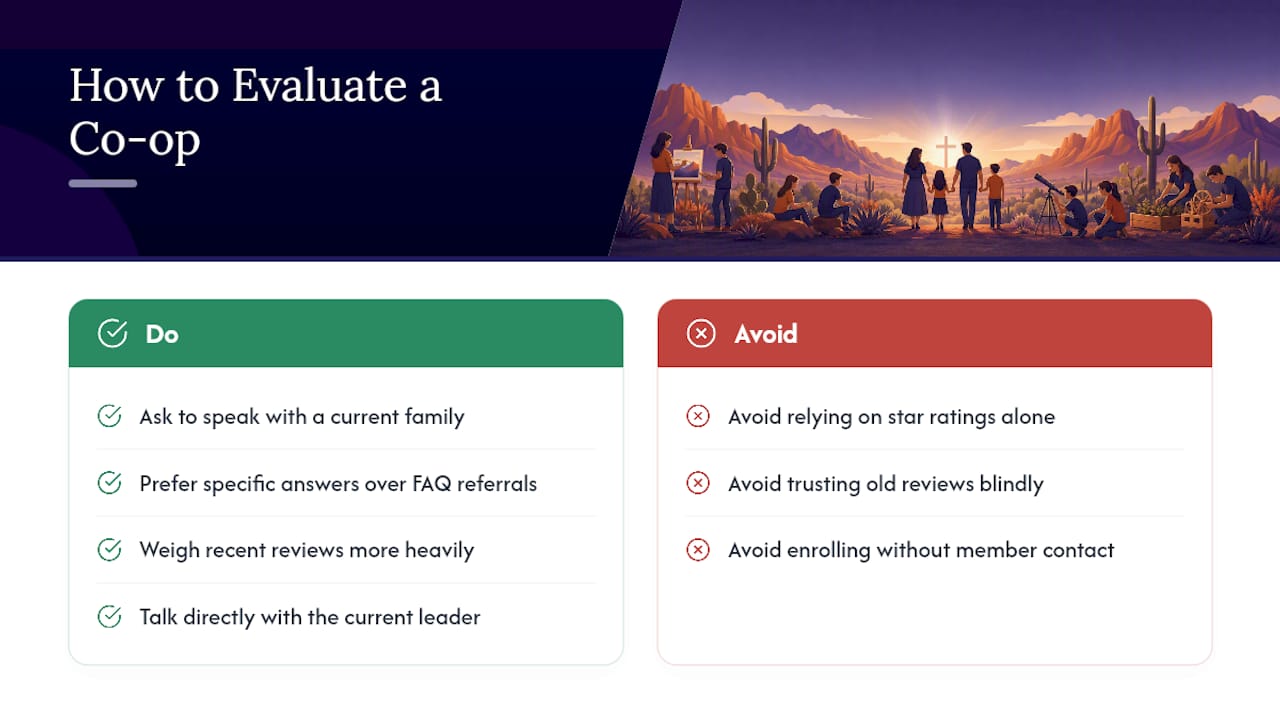
The most useful signal isn't a star rating. It's whether current members answer your questions specifically instead of pointing you to a generic FAQ page. Ask a prospective co-op if you can talk to a current family before you enroll. Most healthy co-ops will connect you readily; hesitation on this point is itself useful information.
Reviews on a co-op's Facebook group or homeschool-specific listing sites are worth reading, but weigh recent posts more heavily than old ones. Leadership changes, fee adjustments, and class offerings shift year to year, and a glowing review from three years ago may not reflect this year's reality. When in doubt, a direct conversation with the current leader beats any secondhand account.
Making the Transition Smooth When You Join a New Program
Joining mid-year or switching co-ops rattles most families more than it should. The transition goes easier when you treat the first month as an observation period rather than a full commitment.
Start by attending one or two classes before enrolling your child fully, if the co-op allows it. This lets your child get a feel for the group dynamic and gives you a read on teaching style without a financial commitment attached.
Talk to your child honestly about what to expect, especially if they're moving from a different co-op or from no group setting at all. Kids often adjust faster than parents anticipate, but knowing the schedule, the dress expectations, and who else attends helps ease the first day.
Keep your paperwork organized from day one: fee receipts, the refund policy in writing, and any waiver or liability forms. If you're also managing an ESA account, save vendor confirmations separately, since reconciling homeschool enrichment costs against ESA rules gets harder retroactively than it does in real time.
Give it six weeks before deciding whether the fit is right. First-month friction, whether it's a personality clash in class or a scheduling hiccup, often resolves once routines settle. If concerns persist past that point, a direct conversation with the co-op leader usually clarifies whether it's a fixable issue or a genuine mismatch.
Why a Statewide, ESA-Aware Directory Matters
Arizona's homeschool landscape is generous but fragmented. Families waste real time cross-referencing Facebook groups, county pages, and word of mouth just to find out whether a co-op takes ESA funds. A directory built around local search and ESA-aware filters removes that guesswork and reduces the chance of a costly compliance misstep before it happens.
Find Your Match Faster With Arizona Christian Homeschools
Arizona Christian Homeschools gets you past the Facebook-group scavenger hunt that eats up weeks of a typical co-op search. Instead of cross-referencing five different sources to find out who meets nearby and who accepts ESA funds, you search once, by city, and see both.

Here's the quick version: search your city or county in the directory, filter results for program type and ESA acceptance, then message the leader directly or ask about a trial visit. If you're in the East Valley, the Mesa program listings are a solid starting point given GRACE's long presence there. Families in northern or central Arizona should check the Sedona and Verde Valley microschool and co-op listings for options closer to home.
Start your search today at the homeschool co-ops near me directory and message a leader before the week is out.
Where to Verify Registration, ESA, and Co-op Details
- Maricopa County Homeschool office: filing steps, notarization, and accepted proof of identity
- Pima County homeschool registration: online filing and ESA/virtual charter exceptions
- Arizona homeschool law summary, HSLDA: required subjects and state-level rules
- Pima County homeschool groups and co-ops list: local group listings
Sources
- Arizona - Johns Hopkins Homeschool Hub
- Homeschool Information - Pima County Schools - Tucson, AZ
- Homeschool — Office of Maricopa County School Superintendent
- Homeschool Laws — HSLDA (Arizona)
- Homeschool groups and co-ops, Pima County
FAQ
Does Arizona pay parents to homeschool?
Arizona doesn't pay parents directly, but its Empowerment Scholarship Account program can cover qualifying homeschool expenses like curriculum, tutoring, and therapy for eligible families.
What is the best Christian homeschooling program in Arizona?
There's no single best program. The right fit depends on denominational stance, curriculum style, and schedule, which is why comparing several options through a directory like Arizona Christian Homeschools before committing pays off.
What is the hardest age to homeschool?
Many families report middle school years as the toughest transition, since academic demands rise while kids also crave more social independence, which is exactly where co-ops and enrichment programs tend to help most.
Does Arizona require testing for homeschoolers?
No. Arizona does not mandate standardized testing or teacher qualifications for homeschooling parents, though required subjects still include reading, grammar, math, social studies, and science.
How long do I have to file my Affidavit of Intent?
You must file within 30 days of starting homeschool instruction, and the affidavit needs proof of your child's age or identity for children six to sixteen.