
If you're looking for Christian homeschool co-ops in Peoria, start with three groups: the Peoria Area Association of Christian Homeschoolers (PAACH), Tri-County Enrichment Co-op, and St. Therese Catholic Home Schooling. Email PAACH at peoriapaach@gmail.com or check the group's listing directly, since these three cover different needs, from broad community support to structured Friday classes to Catholic-specific fellowship. A trial visit will tell you fast whether a group's format fits your family.
TL;DR:
- Most Peoria families combine a broad support group like PAACH with a more structured academic or faith-specific co-op to balance community support and regular instruction.
- PAACH offers support services such as testing coordination and mentoring and charges around $25 annually, making it ideal for community-focused families.
- Tri-County Enrichment provides weekly classes for Pre-K to 12th grade during the school year, demanding more time but offering in-person peer instruction.
- St. Therese Catholic Home Schooling emphasizes faith-based activities aligned with the liturgical calendar, with groups of 26 to 75 families participating more than once weekly.
- Outside Peoria, Christian homeschooling programs can be found via local directories, with Arizona's site providing detailed listings organized by city and program type.
Table of Contents
- Christian Homeschool Co-ops in Peoria: Group Profiles
- What Kinds of Christian Homeschool Groups Exist in Peoria?
- How Do You Choose the Right Co-op for Your Family?
- Joining a Peoria Homeschool Co-op: Your First 90 Days
- A Peoria Perspective on Homeschool Community
- Finding Christian Homeschool Co-ops Beyond Peoria's Big Three
- Sources
- FAQ
Christian Homeschool Co-ops in Peoria: Group Profiles
Peoria families have real options, and each group serves a different piece of the homeschooling puzzle. Knowing what each one actually offers before you reach out saves you a few awkward first emails.
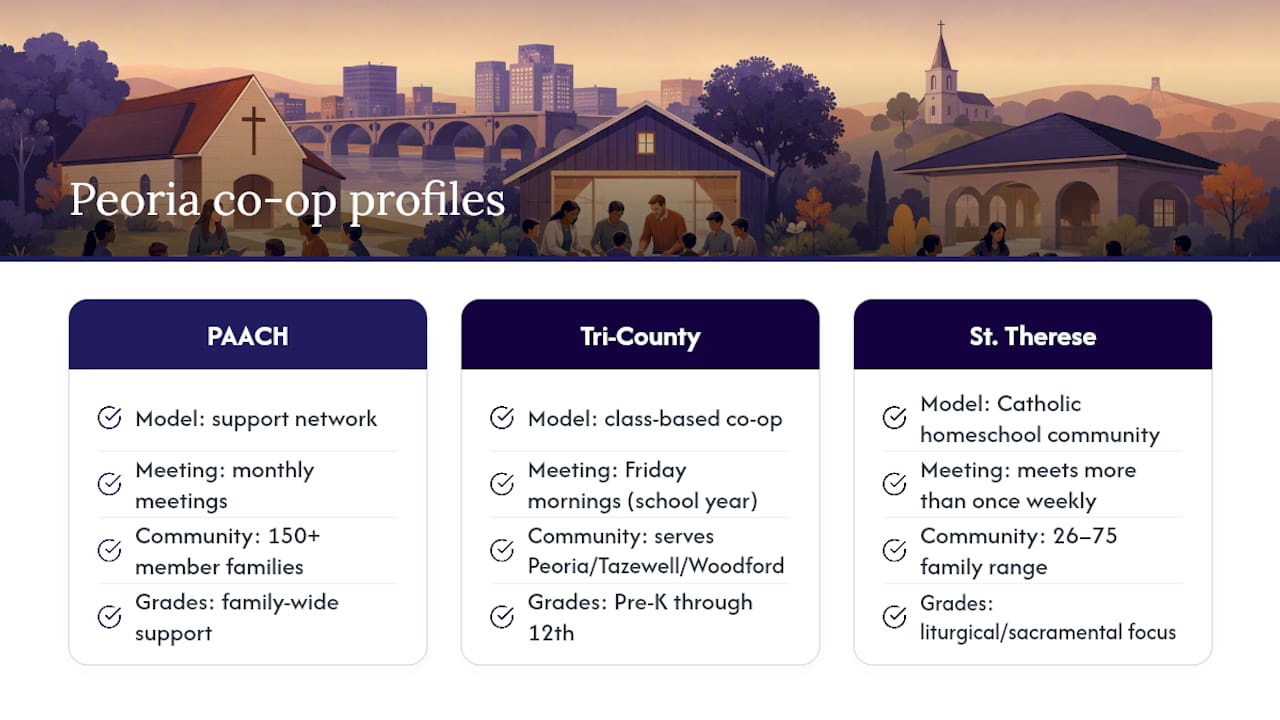
PAACH is the largest umbrella group serving Peoria and the surrounding central Illinois area, with 150+ member families and monthly meetings. It functions less like a classroom co-op and more like a support network: standardized testing coordination, mentoring for newer homeschool parents, book fairs, a graduation ceremony each spring, and an ongoing events calendar. Membership requires an annual fee, and PAACH also passes along an HSLDA discount to its members. For families who want community first and academics second, this is usually the first call to make.
Tri-County Enrichment Co-op takes the opposite approach. It's built around Friday morning classes during the school year for students from Pre-K through 12th grade, serving families across Peoria, Tazewell, and Woodford counties. Parents drop off (or teach) at rented classroom space, and a nursery is available for younger siblings. This is the model to consider if your kids thrive on a predictable weekly schedule with peer instruction, rather than an all parent-led approach.
St. Therese Catholic Home Schooling serves a Catholic-specific homeschool community in Peoria, with a group size in the 26 to 75 family range and activities that meet more than once a week. Expect a curriculum and social calendar built around the liturgical year and sacramental milestones, alongside typical co-op fare like field trips and group projects.
Beyond these three, PAACH's own local resources page lists additional smaller groups, including Dunlap Co-Op, Peoria Cooperative Academy Co-Op, and Bartonville Christian Church Homeschool Co-op, worth a look once you've sized up the big three.
What Kinds of Christian Homeschool Groups Exist in Peoria?
Not every "co-op" means the same thing, and mixing that up leads to a lot of wasted first visits. Peoria's Christian homeschooling scene generally breaks into four models.
- Umbrella or support groups. PAACH is the clearest example: low time commitment, minimal fees, and a focus on community, testing help, and events rather than weekly classes.
- Academic or class-based co-ops. Tri-County Enrichment fits here, with a fixed weekly schedule, assigned classes, and more structure, but usually a higher time and volunteer commitment from parents; incorporating homeschool science experiments that kids actually remember can enhance those hands-on classes.
- Faith-specific groups. St. Therese narrows its focus to a particular tradition (Catholic, in this case), which matters if doctrinal alignment and shared religious practice are non-negotiable for your family.
- Niche extracurricular co-ops. Smaller groups built around speech and debate, athletics, or the arts, often layered on top of one of the three models above.
The trade-offs are pretty straightforward: support groups ask little of your calendar but offer little structured teaching; academic co-ops demand more of your Fridays (and often a teaching or supervision rotation) but deliver real classroom rhythm. The pattern most Peoria families settle into, and it works, is joining a broad group like PAACH for the community and record-keeping support, then adding one focused academic or faith-specific co-op for structured learning.
How Do You Choose the Right Co-op for Your Family?
Before you visit anyone, define your own homeschool philosophy. Are you classical, unit-study based, unschooling, Catholic-specific, or something in between? Co-ops vary widely on this point, and a group with a strong academic bent will feel wrong for a relaxed, child-led family, and vice versa. Local practitioners consistently point to this step first, and it's the single question that filters out the most mismatches.
Once you know your philosophy, run through this checklist:
- Does the meeting day and time actually work with your family's schedule?
- What are the fees, and what do they cover (materials, facility rental, insurance)?
- Are teachers and volunteers background checked, and by whom?
- Does the group accommodate special needs or differing learning paces?
- Does the curriculum or teaching style match what you're already using at home?
When you reach out, ask directly about fees, teacher qualifications, who supervises drop-off classes, and whether you can observe or sit in on a sample lesson before committing. A group that hesitates on any of those is worth a second look.
Watch for red flags: leadership that won't name references or other member families, unclear answers about who supervises children during class time, or vague safeguarding policies. A well-run Christian co-op, even a small one, should be able to answer these questions without hesitation.
Pro Tip: Bring a specific question about your child's grade level or learning style to your first conversation. How a group answers it tells you more about fit than any brochure or website ever will.
Joining a Peoria Homeschool Co-op: Your First 90 Days
Getting from "interested" to "enrolled" is simpler than most new families expect.
- Send a short introductory email or attend a meet-and-greet. Mention your children's ages, your homeschool approach, and what you're hoping to find, whether that's community, structured classes, or both.
- Complete onboarding. Most groups ask for a membership form, an annual fee (often around $25 for larger umbrella groups), and attendance at an orientation session before your first meeting.
- Try more than one group. It's entirely normal, and respectful, to visit two or three co-ops in your first month before committing. Just be upfront that you're comparing options.
- Use the umbrella group's extras. Standardized testing coordination, mentoring, and graduation services through a group like PAACH can save you real legwork later in your homeschool journey.
Keep basic records of attendance and any testing results from the start. It's far easier than reconstructing them years later.
A Peoria Perspective on Homeschool Community
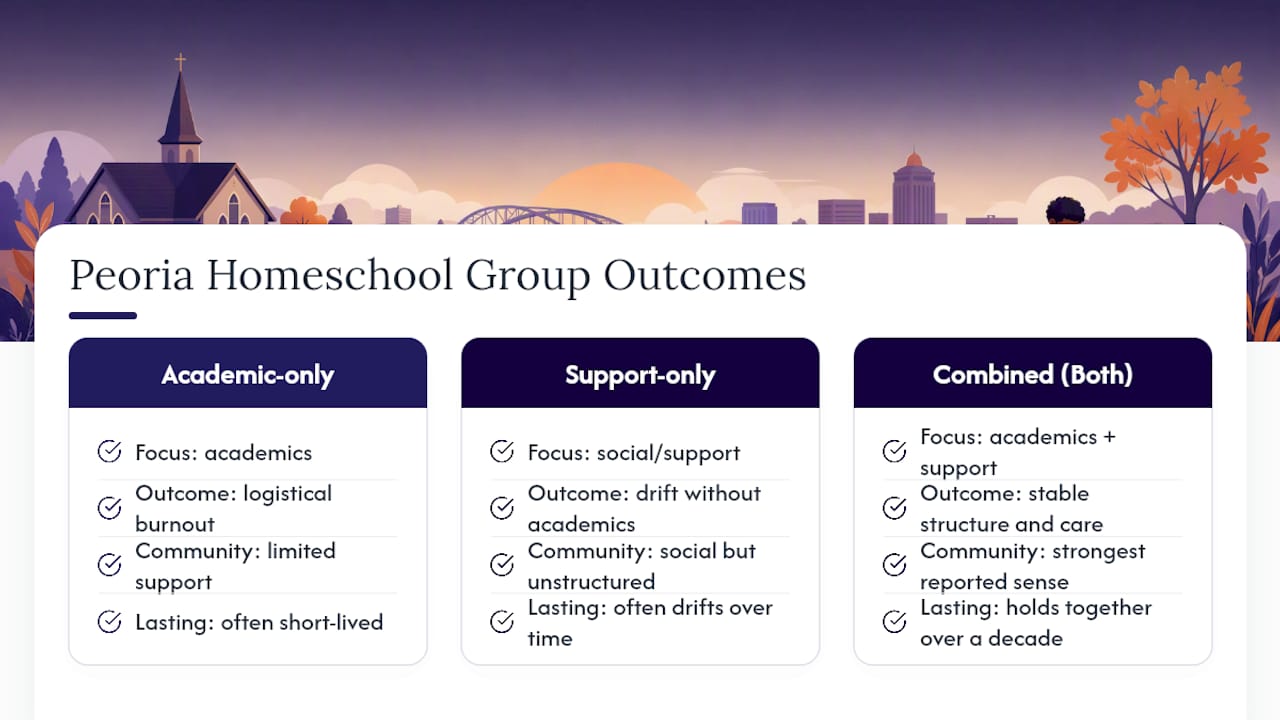
Grant has spent years studying how faith-based homeschool networks function across the Southwest and Midwest, and the pattern in Peoria isn't unique, but it is instructive. Families who join only an academic co-op tend to burn out on logistics without a support network; families who join only a support group often drift without academic structure. The ones who last, and who report the strongest sense of community, are almost always doing both: a broad umbrella like PAACH for events, testing, and mentoring, plus a focused group like Tri-County Enrichment or St. Therese for weekly structure.
What gets underestimated is how much the combination matters more than either group alone. Peoria's homeschooling scene isn't large enough for families to be picky about a single perfect group. It's large enough, though, to build a personalized patchwork that actually holds together over a decade of schooling.
— Grant
Finding Christian Homeschool Co-ops Beyond Peoria's Big Three
Once you've contacted PAACH, Tri-County Enrichment, or St. Therese, the natural next question is what else exists nearby, or what to do if none of the three feel like the right fit. That's where a searchable directory saves real time.
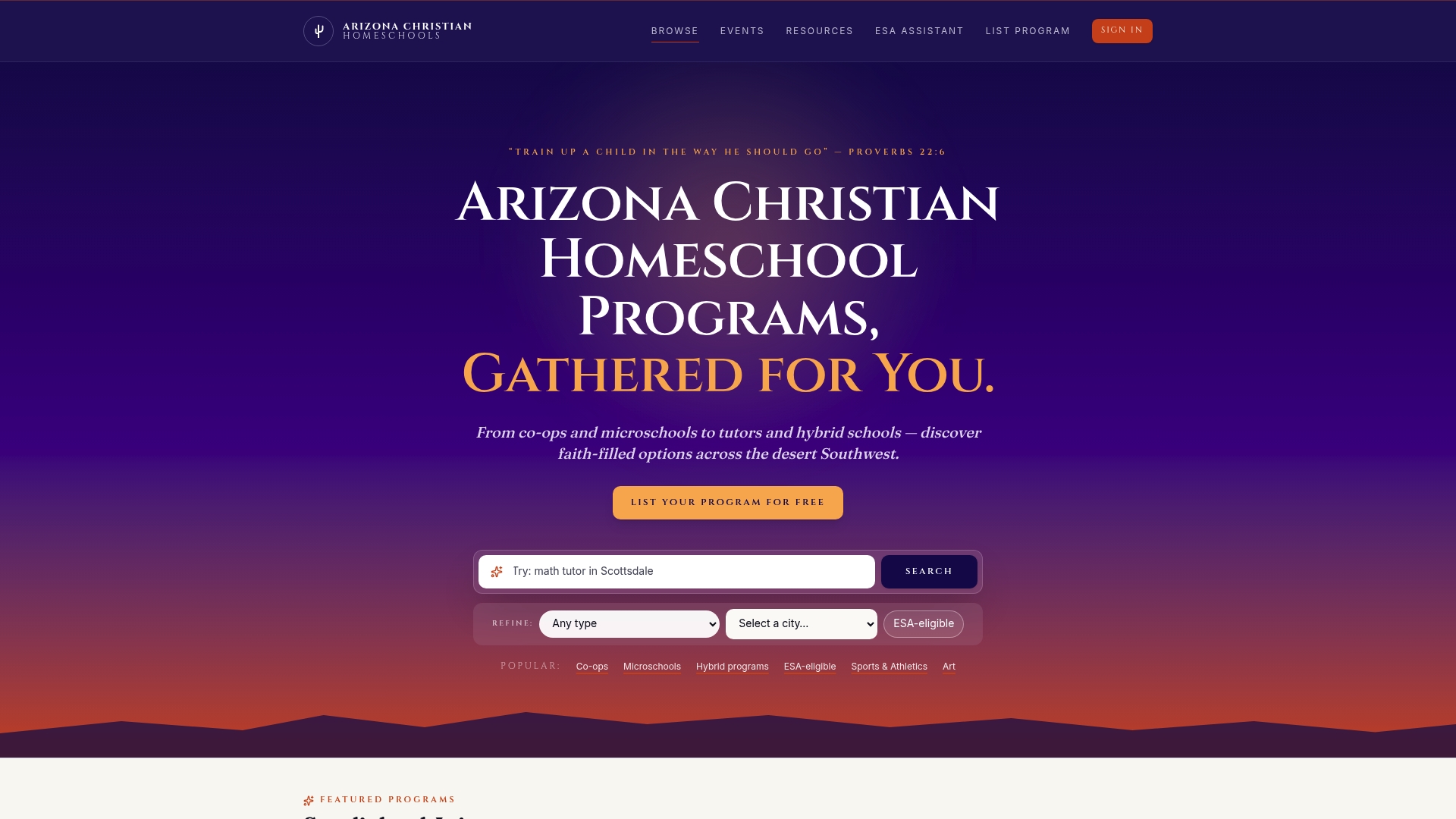
Arizona Christian Homeschools maintains localized listings across the desert Southwest, including co-ops, microschools, tutors, and hybrid programs, all organized by city so you're not piecing together information from a dozen scattered Facebook groups. Each listing notes the program type, so you can tell at a glance whether you're looking at a support umbrella, an academic co-op, or a faith-specific group, without waiting on an email reply first. For Arizona families, the directory also flags Empowerment Scholarship Account (ESA) eligibility, which can offset enrichment and co-op costs directly. Browse the Christian homeschool co-op directory to compare programs near you and reach out to the ones that match your family's philosophy.
Sources
Meeting times, fees, and membership requirements change from year to year, so confirm details directly before you visit. PAACH's official site lists its events calendar and membership information, and you can reach the group directly at peoriapaach@gmail.com. Tri-County Enrichment Co-op's about page covers class schedules and county coverage. HSLDA's group listings for PAACH and St. Therese Catholic Home Schooling confirm group size and meeting cadence. Families outside Illinois can browse Arizona-specific listings on the Peoria, Arizona program directory for comparison.
FAQ
What is the largest Christian homeschool co-op in Peoria?
PAACH is the largest, with 150+ member families and monthly meetings serving the central Illinois area, including Peoria.
How much does it cost to join a Peoria homeschool co-op?
Annual subscriber fees for larger umbrella groups like PAACH run around $25 a year; academic co-ops such as Tri-County Enrichment and faith-specific groups like St. Therese may add class or activity fees on top.
Is Tri-County Enrichment Co-op religious?
Tri-County Enrichment runs Friday morning academic classes for Pre-K through 12th grade serving Peoria, Tazewell, and Woodford counties, and operates within a Christian homeschooling framework common to the area's co-op network.
Can I join more than one homeschool co-op in Peoria?
Yes, and it's the common local pattern: many families join a broad support group like PAACH alongside a focused academic or faith-specific co-op such as Tri-County Enrichment or St. Therese.
How do I find Christian homeschool co-ops near Peoria beyond the main three?
Check PAACH's local resources page for smaller area groups, or search the Arizona Christian Homeschools directory for listings organized by city and program type.