
For faith-centered families in Arizona, Arizona Christian Homeschool Programs is the most practical starting point for finding a local co-op. The directory combines city-level search, ESA-friendly filters, and curated listings so you spend less time hunting and more time connecting. Roughly 5.5% of K–12 students in Arizona were formally homeschooled in the 2024–2025 school year, and more than 100,000 students participate in the state's Empowerment Scholarship Account (ESA) program — which means the co-op landscape here is active, varied, and worth navigating carefully.
Three things to verify before you commit to any group:
- Arizona affidavit status: Confirm your family files under A.R.S. 15-802; some co-ops restrict membership to families homeschooling under this statute.
- ESA acceptance: Ask each co-op directly whether it accepts ESA-funded students — policies differ by group.
- Parent volunteer load: Most active co-ops require job credits for teaching, supervision, or administration. Know the minimum before you register.
Table of Contents
- What types of homeschool co-ops are available in Arizona?
- Where are co-ops concentrated across Arizona?
- How do you evaluate a co-op leader's qualifications?
- How does group size affect your child's experience?
- What parent involvement do co-ops actually require?
- How do co-ops handle special needs and inclusivity?
- Arizonachristianhomeschools: your starting point for Arizona co-ops
- Key Takeaways
What types of homeschool co-ops are available in Arizona?
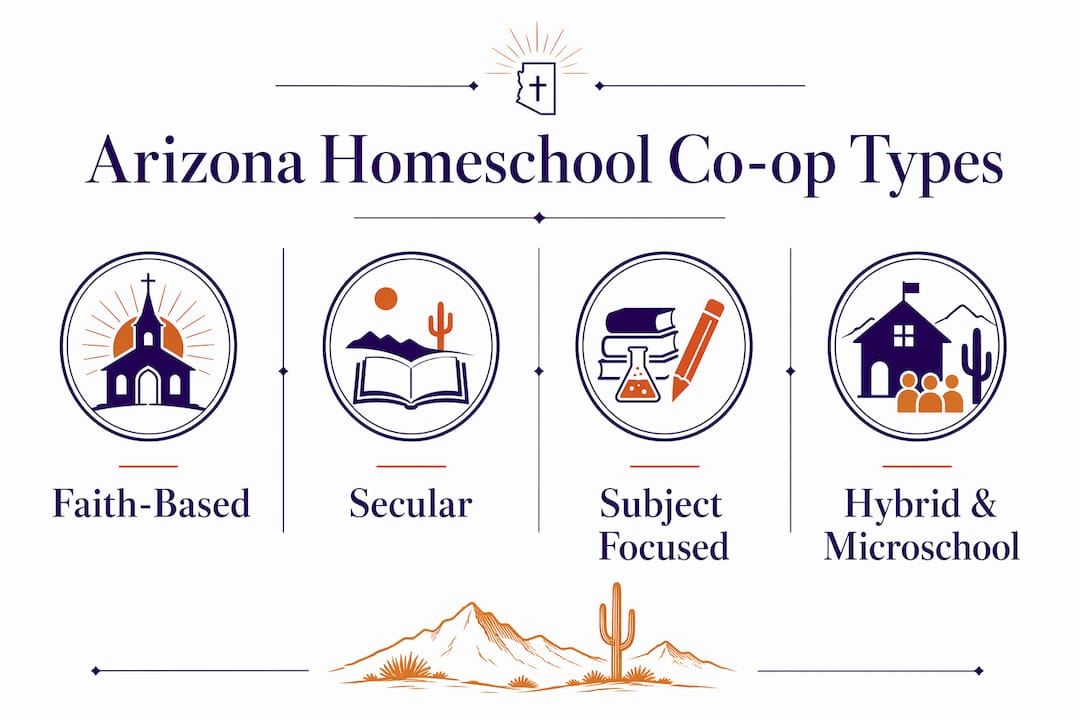
Arizona's co-op options fall into four broad categories, each serving a different family priority.
Christ-centered co-ops integrate Bible teaching, Christian worldview, and faith formation alongside academics. Groups like Branches Southwest meet weekly and require job credits from every member family. Harvest Church's HCAZ Homeschool is an ESA vendor that runs Monday through Wednesday with structured classes and outdoor learning.
Secular community co-ops prioritize inclusive, parent-led learning without a religious framework. Growing Together AZ (GTAZ) launched in 2020 and has built a broad community around meetups, nature days, field trips, and parent-led classes open to families of all backgrounds.
Subject-focused and enrichment co-ops concentrate on specific disciplines — STEM, classical studies, arts, or language arts — rather than full-day instruction. These work well as supplements to a home curriculum rather than a primary school structure.

Hybrid and microschool programs blend drop-off instruction with parent involvement. Families who want a more structured, teacher-led environment without full private school enrollment often find hybrid programs the right middle ground. These differ from traditional co-ops in that a paid or credentialed instructor typically leads the class.
Where are co-ops concentrated across Arizona?
The Phoenix metro, Tucson, and the East Valley have the highest density of organized co-ops and resource centers. Families in Chandler, Gilbert, Mesa, and Scottsdale generally have several options within a short drive. The West Valley — Goodyear, Litchfield Park, Surprise — has active groups including Branches Southwest and Homeschoolers 4 Him.
Northern Arizona (Flagstaff, Prescott) and rural regions tend toward smaller, more informal gatherings, often coordinated through Facebook groups rather than structured websites. Yuma families should note that ESA students may face an athletic fee per sport with the local high school district — a county-level rule worth confirming before assuming uniform access statewide.
Pro Tip: Facebook groups and local social channels often carry the most current registration windows and last-minute changes. Pair a social check with a directory listing before assuming a group is still active.
How do you evaluate a co-op leader's qualifications?
Leader qualifications in Arizona co-ops vary widely because the state does not require homeschool parents to hold teaching credentials. That said, there are concrete signals worth asking about directly.
- Does the lead teacher have subject-matter experience, a degree, or prior classroom teaching background?
- Has the co-op been operating for more than two years with consistent enrollment?
- Are written policies available for attendance, refunds, child safety, and behavior?
- Does the group carry liability insurance and conduct background checks on adult volunteers?
Groups affiliated with established organizations — AFHE, a church, or a classical education network — often have more formal accountability structures than independent groups.
How does group size affect your child's experience?
Smaller co-ops (8–15 families) tend to offer closer relationships between parents and more individual attention in class. Larger groups (30+ families) can provide a wider course catalog, more extracurricular options, and a stronger social network — but individual attention in any single class may be closer to a traditional classroom setting.
Community and social support consistently rank as the primary benefit families cite when describing long-term homeschooling success. A co-op with 12 deeply engaged families often serves a child better than a 50-family group where participation is uneven.
What parent involvement do co-ops actually require?
Most active Arizona co-ops are volunteer-led and require parents to earn job credits each semester. A job credit might mean teaching a class, supervising a lunch period, handling registration, or managing communications. Branches Southwest, for example, requires every member family to hold at least one on-campus job.
The time commitment varies. Some co-ops ask for one hour per week; others expect a parent on-site every meeting day. Before joining, ask for the written job-credit policy and the minimum hours per semester. Families using ESA funds should also confirm whether the co-op's fee structure is compatible with how ESA reimbursements work.
How do co-ops handle special needs and inclusivity?
Policies on special educational needs and inclusivity differ significantly across Arizona co-ops. Faith-based groups generally welcome all families who share their values, though academic accommodations may be limited by the volunteer nature of instruction. Secular community co-ops like GTAZ explicitly build around an all-inclusive model.
Before enrolling a child with learning differences, ask the co-op leader directly: Does the group have experience supporting students with IEPs or learning accommodations? Are class sizes small enough for differentiated instruction? What is the process if a child needs additional support mid-year? Written answers to these questions are a stronger signal than a general "we welcome everyone" statement on a website.
Experienced Arizona families consistently recommend attending a park day or informational meeting before committing — it is the fastest way to assess whether a group's culture and capacity genuinely match your child's needs.
Arizonachristianhomeschools: your starting point for Arizona co-ops
Finding the right co-op takes time, but the search gets shorter when you start with a directory built specifically for Arizona families.
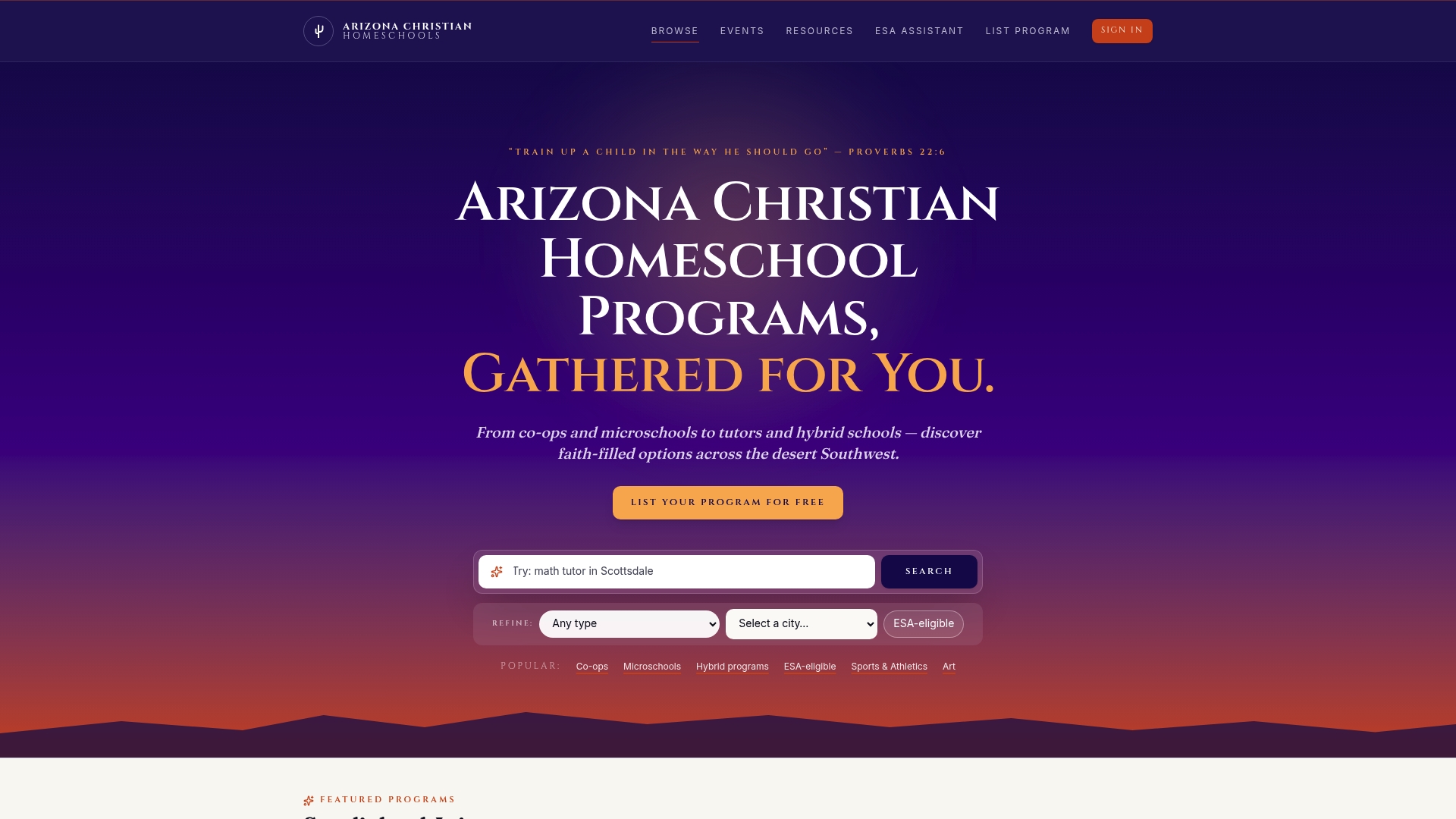
Arizonachristianhomeschools aggregates Christian co-ops, hybrid programs, curriculum options, and ESA guidance in one place — searchable by city, filterable by ESA compatibility, and updated for Arizona's specific legal and funding landscape. Whether you are looking for a Christ-centered weekly co-op in the East Valley, a hybrid microschool with drop-off instruction, or a faith-aligned curriculum to pair with co-op classes, the directory gives you a vetted shortlist rather than a cold search. Families who want structured lesson plans can also explore Christian Light Education as a curriculum anchor alongside co-op enrollment.
Start your search at the Christian co-op directory, filter by your city, and request an info day from any group that looks like a fit.
Key Takeaways
For Arizona families, the most effective path to the right co-op is to verify legal status, ESA compatibility, and parent-involvement expectations before attending a trial day.
| Point | Details |
|---|---|
| Start with a local directory | Arizona Christian Homeschool Programs filters by city and ESA compatibility, narrowing the search quickly. |
| Verify affidavit status first | Many co-ops require families to file under A.R.S. 15-802 before accepting membership. |
| Ask about job credits upfront | Most active co-ops require parent volunteer hours each semester; confirm the minimum before registering. |
| Attend a park day before committing | Experienced families rate cultural fit and educational model above geographic convenience. |
| Arizonachristianhomeschools | The directory covers co-ops, hybrid programs, and ESA-friendly curriculum options across Arizona. |