
What are the best Christian microschools in Arizona?
Arizona families have strong options for faith-based personalized education, and the best Christian microschools in Arizona span a range of models, grade levels, and spiritual emphases. Paradise Valley Christian Preparatory leads on academic credentials, while Arcadia Christian Academy and Awaken Hearts Academy stand out for their genuinely small, family-centered learning environments. Here is how the top seven compare.
| School | Location | Grades | Learning Model | Faith Integration | Accreditations | Rating |
|---|---|---|---|---|---|---|
| Arcadia Christian Academy | Arizona | Pre-K–K | Hybrid (classroom + home) | Nondenominational, project-based | — | 5★ (28 reviews) |
| Awaken Hearts Academy | Arizona | Elementary | Full-time microschool | Identity in Christ, character-led | — | — |
| Tri-City Christian Academy | East Valley, AZ | K–12 | Full-time | Biblical foundation, athletics | — | — |
| HOPE Christian Academy | Arizona | Pre-K–K | Hybrid (three days in-person, two remote) | Family-teacher partnership | — | — |
| Cross Christian Academy | Arizona | Pre-K–Elementary | Full-time | Bible-based, state licensed | Quality First partner | — |
| Vision Christian Academy | Glendale, AZ | K–High School | Full-time, traditional | Scriptural worldview, A-Beka | Ministry of Vision Baptist Church | — |
| Paradise Valley Christian Preparatory | Paradise Valley, AZ | Pre-K–12 | Full-time | Spiritual nurturing + academic rigor | ACSI and Cognia accredited | — |
Paradise Valley Christian Preparatory holds the strongest credential profile, ranked #1 Christian High School and #4 Private K-12 in Arizona with dual ACSI and Cognia accreditation. For families prioritizing small class sizes, Arcadia Christian Academy keeps Pre-K and Kindergarten at a 1:9 student-teacher ratio, rising to 1:18 for upper grades, with no homework and optional electives including STEM, culinary arts, and jiu jitsu.
HOPE Christian Academy runs a structured hybrid schedule: in-person Tuesday, Thursday, and Friday, with remote learning on Monday and Wednesday. Cross Christian Academy publishes concrete tuition figures, with Kindergarten set at $6,500 for 2025-26, and offers monthly payment plans alongside tuition assistance.

Pro Tip: Arizona microschools fill fast. Contact your top choices before March each year, and ask specifically whether they accept Arizona Empowerment Scholarship Account (ESA) funding through ClassWallet. Many do, and it can cover tuition entirely.
Table of Contents
- What makes Christian microschools different from traditional private schools?
- Which Christian microschool niche fits your child best?
- How does ESA funding work for Arizona Christian microschools?
- Community resources and directory support for Arizona Christian families
- Arizonachristianhomeschools connects you to the right fit
- Key Takeaways
What makes Christian microschools different from traditional private schools?
Christian microschools are small-group learning environments, typically capped at 5–15 students per class, where biblical teaching is woven into every subject rather than confined to a single Bible class. The model treats faith and academics as inseparable, which is the core distinction from most traditional private schools.
What draws Arizona families to this model:
- Small, known communities. Teachers know each child's learning style, pace, and spiritual needs by name.
- Whole-child focus. Academic growth, character development, and spiritual formation are treated as equally important.
- Family partnership. Parents are active co-educators, not passive observers. Hybrid models make this explicit.
- Flexible scheduling. Many microschools accommodate travel, family rhythms, and diverse learning needs that larger schools cannot.
- Faith-integrated curriculum. Scripture and a biblical worldview shape how math, science, history, and language arts are taught.
Experienced educators are drawn to microschooling precisely because it lets them give personalized attention to students whose needs get overlooked in larger classrooms. For families with neurodiverse children or those who want more than a standardized curriculum, the microschool model often fits better than any traditional alternative.
Which Christian microschool niche fits your child best?
Not every Christ-centered microschool operates the same way. Arizona families will find meaningful differences in pedagogy, denominational emphasis, and daily structure.
- Nondenominational and project-based. Arcadia Christian Academy takes a collaborative, nondenominational approach. Students engage in project-based and play-based learning, and the no-homework policy reflects a philosophy that learning should not follow children home as a burden.
- Identity and character formation. Awaken Hearts Academy centers its model on a child's identity in Christ, blending structured instruction with freedom for self-directed discovery. The emphasis on leadership and compassionate character sets it apart from purely academic programs.
- Hybrid and remote. HOPE Christian Academy's three-day in-person, two-day remote schedule reflects a hybrid microschooling model that actively involves parents as co-educators on home days. This structure works well for families who want professional teacher partnerships without a five-day-a-week commitment.
- Traditional scriptural curriculum. Vision Christian Academy uses the A-Beka curriculum within a ministry context affiliated with Vision Baptist Church, serving families near Glendale and Luke Air Force Base who want a traditional classroom environment grounded in a scriptural worldview.
- Athletics and full K-12 scope. Tri-City Christian Academy serves the East Valley with a full sports schedule including volleyball, soccer, basketball, flag football, and track, alongside college-preparatory academics. Families who want extracurricular depth alongside spiritual formation will find the most complete program here.
Arizona's minimal regulatory barriers have made it one of the most welcoming states for diverse microschool models, allowing faith-based programs to design their own structures without the constraints that limit schools in other states.
How does ESA funding work for Arizona Christian microschools?
Arizona's Empowerment Scholarship Account program has expanded access to private faith-based education at a scale few states have matched. Enrollment grew from roughly 12,000 students in 2022-23 to over 80,000 in 2024-25, reflecting how broadly Arizona families have adopted the program.
Key practical points for families:
- ESA funds can cover tuition. Many Arizona Christian microschools accept ESA payments, and the funding often covers tuition in full at smaller programs.
- ClassWallet is the payment platform. The Arizona Department of Education routes ESA funds through ClassWallet, which families use to pay approved schools and tutors directly.
- Enrollment moves quickly. Because microschools run lean administratively and keep class sizes small, seats fill fast. Applying early, ideally by late winter, is the most reliable way to secure a spot.
- State licensing and accreditation matter. Cross Christian Academy's state licensing and Quality First partnership, and Paradise Valley Christian Preparatory's ACSI and Cognia accreditation, both signal accountability that some ESA families prioritize.
- Teacher qualifications vary. Ask each school directly about lead teacher credentials. Accredited programs like Paradise Valley Christian Preparatory maintain formal standards; smaller microschools may rely on experienced educators without traditional certification.
For families exploring ESA-approved tutors to supplement a microschool program, Arizona also maintains a directory of ClassWallet-eligible tutoring services that can fill gaps in specialized subjects.
Pro Tip: If you are comparing tuition costs, ask whether the school's ESA acceptance is current for the 2025-26 school year. Approval status can change between enrollment cycles.
Community resources and directory support for Arizona Christian families
Finding the right microschool is only the first step. Ongoing support through co-ops, curriculum guidance, and community events makes a real difference in how well a faith-based education holds together over time.
Arizonachristianhomeschools maintains a free directory connecting Arizona families with:
- Christian microschools across the state, searchable by city and grade level
- Homeschool co-ops that offer cooperative enrichment, group classes, and community connection
- Qualified homeschool tutors for personalized academic support
- Curriculum guides covering programs like Christian Light Education and Berean Builders, suited to both microschool and home settings
- ESA eligibility information and resources to help families navigate funding options
The directory also lists enrichment programs, educational therapy providers, sports and fitness options, and field trip organizations. For families building a hybrid education plan, having these resources in one place reduces the time spent searching across disconnected sources. Connecting with a local Christian homeschool co-op can also provide the peer community that microschool students sometimes miss when class sizes are very small.
Arizonachristianhomeschools connects you to the right fit
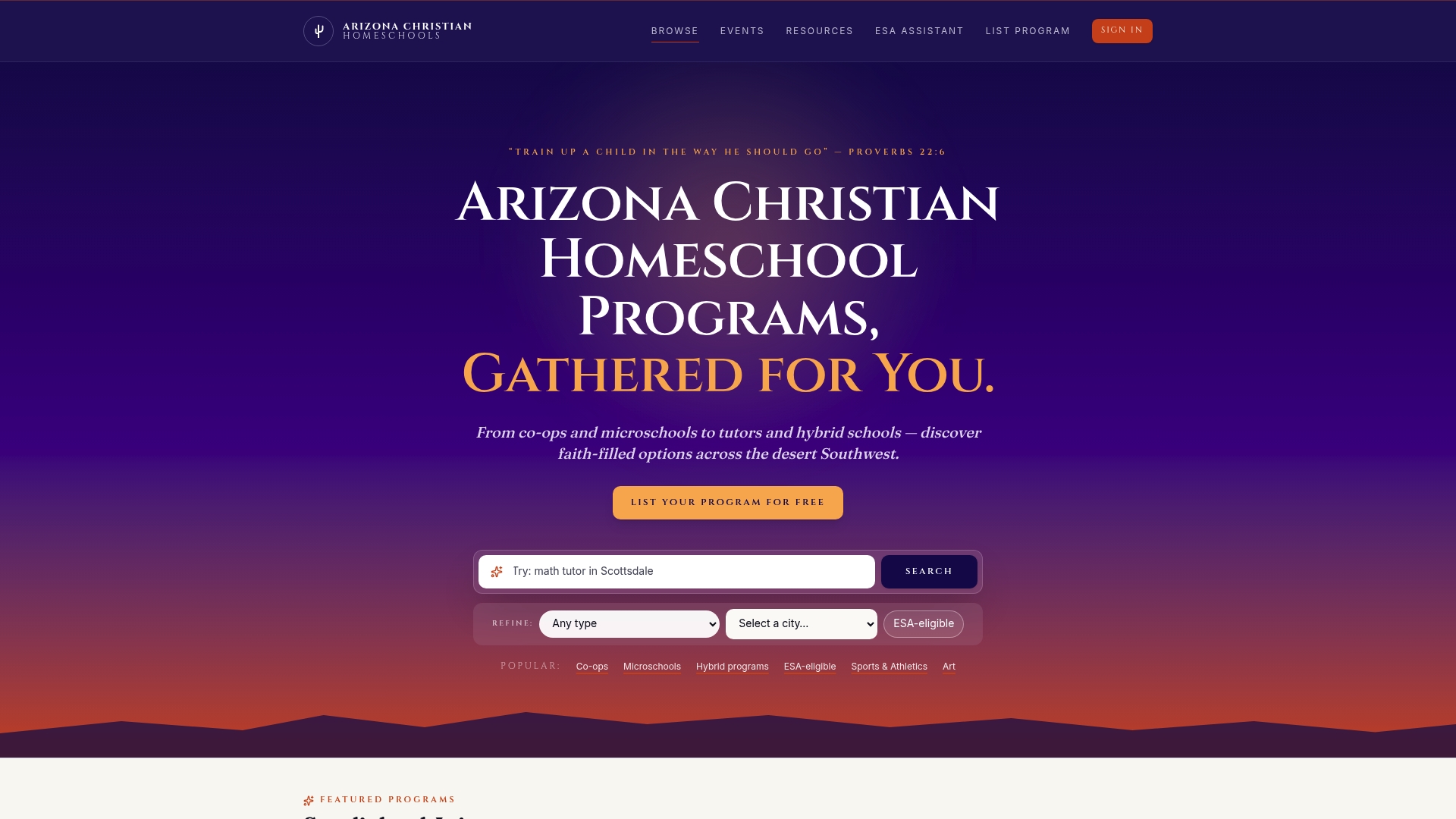
Choosing between seven strong schools takes time, and the right answer depends on your child's grade, your family's schedule, and how you want faith woven into daily learning. Arizonachristianhomeschools offers a practical shortcut: a free, localized directory of Christian microschools, co-ops, tutors, and homeschool curriculums across Arizona, all in one place. Unlike searching school by school, the directory lets you filter by city, grade level, and program type, then connect directly with programs that match your priorities. If you are also weighing curriculum options for home learning days, the Christian microschools directory includes ESA eligibility details so you can plan funding alongside enrollment. Browse the directory today and find the faith-based program that fits your family.
Key Takeaways
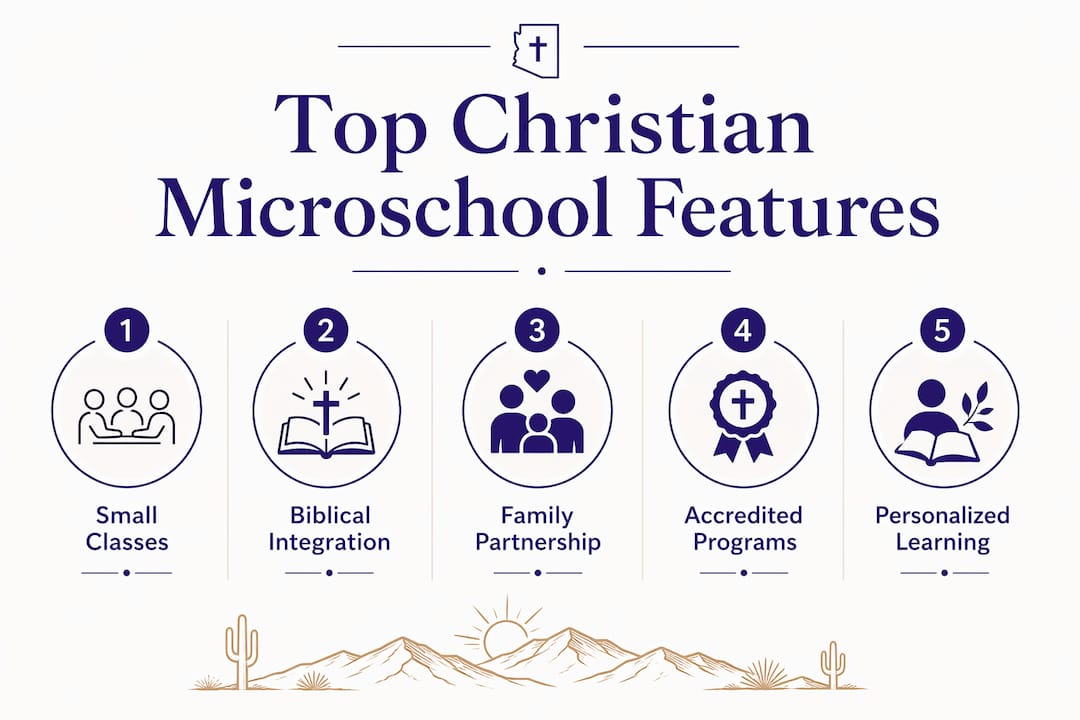
Arizona's best Christian microschools combine small class sizes, biblical integration, and family partnership to deliver personalized education that traditional private schools rarely match.
| Point | Details |
|---|---|
| ESA funding is widely available | Over 80,000 Arizona students used ESA in 2024-25, and many Christian microschools accept it through ClassWallet. |
| Class sizes define the model | Typical Christian microschools in Arizona have classes ranging from 5 to 15 students, and Arcadia Christian Academy maintains a 1:9 student-teacher ratio in Pre-K and Kindergarten. |
| Accreditation signals accountability | Paradise Valley Christian Preparatory holds ACSI and Cognia accreditation, ranking #1 Christian High School in Arizona. |
| Enroll early | Microschools fill quickly due to small capacities; contact schools before March for the best chance at a seat. |
| Arizonachristianhomeschools | The free directory connects Arizona families with local Christian microschools, co-ops, tutors, and ESA-eligible resources in one place. |