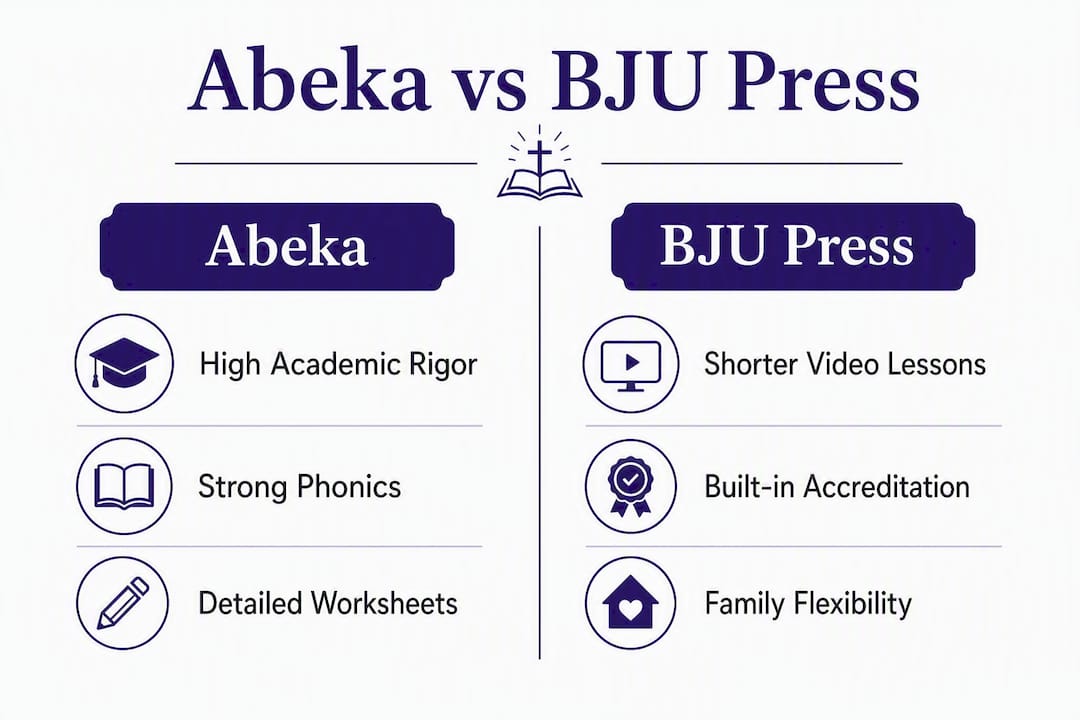
Choose Abeka if you want a highly structured, workbook-driven school-at-home week. Choose BJU Press if you need stronger teacher explanations, shorter video lessons, and more conceptual depth. Both programs are Christ-centered, cover young-earth creationism in science, and run from PreK through grade 12, but they serve different family rhythms.
The fastest way to choose: Ask three questions. Does your child thrive with repetition and predictable daily drills? (Abeka.) Does your child need a teacher to explain the "why" before practicing? (BJU Press.) Are you tracking high-school transcripts without an outside service? (BJU Press Distance Learning includes accreditation; Abeka Academy typically charges separately for that service.)
For Arizona families using ESA homeschool funds, both curricula are generally ESA-eligible as curriculum expenses. Run a one-week trial before purchasing a full-year kit.
- Confirm your child's placement level before ordering — Abeka runs slightly above grade level, which accelerates strong readers but can frustrate struggling ones.
- Download sample lessons from each publisher and teach three consecutive days using only those materials.
- Measure time on task, your own prep time, and your child's engagement at the end of each session.
Table of Contents
- How do Abeka and BJU Press compare side by side?
- Which curriculum fits your family's situation?
- Arizonachristianhomeschools helps you find local programs and next steps
- Key Takeaways
How do Abeka and BJU Press compare side by side?
| Dimension | Abeka | BJU Press |
|---|---|---|
| Pedagogy / teaching style | Direct, scripted instruction; rote memorization; formal | Conceptual "why" explanations; teacher-led discussion; more conversational |
| Pacing & rigor | Slightly above grade level; fast-paced spiral review | Grade-level; slightly more flexible pacing |
| Lesson format | Classroom video (teacher + students); longer lessons | Studio video; teacher speaks directly to child; shorter lessons |
| Parent time & involvement | High: daily worksheet checking, consistent seatwork management | Medium-high: more active concept teaching, less grading time |
| Accreditation | Available via Abeka Academy; often priced separately | Included in BJU Press Distance Learning; Academy of Home Education |
| Grade coverage | PreK–12 | PreK–12 |
| Faith / worldview | Conservative Protestant; formal devotional tone | Conservative Protestant; slightly more academic tone |
| Support resources | Scripted teacher guides; fewer conventions attended | Teacher manuals, Homeschool Hub platform; active convention presence |
| Assessment & reporting | Tests and quizzes included; parent-managed transcripts | Tests included; accredited transcript option built into distance learning |
Three decision signals for Arizona families:
- ESA budgeting: BJU Press's lower video-package price can stretch ESA funds further per child, especially in a multi-child household. Track consumable workbook costs separately — those are non-reusable each year for both publishers.
- Co-op compatibility: Abeka's scripted, predictable sequence makes it easy for a co-op teacher to pick up mid-lesson. BJU Press's conceptual approach pairs well with co-ops that run discussion-based enrichment alongside core subjects.
- Used-book savings: Textbooks from both publishers can be purchased used through online curriculum marketplaces; consumable workbooks must be purchased new each year.
Pro Tip: Many experienced homeschoolers combine both publishers — Abeka for phonics and arithmetic drill, BJU Press for literature, writing, and lab science — rather than committing one publisher for every subject.
Which curriculum fits your family's situation?
Scenario-based picks:
- Accelerated single learner: Abeka. The above-grade-level pace and heavy drill reward students who absorb material quickly and enjoy structured repetition.
- Multi-child family on an ESA budget: Abeka for lower grades (reusable texts, predictable sequence); BJU Press for high school (built-in accreditation saves transcript service fees).
- Co-op participant: BJU Press. Shorter video lessons fit a hybrid schedule, and the conceptual teaching style complements group discussion time.
- Parent who wants minimal daily prep: Abeka. Scripted lessons reduce planning; the sequence is fully laid out day by day.
- High schooler needing transcripts: BJU Press Distance Learning. Accreditation is included, which simplifies record-keeping without an external service.
- Child who needs character-focused storytelling alongside academics: Either curriculum pairs well with character education resources that reinforce the biblical worldview both publishers share.
Estimated parent involvement by grade band:
| Grade Band | Abeka | BJU Press |
|---|---|---|
| — | High | Medium-High |
| — | Medium-High | Medium |
| — | Medium | Medium (Low with Distance Learning) |
One-week trial plan: Pull three days of sample lessons from each publisher. Teach them back-to-back in your normal school window. Watch for three red flags: your child consistently finishes well under or over the allotted time (pacing mismatch), you spend more time re-explaining than the lesson budgeted (teaching-style mismatch), or your child resists sitting down at all (format mismatch). If you switch mid-year, budget roughly a month for your child to recalibrate to the new pace and seatwork expectations.
Arizonachristianhomeschools helps you find local programs and next steps
Choosing between these two curricula is easier when you can see how other Arizona families are using them in real co-ops, microschools, and hybrid programs near you.

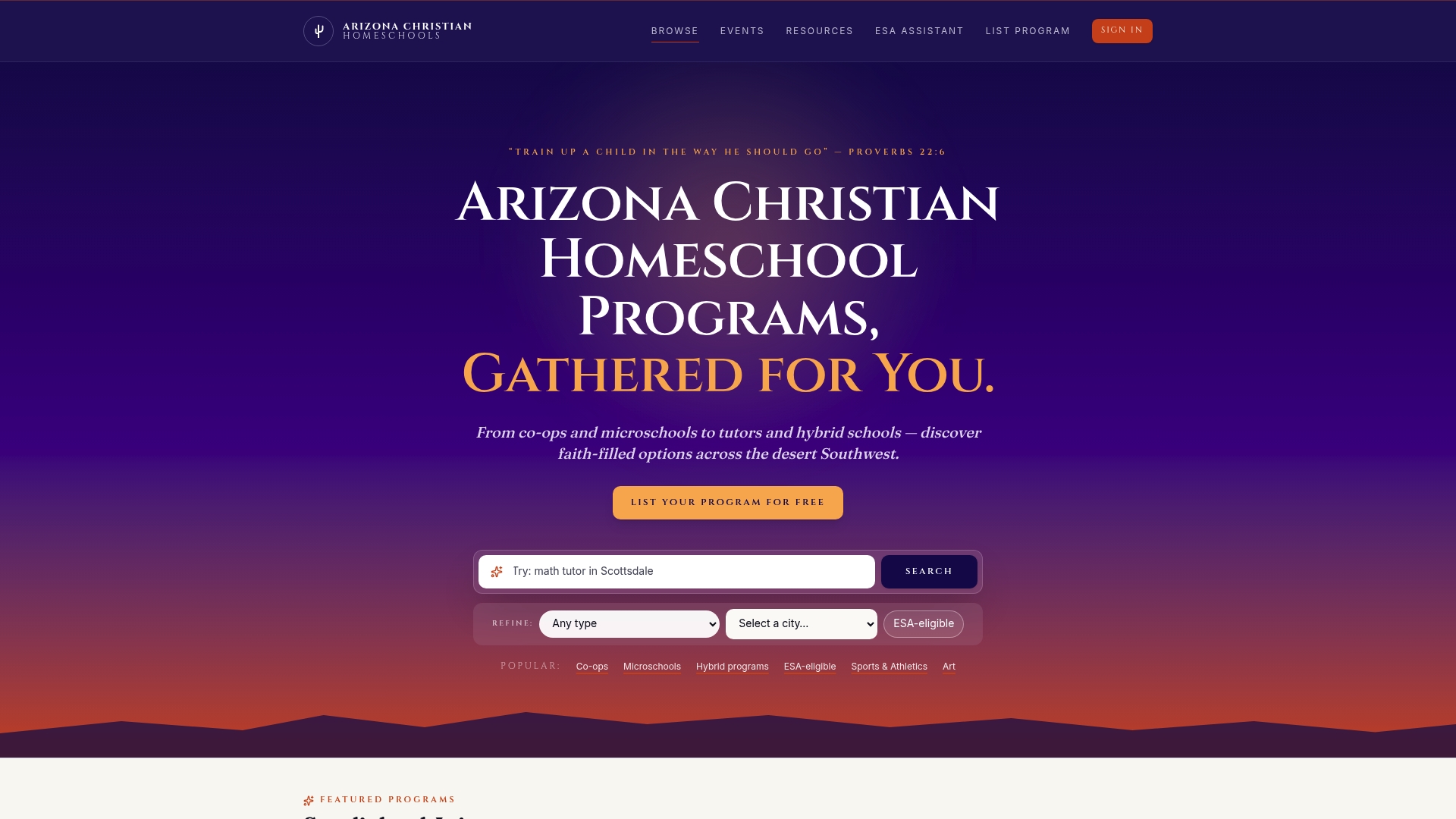
Arizonachristianhomeschools maintains a free directory of Christ-centered programs across the state, including listings that use Abeka, BJU Press, and mixed-curriculum approaches. You can search by city, filter by program type, and find local tutors or co-ops that already run the curriculum you are considering, so you can observe a class or join a trial meeting before committing to a full-year purchase. The directory also includes ESA eligibility guidance to help you estimate annual costs per child.
Find a co-op near you and connect with a local program this week.
Key Takeaways
BJU Press is the stronger fit for most Arizona families who need built-in accreditation, shorter video lessons, and a lower distance-learning price; Abeka suits families who want maximum structure, strong phonics, and predictable daily assignments.
| Point | Details |
|---|---|
| Pacing difference | Abeka runs slightly above grade level; BJU Press stays at grade level with more flexible pacing. |
| Accreditation cost | BJU Press Distance Learning includes accreditation; Abeka Academy typically charges separately for that service. |
| Video pricing | BJU Press grade 1 independent study runs approximately $1,099; comparable Abeka packages reach $1,390–$1,790. |
| Parent workload | Abeka demands high daily involvement for worksheet management; BJU Press requires more active teaching but less grading time. |
| Arizonachristianhomeschools | The free directory lists local co-ops, tutors, and hybrid programs using both Abeka and BJU Press, with ESA eligibility guidance. |