
Choose All About Reading if you want short, scripted daily lessons with minimal prep; choose Logic of English if you want one integrated system that covers reading, spelling, and handwriting through explicit phonogram rules. Both programs are built on structured literacy principles, but they serve different teaching styles and family schedules.
Three decision criteria separate most families:
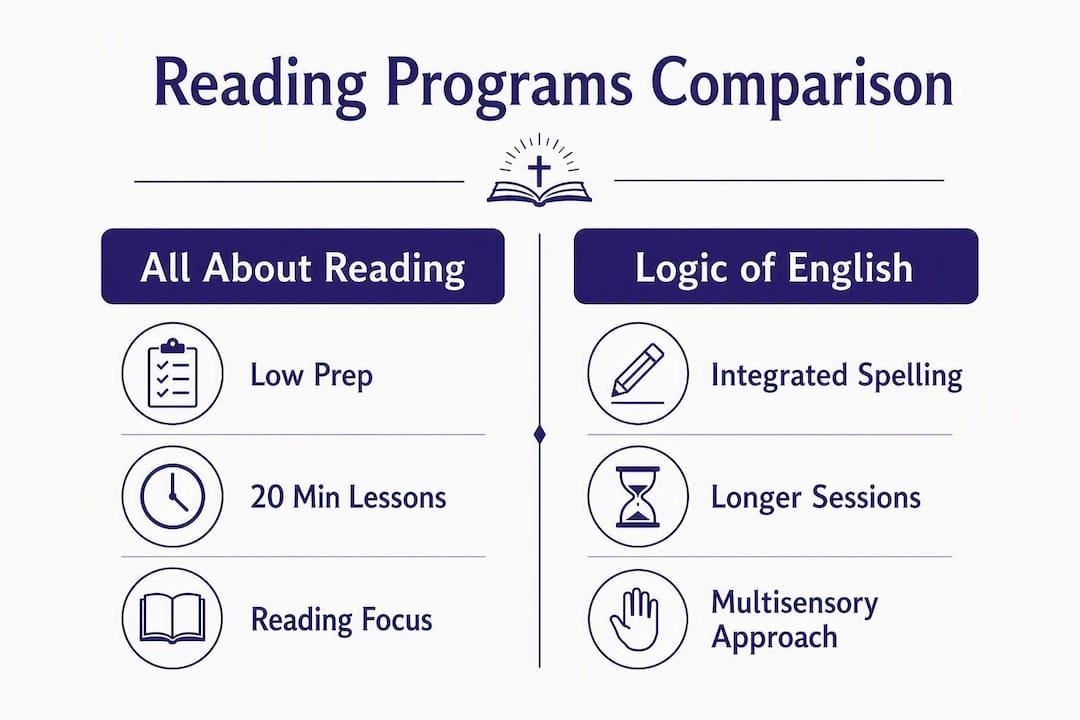
- Lesson time and parent prep: AAR lessons run around 20 minutes and require almost no preparation. LoE lessons are longer and expect you to internalize phonograms and spelling rules before teaching.
- Spelling scope: AAR teaches reading only; most families add All About Spelling as a companion. LoE bundles spelling, handwriting, and reading from day one.
- Dyslexia suitability: Both programs are used with dyslexic learners, but AAR's gentle pace suits early or struggling readers, while LoE's deeper orthographic framework suits students ready for explicit rule instruction.
TL;DR: If you are new to homeschooling or have a young or attention-limited reader, start with AAR. If you want a single, rules-based language system and can invest time in learning the program yourself, LoE rewards that effort.
Table of Contents
- How do AAR and LoE compare side by side?
- How does each program actually teach reading?
- What do daily lessons actually look like?
- How is spelling handled, and will you need a second program?
- Is either program suitable for children with dyslexia?
- What does each program cost, and where do you find support?
- How do you decide which program is right for your child?
- Can you switch programs or combine elements from both?
- Key Takeaways
- What families and practitioners actually report
- Arizona Christian Homeschools supports your curriculum choice locally
- Useful sources and where to try sample lessons
How do AAR and LoE compare side by side?
| Dimension | All About Reading | Logic of English |
|---|---|---|
| Best for | Early readers, low-prep families, multiple students | Families wanting one integrated language system |
| Phonics model | Synthetic, scripted, mastery-based | Analytic/synthetic blend; phonogram-rule emphasis |
| Spelling | Separate program recommended (All About Spelling) | Fully integrated from the start |
| Parent prep | Open-and-go; script provided | Requires learning phonograms and spelling rules |
| Lesson length | ~20 minutes | Longer, multi-part lessons |
| Materials | Teacher guide, student activity book, decodable readers, letter tiles | Teacher guide, student workbook, phonogram cards, readers |
| Price shape | Per-level purchase; add-on spelling adds cost | Bundled; competitive when compared as a full system |
| Teacher training | Self-serve videos; active online community | Publisher training available; steeper initial learning curve |
| Dyslexia suitability | Strong; gentle pacing suits early intervention | Strong; deeper rules benefit older or more analytical learners |
The single biggest practical difference families notice week to week is scripting. With AAR, you open the book and read the lesson aloud. With LoE, you need to know the material well enough to explain why a word is spelled the way it is, which is genuinely rewarding once you get there but takes real upfront investment.
How does each program actually teach reading?
Both All About Reading and Logic of English draw from Orton-Gillingham principles: explicit, sequential, multisensory phonics instruction that research supports for struggling readers. Where they diverge is in scope and daily practice.
All About Reading focuses exclusively on reading. Lessons follow a scripted sequence: the parent reads the script, the child responds, and decodable readers reinforce each skill before moving on. Mastery is the gate, not the calendar. A typical activity might look like this: the parent holds up a letter tile, the child names the sound, then blends a short word using tiles on the table before reading a matched decodable story.
Logic of English treats reading as one part of a larger language system. From the first lesson, students learn phonograms (letter combinations and their sounds), spelling rules, and handwriting together. The program teaches 74 phonograms and 31 spelling rules designed to explain the majority of English spelling patterns. A sample LoE activity: the teacher introduces a phonogram card, explains the rule governing its sound, the student writes the phonogram, then applies it in a spelling word before reading a sentence containing it.
Key scope differences:
- AAR covers pre-reading through fluency across four levels; spelling is a separate purchase.
- LoE covers phonograms, spelling rules, handwriting, and reading in one sequence.
- Both use mastery-based placement rather than strict grade levels.
What do daily lessons actually look like?
Day-to-day reality is where families make or break a curriculum choice.
With AAR, a typical session runs about 20 minutes. You open the teacher guide, follow the script, use letter tiles for phonemic awareness, read a short decodable passage together, and close the book. There is no pre-reading required. This structure makes AAR particularly manageable in multi-student households, where a parent might teach two or three children at different levels the same morning.

LoE lessons have more moving parts. A full lesson can include phonogram review with cards, a new rule introduction, a spelling dictation segment, handwriting practice, and a reading passage. The depth is genuinely useful, but it means a parent who skips prep will feel it immediately. Parents who underestimate the time needed for LoE's preparation often drop the program; previewing a complete lesson before purchasing is one of the strongest predictors of whether a family sticks with it.
Common manipulatives and routine elements:
- AAR: Letter tiles, phonogram cards, decodable readers (included per level), fluency pages
- LoE: Phonogram cards, student workbook, handwriting pages, optional game supplements
For families with short attention windows or busy mornings, AAR's contained format is a genuine advantage. LoE's longer lessons suit children who can sustain focus and parents who enjoy the linguistic depth.
How is spelling handled, and will you need a second program?
This is the most practical cost-and-logistics question in the AAR vs LoE comparison.
AAR teaches reading only. Most families add All About Spelling as a companion, which uses the same letter tiles and a parallel mastery sequence. Running both programs means two lesson slots per day, two sets of materials to track, and two purchase paths. When families add All About Spelling to All About Reading, the apparent price gap versus LoE narrows considerably, because LoE's bundled model covers spelling, handwriting, and reading in one purchase.
LoE integrates spelling from day one. Every reading lesson reinforces spelling rules explicitly, so there is no second program to manage. The program covers 74 phonograms and about 31 spelling rules, providing a comprehensive framework by design. The trade-off is that the integrated approach requires more from the teacher upfront.
| Approach | Spelling coverage | Extra program needed | Typical family outcome |
|---|---|---|---|
| All About Reading | Reading only | Yes (All About Spelling recommended) | Two shorter daily lessons; slightly more to manage |
| Logic of English | Fully integrated | No | One longer daily lesson; less logistical overhead |
Families who prefer shorter, focused lessons and do not mind managing two programs often prefer the AAR plus All About Spelling combination. Families who want one cohesive language system and are willing to invest in learning it tend to prefer LoE.
Is either program suitable for children with dyslexia?
Both programs are frequently used and considered effective for students with dyslexia because of their structured, multisensory, phonics-based design. Structured, multisensory phonics instruction is well-supported for struggling readers by organizations that synthesize reading-science evidence, consistent with Orton-Gillingham principles. The difference lies in depth and teacher preparation.

AAR's scripted, gentle pacing suits early-stage or younger dyslexic readers. The short lessons reduce cognitive fatigue, and the mastery gate prevents moving forward before a skill is solid. LoE's explicit spelling rules and phonogram framework can be especially powerful for older dyslexic students who benefit from understanding why English works the way it does, not just how to decode it.
Practical accommodations for either program:
- Break lessons into two shorter segments if attention fades before the lesson ends.
- Add an extra review day before introducing new phonograms or rules.
- Use multisensory supports: sand trays, tactile letter tiles, or verbal repetition of spelling rules.
Pro Tip: If your child masters AAR's decodable readers easily but still struggles with spelling or multi-syllable words, that is a strong signal they are ready for a more analytical, rules-based program like LoE. Consider running a placement assessment and previewing an LoE lesson before switching. For families in Arizona, a structured literacy tutor can help you make that call with confidence.
What does each program cost, and where do you find support?
Cost comparisons should account for the full system, not just the first level. AAR alone looks less expensive per level, but adding All About Spelling brings the multi-year total closer to LoE's bundled price. Comparing three-year total ownership cost gives a more accurate picture than per-level price alone.
Core materials by program:
- All About Reading: Teacher guide, student activity book, decodable readers, letter tiles (some included in kits, some purchased separately per level)
- Logic of English: Teacher guide, student workbook, phonogram cards, readers; handwriting materials included
Support and training:
- AAR offers self-serve tutorial videos and a large, active online parent community; the scripted format means most parents need minimal outside training.
- LoE offers publisher-provided training resources and an online community; the steeper learning curve means many parents benefit from watching training videos or joining a co-op study group before starting.
For parents who want hands-on support with ELA skills for struggling students, connecting with a tutor experienced in structured literacy can reduce the learning curve for either program significantly.
How do you decide which program is right for your child?
Work through this checklist before purchasing:
- Assess your child's current reading level. Use each publisher's free placement test, not grade level, to find the right starting point. Correct placement reduces boredom and frustration with either program.
- Estimate your daily lesson time. If you have 20 minutes, AAR fits. If you can reliably give 30–45 minutes and prep time, LoE is viable.
- Gauge your willingness to learn the material yourself. LoE requires you to know the phonograms and rules before teaching them. AAR does not.
- Decide on spelling scope. Do you want spelling integrated or are you comfortable running two programs?
- Consider your child's attention profile. Short, contained lessons favor AAR. Longer, multi-part lessons suit children who can sustain focus.
Questions to ask when previewing sample lessons:
- Can I read this script cold, or does it require pre-study?
- Does my child respond better to decodable stories or to rule-based explanations?
- How does the program handle a lesson when my child does not master a skill?
- What does the publisher recommend if my child plateaus?
Red flags to watch for:
- The daily lesson time consistently exceeds what your schedule allows.
- The program has no clear protocol for reviewing missed skills.
- You cannot find placement guidance for a child who is between levels.
- The teacher prep requirement is higher than you realized after previewing a full lesson.
Can you switch programs or combine elements from both?
Switching between AAR and LoE is manageable because the underlying phonics skills transfer. The main risk when moving from AAR to LoE is a gap in explicit spelling rules, since AAR does not teach them systematically. Running a placement test and filling any spelling-rule gaps before starting LoE prevents that gap from causing frustration.
Practical transition checklist:
- Complete AAR's placement assessment to confirm reading level before starting LoE.
- Review LoE's phonogram list and identify which ones your child has not yet encountered.
- Plan a short bridge period (two to four weeks) reviewing foundational spelling rules before beginning LoE's full lesson sequence.
Realistic combinations families use:
- AAR for reading lessons plus All About Spelling for systematic spelling instruction (popular for attention-limited children who need shorter sessions).
- LoE as the primary language program with AAR decodable readers used as supplemental fluency practice.
When combining programs, prioritize the core daily lesson from your chosen primary program and treat the second program as a supplement, not a co-equal. Trying to run both programs at full pace leads to overload quickly.
Key Takeaways
Both programs work when matched to the right family; the choice comes down to lesson length, parent prep capacity, and whether you want spelling integrated or separate.
| Point | Details |
|---|---|
| AAR suits low-prep families | Scripted 20-minute lessons make AAR the practical choice for busy or new homeschool parents. |
| LoE integrates spelling and rules | Logic of English covers reading, spelling, and handwriting in one system using explicit phonograms (74 taught) and about 31 spelling rules. |
| Both support dyslexic learners | AAR's gentle pace suits early intervention; LoE's rule depth benefits older or more analytical struggling readers. |
| Total cost is comparable | Adding All About Spelling to AAR narrows the price gap with LoE's bundled model; compare full system cost, not per-level price. |
| Arizonachristianhomeschools connects you locally | Arizona families can use the directory to find co-ops, structured literacy tutors, and ESA-eligible programs that support either curriculum. |
Pro Tip: Before committing to either program, download a free sample lesson from the publisher's website and teach it to your child as if it were a real lesson. Time yourself. That single trial predicts your long-term experience better than any review.
What families and practitioners actually report
The community consensus on the AAR vs LoE comparison is consistent: both programs work, and the choice is almost always about the parent's teaching style rather than the child's ability. Families who thrive with AAR describe the scripted format as freeing, not limiting. They appreciate being able to pick up the book after a chaotic morning and teach a solid lesson without having prepared anything the night before.
Families who commit to LoE often describe a learning curve in the first four to six weeks, followed by a shift where the phonogram framework starts to feel natural. At that point, many report that their children begin to notice spelling patterns independently, which is one of LoE's most cited long-term benefits.
Experts advise choosing the program that fits your current season of life: many families start with a scripted, short-lesson program and move to a more integrated system as the child grows or as parental bandwidth changes. That is not a failure of the first program. It is good curriculum planning.
For Arizona families, local co-ops and structured literacy tutors can reduce the implementation burden for either program, especially in the early weeks when the routine is still forming. Connecting with a community of parents using the same curriculum makes a measurable difference in follow-through.
Arizona Christian Homeschools supports your curriculum choice locally
Choosing between AAR and LoE is only half the work. Finding local support to implement your chosen program consistently is where many families get stuck. Arizonachristianhomeschools makes that part straightforward.

The directory connects Arizona families with co-ops, microschools, and structured literacy tutors experienced with Orton-Gillingham and phonics-based programs. You can search by city, filter for ESA-eligible services, and find programs that align with your faith values and your child's learning needs. Whether you need a tutor to help you launch LoE's phonogram system or a co-op group where other parents are using AAR, the directory surfaces those options in one place.
Arizona families using the Empowerment Scholarship Account can also use the site's ESA eligibility information to understand which tutoring and curriculum services may qualify for funding. Browse the Christian homeschool curriculum directory or find a co-op near you to take your next step today.
Useful sources and where to try sample lessons
Before purchasing either program, use these resources to preview lessons and confirm placement:
- All About Reading placement test and sample lessons: Start here to find the right AAR level for your child.
- Orton-Gillingham resources in Arizona: Background on structured literacy certifications and local OG-trained tutors.
- HomeschoolPicks: AAR vs LoE comparison: Detailed side-by-side review with cost and community notes.
- Homeschool Teacher Guide: LoE vs AAR: Practical breakdown of lesson length, phonogram scope, and parent prep requirements.
- HomeschoolPicks: LoE for dyslexic learners: Focused review of LoE's suitability for students with dyslexia.
- IES What Works Clearinghouse: Federal reading-science practice guide; useful for understanding what the research says about foundational literacy instruction.
- NICHD reading research: Primary-source reading research from the National Institute of Child Health and Human Development.
- HSLDA: Struggling learners guidance: Practical guidance for homeschool families navigating learning differences.
When you preview a sample lesson, time the full session, note how much pre-reading you needed, and observe whether your child engages with the lesson format. Use the publisher's placement test rather than your child's grade level to find the right starting point. That combination of placement testing and lesson preview gives you the clearest picture of which program will actually work in your home.